
Tuesday, 25 November 2025

9 Pandas Tricks That Data Scientists Use Quietly


9 Python Coding Boosters to Level Up Your Workflow


1 Use F-srtings for cleaner printing


name="Alice"
age=25
print(f"My name is {name} and I am {age}  years old.")

#source code --> clcoding.com 

Output:

My name is Alice and I am 25  years old.


2 Use comprehension for one line loops


nums=[1,2,3,4,5]
squares=[n**2 for n in nums]
print(squares)

#source code --> clcoding.com 

Output:

[1, 4, 9, 16, 25]

3 Use enumerate() for indexed loop


items=["apple","banana","cherry"]
for i,item in enumerate(items):
    print(i,item)

#source code --> clcoding.com 

Output:

0 apple
1 banana
2 cherry

4. Use zip() to combine multiple list

names=["Alice","Bob","Charlie"]
scores=[90,85,88]
for name,score in zip(names,scores):
    print(name,score)
#source code --> clcoding.com 

Output:

Alice 90
Bob 85
Charlie 88

5. Dictionary comprehension for quick mapping

nums=[1,2,3,4]
squares={n: n**2 for n in nums}
print(squares)

#source code --> clcoding.com 

Output:

{1: 1, 2: 4, 3: 9, 4: 16}

6. Use get() to access dictionary keys


user={"name": "Alice"}
print(user.get("age","Not provided"))
     
#source code --> clcoding.com 

Output:

Not provided

7. Unpack list or tuples easily

data=(10,20,30)
a,b,c =data
print(a,b,c)

#source code --> clcoding.com 

Output:

10 20 30

8. Use context manager to handle file automatically

with open("example.txt", "w") as f:
    f.write("Hello, Python!")

with open("example.txt", "r") as f:
    content = f.read()

print(content)
  
#source code --> clcoding.com

Output:
Hello, Python!

9. args and kwargs for flexible function

def info(*args,**kwargs):
    print("Args:",args)
    print("Kwargs:",kwargs)
info("Python", version=3.11,mode="Fast")

#source code --> clcoding.com 

Output:

Args: ('Python',)
Kwargs: {'version': 3.11, 'mode': 'Fast'}

Python Coding Challenge - Question with Answer (01261125)


Explanation:

๐Ÿ”น Line 1: Creating a Nested List
data = [[1,2], [3,4], [5,6]]

Explanation

data is a list of lists (nested list).

It contains three separate sublists.

Each sublist holds two numbers.

We will later flatten these sublists into one single list.

๐Ÿ”น Line 2: Creating an Empty Output List
flat = []

Explanation

flat is an empty list.

This list will store all numbers from the nested structure after flattening.

It starts empty and will be filled step by step.

๐Ÿ”น Line 3: Flattening Using map() With Lambda
list(map(lambda x: flat.extend(x), data))

Explanation

This is the most important line. Here’s how it works:

A. map()

map() loops over each sublist inside data.

B. lambda x

x represents each sublist from data, one at a time:

First: [1, 2]

Second: [3, 4]

Third: [5, 6]

C. flat.extend(x)

.extend() adds each element of x into flat.

It does not add the sublist — it adds the individual numbers.

D. How flat changes
Step Value of x flat after extend
1 [1, 2] [1, 2]
2 [3, 4] [1, 2, 3, 4]
3 [5, 6] [1, 2, 3, 4, 5, 6]
E. Why list(...) ?

map() doesn’t run immediately.

Wrapping it with list() forces all iterations to execute.

๐Ÿ”น Line 4: Printing the Final Output
print(flat)

Explanation

Prints the fully flattened list.

All nested values are now in one single list.

๐ŸŽ‰ Final Output
[1, 2, 3, 4, 5, 6]

APPLICATION OF PYTHON FOR GAME DEVELOPMENT

Machine Learning Pipelines with Azure ML Studio


Introduction

Today, building a machine learning (ML) system isn’t just about training a model. You need a robust pipeline: data preprocessing, model training, evaluation, and deployment. The Machine Learning Pipelines with Azure ML Studio project on Coursera is a hands-on, guided experience that introduces you to all these stages — using Microsoft Azure’s ML Studio interface. It’s a quick but powerful way to build practical ML skills on a cloud platform without writing any code.


Why This Project Is Valuable

  • End-to-End Experience: You don’t just train a model — you build a complete pipeline, score it, evaluate it, and deploy it as a web service.

  • No-Code Interface: You use Azure ML Studio’s visual interface, making it accessible even if you don’t want to write Python or use SDKs.

  • Deployable Outcome: At the end, you’ll deploy your trained model as a web service, giving you a real endpoint to send data and get predictions.

  • Real Data Use Case: You work on a real-world dataset (Adult Census) to build a classification model that predicts income, giving you practical experience in dealing with tabular data, preprocessing, class imbalance, and model evaluation.

  • Quick but Deep: The project takes around 2 hours, but packs in a lot — data cleaning, model tuning, evaluation, and deployment — making it efficient for busy learners.


Key Learnings & Skills

Here are the main skills and concepts you’ll practice during this project:

  1. Data Preprocessing

    • Clean the dataset using Azure ML Studio modules

    • Handle class imbalance, which is a common real-world problem in classification tasks

  2. Model Training & Hyperparameter Tuning

    • Train a Two-Class Boosted Decision Tree model

    • Tune hyperparameters to improve the model’s performance

  3. Model Scoring & Evaluation

    • Run a scoring experiment to generate predictions on the dataset

    • Evaluate your model’s performance using appropriate metrics

  4. Pipeline Creation

    • Build a pipeline that connects preprocessing, training, and scoring steps

    • Understand how data flows through the pipeline in a visual, modular setup

  5. Model Deployment

    • Deploy the trained model as a web service on Azure

    • Test the deployed service: send new data and receive predictions


Who Should Do This Project

  • Beginner ML Learners: If you’re new to machine learning and want a guided, no-code way to understand pipelines.

  • Aspiring Data Scientists / Analysts: Great for people who want to understand not just models, but the full ML lifecycle.

  • Cloud Practitioners: If you have or plan to use Azure, this gives a foundational experience in Azure ML Studio.

  • Product Managers / Business Professionals: Helps you understand how ML can be operationalized through pipelines and web services.

  • Students & Learners in AI: A quick yet powerful way to get hands-on with model deployment and cloud-based ML.


How to Make the Most of This Project

  • Follow the Guided Steps: Use the split-screen video + workspace to replicate each step carefully.

  • Experiment with Data: Try altering the dataset (remove some features or rows) to see how it affects model performance.

  • Tune Differently: Explore different hyperparameter settings for the decision tree to understand how tuning affects accuracy.

  • Test the Endpoint: Once deployed, try sending different example inputs to the web service and analyze the predictions.

  • Reflect on the Pipeline Design: Think about how each module (preprocessing, training, scoring) is designed and how you might improve or extend it.


What You’ll Walk Away With

  • A working machine learning pipeline on Azure ML Studio

  • Experience building, scoring, evaluating, and deploying a classification model

  • Hands-on exposure to handling class imbalance, hyperparameter tuning, and model deployment

  • A deployed model endpoint — you can call it with new data for predictions

  • A foundational cloud ML skill that opens the door to more complex scenarios (e.g., MLOps, automated retraining)


Join Now: Machine Learning Pipelines with Azure ML Studio

Conclusion

Machine Learning Pipelines with Azure ML Studio is a powerful, efficient guided project that teaches you how to build real-world, production-capable ML pipelines — all through a visual, no-code interface. It’s an excellent starting point whether you are new to machine learning, exploring Azure, or want to understand how data pipelines and deployment work in a cloud environment.

Deep Learning RNN & LSTM: Stock Price Prediction


'' failed to upload. Invalid response: RpcError

Introduction

Predicting stock prices is a classic and challenging use-case for deep learning, especially because financial data is sequential and highly volatile. The Deep Learning RNN & LSTM: Stock Price Prediction course on Coursera gives you a hands-on experience building recurrent neural networks (RNNs) with Long Short-Term Memory (LSTM) layers, specifically applied to time-series data from the stock market. In just a few hours, you’ll learn how to preprocess market data, create and train a predictive model, and visualize its forecasts.


Why This Course Is Valuable

  • Time Series Focus: Instead of treating stock data like regular tabular data, the course emphasizes sequence modeling, which is more appropriate for time-series forecasting.

  • Deep Learning Application: Learners build real RNN models using LSTM — a type of recurrent network that’s well-suited for learning temporal dependencies.

  • Practical Pipeline: The course walks you through end-to-end steps: data preprocessing, feature scaling, model building, evaluation, and visualization.

  • Real-world Dataset: You work with actual stock price data, giving your learning a realistic context.

  • Beginner to Intermediate Friendly: Even if you haven’t worked extensively with RNNs before, this course provides gentle but effective guidance.

  • Job-Relevant Skills: You’ll pick up key data science and deep learning skills including data transformation, Keras, TensorFlow, predictive modeling, and time-series analysis.


What You’ll Learn

  1. Data Preprocessing & Exploratory Analysis

    • How to clean stock data, scale features, and explore trends and patterns.

    • Techniques to make your time-series data suitable for LSTM input.

  2. Building an RNN with LSTM Layers

    • Constructing a recurrent neural network using LSTM units.

    • Understanding how LSTM can capture long-term dependencies in sequential financial data.

  3. Model Training & Optimization

    • Training your model on historical stock data.

    • Applying hyperparameter tuning to improve performance and prevent overfitting.

  4. Prediction & Evaluation

    • Generating stock price forecasts using your trained LSTM model.

    • Evaluating predictions using visual tools and metrics to assess model accuracy and reliability.

  5. Visualization of Results

    • Plotting predicted vs actual stock prices.

    • Interpreting model behavior and understanding where it works well (or doesn’t).


Skills You’ll Gain

  • Time-Series Analysis & Forecasting

  • Deep Learning (RNN, LSTM)

  • Data Processing & Feature Engineering

  • Data Visualization with Python

  • Use of TensorFlow / Keras for sequence models

  • Predictive Modeling for Financial Data


Who Should Take This Course

  • Aspiring Data Scientists: If you want to apply deep learning to financial time-series data.

  • Quant Enthusiasts: For people interested in algorithmic trading, forecasting, or financial modeling.

  • Deep Learning Learners: If you already know the basics of neural networks and want to explore sequence-based models.

  • Analysts & Programmers: Analysts dealing with time-series data or Python programmers who want to build predictive models.

  • Students & Researchers: Anyone working on projects involving forecasting, signal processing, or sequence modeling.


How to Make the Most of It

  • Code Along: Follow every notebook or code exercise to internalize how LSTM is implemented.

  • Tinker with Data: Try different window sizes, feature sets, or scaling techniques to see how they affect predictions.

  • Experiment with Hyperparameters: Change the number of LSTM units, layers, learning rate, and batch size to improve or degrade performance — and learn from that.

  • Visualize Results Deeply: Don’t just look at a simple line plot — compare training vs validation loss, look at residuals (prediction error), and try to interpret model behavior.

  • Extend Beyond the Course: Once you finish, try predicting other financial series (crypto, forex, commodities) using the same architecture.


What You’ll Walk Away With

  • A working RNN-LSTM model for stock price prediction.

  • A deeper understanding of how recurrent neural networks work in practice.

  • Experience in preparing real financial data for deep learning tasks.

  • The ability to visualize and evaluate time-series predictions, not just build them.

  • Confidence to build more advanced sequence models or apply them to other domains.


Join Now: Deep Learning RNN & LSTM: Stock Price Prediction

Conclusion

The Deep Learning RNN & LSTM: Stock Price Prediction course is a compact but powerful way to learn how to apply recurrent neural networks for financial forecasting. By combining theory, practical coding, and real data, it gives you a strong foundation in sequence modeling and deep learning — skills that are highly relevant in finance, AI, and data science.

Smart Teaching and Learning with AI Specialization


Introduction

AI is not just reshaping industries — it's transforming how we teach and learn. The Smart Teaching & Learning with AI Specialization offered by Politecnico di Milano equips educators, instructional designers, and learning professionals with the knowledge and tools to integrate AI into effective, personalized learning experiences. This specialization empowers teachers to design smarter learning systems, leverage generative AI, and create future-ready educational environments.


Why This Specialization Matters

  • Modern Pedagogy + AI: Rather than just exploring AI tools, this specialization connects them with modern teaching theories—so educators can redesign learning experiences meaningfully, not superficially.

  • Active Learning Focus: It emphasizes active learning strategies, helping teachers engage learners deeply and create coherent, learner-centered courses.

  • AI-Powered Personalization: With AI integration, educators can tailor learning to individual needs, making experiences more adaptive, efficient, and effective.

  • Hybrid & Flexible Learning: The curriculum prepares educators to design for online, face-to-face, and hybrid contexts, which is increasingly relevant today.

  • Lifelong Learning Impact: It isn’t just about delivering content — it builds a mindset for lifelong learning, leveraging AI to help both teachers and students learn continuously.


What You’ll Learn: Core Courses

The Specialization is made up of three main courses, each building on the other to give a well-rounded skillset:

  1. Designing Learning Innovation

    • Learn foundational pedagogical frameworks such as constructive alignment.

    • Explore active learning methodologies and new assessment strategies.

    • Gain skills in designing engaging, student-centered curricula.

  2. Smart Learning Design

    • Understand the motivations and trends driving educational innovation.

    • Apply a structured method (the SLD25 method) to design learning activities for hybrid environments.

    • Critically evaluate various learning formats (online, in-person, blended) and choose what’s best for a given context.

  3. Learning with AI

    • Discover how AI can enhance learning: from personalization to generative tools.

    • Learn to leverage large language models (LLMs) to support personalized learning pathways.

    • Apply AI strategies to improve student-centered learning, critical thinking, and lifelong learning.


Key Skills You’ll Gain

  • Instructional design for active, student-centered learning

  • Hybrid and blended learning strategies

  • Use of AI tools in educational design

  • Personalization using AI / LLMs

  • Learning theory and innovation in education

  • Assessment methods for modern learning environments

  • Critical thinking about AI’s role in education


Who Should Take This Specialization

  • Teachers & Educators: Especially those wanting to design smarter, more adaptive classrooms.

  • Instructional Designers: Professionals tasked with creating curricula or learning interventions in digital or hybrid settings.

  • Trainer / L&D Professionals: People in corporate training who want to use AI to improve engagement and learning effectiveness.

  • School / University Leaders: Leaders who want to guide their institution’s AI-driven learning transformation.

  • Education Technology Professionals: Those building or evaluating edtech products that integrate AI for learning.


How to Maximize Your Learning from This Specialization

  • Build as You Go: After each course, try designing a small lesson or module using the methods and AI tools you’ve learned.

  • Experiment with AI Tools: Use LLMs, generative AI, or other AI-learning tools to test personalization or adaptive learning in your design.

  • Collaborate with Peers: Share ideas and design drafts with other educators — peer feedback can spark valuable improvements.

  • Reflect on Practice: Use a journal or portfolio to document how you used each concept in your context and what worked / didn’t.

  • Iterate and Improve: Go back and refine your designs using student feedback, AI tool experimentation, and assessment insights.


What You’ll Walk Away With

  • A professional certificate that demonstrates your ability to design AI-enabled learning experiences.

  • Practical frameworks and methods to build future-ready, hybrid teaching modules.

  • A toolkit of AI strategies and generative tools tailored for education.

  • Hands-on experience in combining pedagogical theory with powerful AI techniques.

  • A plan or prototype for an AI-enhanced course or learning experience in your own context.


Join Now: Smart Teaching and Learning with AI Specialization

Conclusion

The Smart Teaching & Learning with AI Specialization is more than just a course on AI — it’s a transformative experience for educators who want to harness AI thoughtfully to improve learning. By blending pedagogical innovation with AI-powered personalization, this specialization helps future-proof both teaching and learning.

Python Coding challenge - Day 870| What is the output of the following Python Code?


Code Explanation:

1. Class Definition
class Data:

This creates a new class named Data.

Objects created from this class will hold a data value and know how to represent themselves as text.

2. Constructor Method
    def __init__(self, d):
        self.d = d

__init__ runs every time a new object is created.

It receives a value d and stores it in the object as self.d.

So each Data object will have a d attribute.

3. Magic Method __repr__
    def __repr__(self):
        return f"Data={self.d}"

__repr__ is a magic method that defines how an object should be represented as a string, mainly for debugging.

When you print an object, Python prefers __str__, but if it is not defined, Python uses __repr__.

It returns a string like "Data=9" when the object's d is 9.

4. Creating an Object
obj = Data(9)

Creates an instance named obj with d = 9.

The constructor stores 9 inside self.d.

5. Printing the Object
print(obj)

Since no __str__ method exists, Python uses __repr__.

__repr__ returns:

Data=9


This becomes the final print output.

Final Output
Data=9

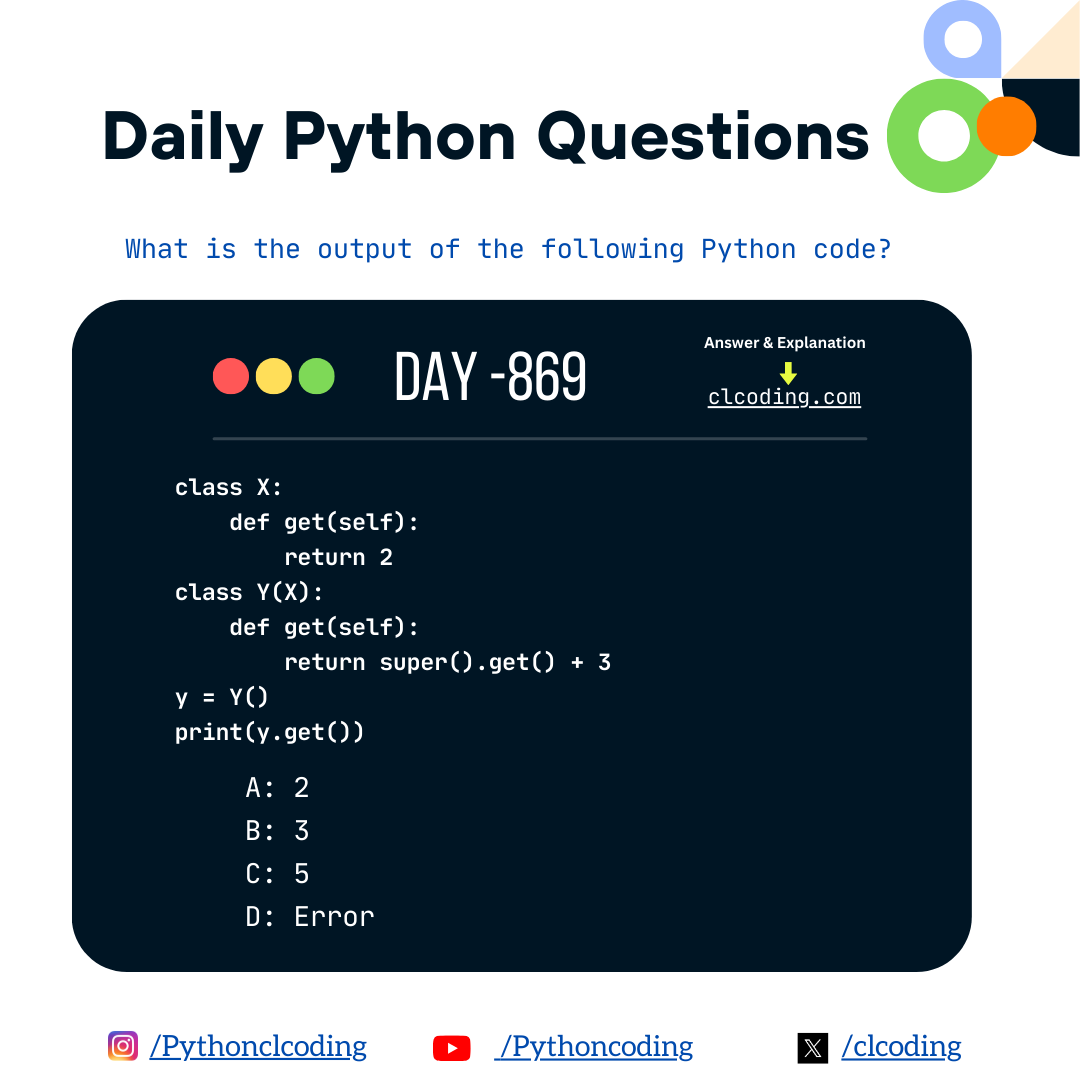
Python Coding challenge - Day 869| What is the output of the following Python Code?


Code Explanation:

1. Class Definition Begins
class X:

A new class X is created.

This class contains one method, get().

2. Method Inside Class X
    def get(self):
        return 2

The method get() always returns the integer 2.

Any object of class X will return 2 when get() is called.

3. Class Y Inheriting From X
class Y(X):

Class Y is created, and it inherits from class X.

This means Y has access to all methods defined in X unless overridden.

4. Overriding the get() Method in Class Y
    def get(self):
        return super().get() + 3

Class Y provides its own version of the get() method.

super().get() calls the parent class (X) version of get(), which returns 2.

Then 3 is added to the result.

Final returned value = 2 + 3 = 5.

5. Creating Object of Class Y
y = Y()

An object y is created from class Y.

This object has access to Y’s overridden get() method.

6. Printing the Result
print(y.get())

Calls Y’s get() method.

That method calls X’s get() → returns 2.

Adds 3 → result = 5.

Prints:

5

Final Output
5

100 Python Programs for Beginner with explanation

Popular Posts

Categories

100 Python Programs for Beginner (118) AI (205) Android (25) AngularJS (1) Api (7) Assembly Language (2) aws (28) Azure (8) BI (10) Books (262) Bootcamp (1) C (78) C# (12) C++ (83) Course (84) Coursera (299) Cybersecurity (29) data (1) Data Analysis (26) Data Analytics (18) data management (15) Data Science (295) Data Strucures (16) Deep Learning (121) Django (16) Downloads (3) edx (21) Engineering (15) Euron (30) Events (7) Excel (18) Finance (9) flask (3) flutter (1) FPL (17) Generative AI (60) Git (9) Google (47) Hadoop (3) HTML Quiz (1) HTML&CSS (48) IBM (41) IoT (3) IS (25) Java (99) Leet Code (4) Machine Learning (246) Meta (24) MICHIGAN (5) microsoft (9) Nvidia (8) Pandas (13) PHP (20) Projects (32) Python (1257) Python Coding Challenge (1038) Python Mistakes (50) Python Quiz (426) Python Tips (5) Questions (3) R (72) React (7) Scripting (3) security (4) Selenium Webdriver (4) Software (19) SQL (46) Udemy (17) UX Research (1) web application (11) Web development (8) web scraping (3)

Followers

Python Coding for Kids ( Free Demo for Everyone)



