Tuesday, 25 November 2025

Deep Learning RNN & LSTM: Stock Price Prediction


'' failed to upload. Invalid response: RpcError

Introduction

Predicting stock prices is a classic and challenging use-case for deep learning, especially because financial data is sequential and highly volatile. The Deep Learning RNN & LSTM: Stock Price Prediction course on Coursera gives you a hands-on experience building recurrent neural networks (RNNs) with Long Short-Term Memory (LSTM) layers, specifically applied to time-series data from the stock market. In just a few hours, you’ll learn how to preprocess market data, create and train a predictive model, and visualize its forecasts.


Why This Course Is Valuable

  • Time Series Focus: Instead of treating stock data like regular tabular data, the course emphasizes sequence modeling, which is more appropriate for time-series forecasting.

  • Deep Learning Application: Learners build real RNN models using LSTM — a type of recurrent network that’s well-suited for learning temporal dependencies.

  • Practical Pipeline: The course walks you through end-to-end steps: data preprocessing, feature scaling, model building, evaluation, and visualization.

  • Real-world Dataset: You work with actual stock price data, giving your learning a realistic context.

  • Beginner to Intermediate Friendly: Even if you haven’t worked extensively with RNNs before, this course provides gentle but effective guidance.

  • Job-Relevant Skills: You’ll pick up key data science and deep learning skills including data transformation, Keras, TensorFlow, predictive modeling, and time-series analysis.


What You’ll Learn

  1. Data Preprocessing & Exploratory Analysis

    • How to clean stock data, scale features, and explore trends and patterns.

    • Techniques to make your time-series data suitable for LSTM input.

  2. Building an RNN with LSTM Layers

    • Constructing a recurrent neural network using LSTM units.

    • Understanding how LSTM can capture long-term dependencies in sequential financial data.

  3. Model Training & Optimization

    • Training your model on historical stock data.

    • Applying hyperparameter tuning to improve performance and prevent overfitting.

  4. Prediction & Evaluation

    • Generating stock price forecasts using your trained LSTM model.

    • Evaluating predictions using visual tools and metrics to assess model accuracy and reliability.

  5. Visualization of Results

    • Plotting predicted vs actual stock prices.

    • Interpreting model behavior and understanding where it works well (or doesn’t).


Skills You’ll Gain

  • Time-Series Analysis & Forecasting

  • Deep Learning (RNN, LSTM)

  • Data Processing & Feature Engineering

  • Data Visualization with Python

  • Use of TensorFlow / Keras for sequence models

  • Predictive Modeling for Financial Data


Who Should Take This Course

  • Aspiring Data Scientists: If you want to apply deep learning to financial time-series data.

  • Quant Enthusiasts: For people interested in algorithmic trading, forecasting, or financial modeling.

  • Deep Learning Learners: If you already know the basics of neural networks and want to explore sequence-based models.

  • Analysts & Programmers: Analysts dealing with time-series data or Python programmers who want to build predictive models.

  • Students & Researchers: Anyone working on projects involving forecasting, signal processing, or sequence modeling.


How to Make the Most of It

  • Code Along: Follow every notebook or code exercise to internalize how LSTM is implemented.

  • Tinker with Data: Try different window sizes, feature sets, or scaling techniques to see how they affect predictions.

  • Experiment with Hyperparameters: Change the number of LSTM units, layers, learning rate, and batch size to improve or degrade performance — and learn from that.

  • Visualize Results Deeply: Don’t just look at a simple line plot — compare training vs validation loss, look at residuals (prediction error), and try to interpret model behavior.

  • Extend Beyond the Course: Once you finish, try predicting other financial series (crypto, forex, commodities) using the same architecture.


What You’ll Walk Away With

  • A working RNN-LSTM model for stock price prediction.

  • A deeper understanding of how recurrent neural networks work in practice.

  • Experience in preparing real financial data for deep learning tasks.

  • The ability to visualize and evaluate time-series predictions, not just build them.

  • Confidence to build more advanced sequence models or apply them to other domains.


Join Now: Deep Learning RNN & LSTM: Stock Price Prediction

Conclusion

The Deep Learning RNN & LSTM: Stock Price Prediction course is a compact but powerful way to learn how to apply recurrent neural networks for financial forecasting. By combining theory, practical coding, and real data, it gives you a strong foundation in sequence modeling and deep learning — skills that are highly relevant in finance, AI, and data science.

Smart Teaching and Learning with AI Specialization


Introduction

AI is not just reshaping industries — it's transforming how we teach and learn. The Smart Teaching & Learning with AI Specialization offered by Politecnico di Milano equips educators, instructional designers, and learning professionals with the knowledge and tools to integrate AI into effective, personalized learning experiences. This specialization empowers teachers to design smarter learning systems, leverage generative AI, and create future-ready educational environments.


Why This Specialization Matters

  • Modern Pedagogy + AI: Rather than just exploring AI tools, this specialization connects them with modern teaching theories—so educators can redesign learning experiences meaningfully, not superficially.

  • Active Learning Focus: It emphasizes active learning strategies, helping teachers engage learners deeply and create coherent, learner-centered courses.

  • AI-Powered Personalization: With AI integration, educators can tailor learning to individual needs, making experiences more adaptive, efficient, and effective.

  • Hybrid & Flexible Learning: The curriculum prepares educators to design for online, face-to-face, and hybrid contexts, which is increasingly relevant today.

  • Lifelong Learning Impact: It isn’t just about delivering content — it builds a mindset for lifelong learning, leveraging AI to help both teachers and students learn continuously.


What You’ll Learn: Core Courses

The Specialization is made up of three main courses, each building on the other to give a well-rounded skillset:

  1. Designing Learning Innovation

    • Learn foundational pedagogical frameworks such as constructive alignment.

    • Explore active learning methodologies and new assessment strategies.

    • Gain skills in designing engaging, student-centered curricula.

  2. Smart Learning Design

    • Understand the motivations and trends driving educational innovation.

    • Apply a structured method (the SLD25 method) to design learning activities for hybrid environments.

    • Critically evaluate various learning formats (online, in-person, blended) and choose what’s best for a given context.

  3. Learning with AI

    • Discover how AI can enhance learning: from personalization to generative tools.

    • Learn to leverage large language models (LLMs) to support personalized learning pathways.

    • Apply AI strategies to improve student-centered learning, critical thinking, and lifelong learning.


Key Skills You’ll Gain

  • Instructional design for active, student-centered learning

  • Hybrid and blended learning strategies

  • Use of AI tools in educational design

  • Personalization using AI / LLMs

  • Learning theory and innovation in education

  • Assessment methods for modern learning environments

  • Critical thinking about AI’s role in education


Who Should Take This Specialization

  • Teachers & Educators: Especially those wanting to design smarter, more adaptive classrooms.

  • Instructional Designers: Professionals tasked with creating curricula or learning interventions in digital or hybrid settings.

  • Trainer / L&D Professionals: People in corporate training who want to use AI to improve engagement and learning effectiveness.

  • School / University Leaders: Leaders who want to guide their institution’s AI-driven learning transformation.

  • Education Technology Professionals: Those building or evaluating edtech products that integrate AI for learning.


How to Maximize Your Learning from This Specialization

  • Build as You Go: After each course, try designing a small lesson or module using the methods and AI tools you’ve learned.

  • Experiment with AI Tools: Use LLMs, generative AI, or other AI-learning tools to test personalization or adaptive learning in your design.

  • Collaborate with Peers: Share ideas and design drafts with other educators — peer feedback can spark valuable improvements.

  • Reflect on Practice: Use a journal or portfolio to document how you used each concept in your context and what worked / didn’t.

  • Iterate and Improve: Go back and refine your designs using student feedback, AI tool experimentation, and assessment insights.


What You’ll Walk Away With

  • A professional certificate that demonstrates your ability to design AI-enabled learning experiences.

  • Practical frameworks and methods to build future-ready, hybrid teaching modules.

  • A toolkit of AI strategies and generative tools tailored for education.

  • Hands-on experience in combining pedagogical theory with powerful AI techniques.

  • A plan or prototype for an AI-enhanced course or learning experience in your own context.


Join Now: Smart Teaching and Learning with AI Specialization

Conclusion

The Smart Teaching & Learning with AI Specialization is more than just a course on AI — it’s a transformative experience for educators who want to harness AI thoughtfully to improve learning. By blending pedagogical innovation with AI-powered personalization, this specialization helps future-proof both teaching and learning.

Python Coding challenge - Day 870| What is the output of the following Python Code?


Code Explanation:

1. Class Definition
class Data:

This creates a new class named Data.

Objects created from this class will hold a data value and know how to represent themselves as text.

2. Constructor Method
    def __init__(self, d):
        self.d = d

__init__ runs every time a new object is created.

It receives a value d and stores it in the object as self.d.

So each Data object will have a d attribute.

3. Magic Method __repr__
    def __repr__(self):
        return f"Data={self.d}"

__repr__ is a magic method that defines how an object should be represented as a string, mainly for debugging.

When you print an object, Python prefers __str__, but if it is not defined, Python uses __repr__.

It returns a string like "Data=9" when the object's d is 9.

4. Creating an Object
obj = Data(9)

Creates an instance named obj with d = 9.

The constructor stores 9 inside self.d.

5. Printing the Object
print(obj)

Since no __str__ method exists, Python uses __repr__.

__repr__ returns:

Data=9


This becomes the final print output.

Final Output
Data=9

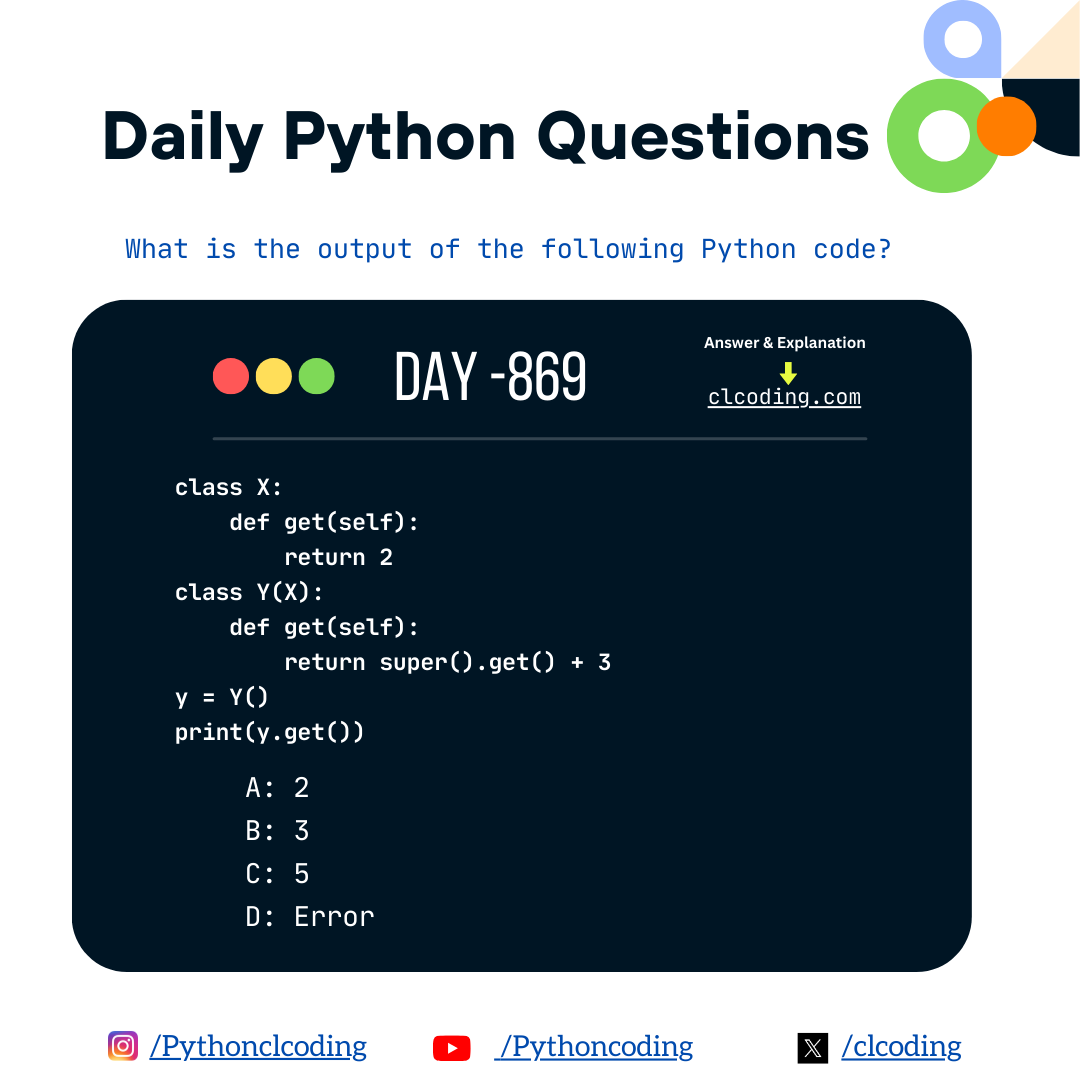
Python Coding challenge - Day 869| What is the output of the following Python Code?


Code Explanation:

1. Class Definition Begins
class X:

A new class X is created.

This class contains one method, get().

2. Method Inside Class X
    def get(self):
        return 2

The method get() always returns the integer 2.

Any object of class X will return 2 when get() is called.

3. Class Y Inheriting From X
class Y(X):

Class Y is created, and it inherits from class X.

This means Y has access to all methods defined in X unless overridden.

4. Overriding the get() Method in Class Y
    def get(self):
        return super().get() + 3

Class Y provides its own version of the get() method.

super().get() calls the parent class (X) version of get(), which returns 2.

Then 3 is added to the result.

Final returned value = 2 + 3 = 5.

5. Creating Object of Class Y
y = Y()

An object y is created from class Y.

This object has access to Y’s overridden get() method.

6. Printing the Result
print(y.get())

Calls Y’s get() method.

That method calls X’s get() → returns 2.

Adds 3 → result = 5.

Prints:

5

Final Output
5

100 Python Programs for Beginner with explanation

Monday, 24 November 2025

Deep Learning Masterclass with TensorFlow 2 Over 20 Projects


Deep learning has moved from research labs into every corner of the modern world—powering recommendation engines, self-driving cars, medical imaging systems, voice assistants, fraud detection pipelines, and countless other applications. For anyone who wants to build real AI systems rather than simply read about them, mastering deep learning hands-on is one of the most valuable skills of the decade.

The Deep Learning Masterclass with TensorFlow 2 stands out as a course designed not just to teach the theory but to immerse learners in real, production-ready projects. This blog explores what makes this learning path so transformative and why it is ideal for both aspiring and experienced AI practitioners.


Why TensorFlow 2 Is the Engine Behind Modern Deep Learning

TensorFlow 2 brought simplicity, speed, and flexibility to deep learning development. With its eager execution, integrated Keras API, seamless model deployment, and support for large-scale training, it has become the preferred framework for building neural networks that scale from prototypes to production.

Learners in this masterclass don’t just write code—they learn how to think in TensorFlow:

  • Structuring neural network architectures

  • Optimizing data pipelines

  • Deploying trained models

  • Understanding GPU acceleration

  • Using callbacks, custom layers, and advanced APIs

This hands-on approach prepares learners to build intelligent systems that reflect today’s industry standards.


A Project-Driven Approach to Deep Learning Mastery

What makes this masterclass unique is the number and diversity of projects—over 20 real applications that help learners internalize concepts through practice. Deep learning isn’t a spectator sport; it must be built, trained, debugged, and deployed. This course embraces that philosophy.

Some of the practical themes explored include:

Computer Vision

Build models for image classification, object recognition, and image generation. Learners explore concepts like convolutional filters, data augmentation, transfer learning, and activation maps.

Natural Language Processing

Use deep learning to understand, generate, and analyze human language. Recurrent networks, LSTMs, transformers, and text vectorization techniques are brought to life.

Generative Deep Learning

Dive into autoencoders, GANs, and other architectures that create new synthetic content—from images to sequences.

Time Series & Forecasting

Build models that predict trends, patterns, and future events using sequential neural networks.

Reinforcement Learning Foundations

Gain early exposure to decision-making systems that learn by interacting with their environments.

Each project integrates real-world datasets, industry workflows, and practical problem-solving—ensuring that learners build a versatile portfolio along the way.


From Foundations to Expert Techniques

This course doesn’t assume expert-level math or prior AI experience. It builds up the learner’s skills step by step:

Core Concepts of Neural Networks

Activation functions, loss functions, gradients, backpropagation, and optimization strategies.

Intermediate Architectures

CNNs, RNNs, LSTMs, GRUs, attention mechanisms, embedding layers.

Advanced Deep Learning Skills

Custom training loops, fine-tuning, hyperparameter optimization, data pipeline engineering, and model deployment.

By the end, learners can confidently read research papers, implement cutting-edge techniques, and apply deep learning to any domain.


A Portfolio That Opens Doors

One of the biggest benefits of a project-oriented masterclass is the portfolio it creates. Learners finish with more than theoretical understanding—they walk away with dozens of practical models they can demonstrate to employers or clients.

A strong deep learning portfolio helps prove:

  • Real coding competency

  • Data handling and preprocessing skills

  • Model evaluation and tuning capabilities

  • Ability to turn an idea into a working AI system

This is exactly what companies look for in machine learning engineers today.


Who This Course Is For

This masterclass is ideal for:

  • Aspiring AI developers who want to break into machine learning

  • Data scientists transitioning into deep learning

  • Software engineers expanding into AI-powered applications

  • Students and researchers wanting practical experience

  • Tech professionals preparing for ML engineering roles

  • Entrepreneurs & innovators building AI-driven products

Whether your goal is employment, academic mastery, or product development, the course meets learners at any level and accelerates them to deep learning proficiency.


Join Now: Deep Learning Masterclass with TensorFlow 2 Over 20 Projects

Final Thoughts: A Gateway Into the Future of AI

Deep learning is reshaping the world at an unprecedented pace. Those who understand how to design, train, and deploy neural networks are reshaping industries—from healthcare and robotics to finance and cybersecurity.

The Deep Learning Masterclass with TensorFlow 2 is not just another tutorial series—it is a comprehensive, beginner-friendly yet advanced, hands-on pathway to becoming a confident AI practitioner. With real projects, modern tools, and a structured curriculum, learners step into the world of artificial intelligence ready to build the future.

Python Coding Challenge - Question with Answer (01251125)


Explanation:

Initialize i
i = 0

The variable i is set to 0.

It will be used as the counter for the while loop.

Create an empty list
funcs = []

funcs is an empty list.

We will store lambda functions inside this list.

Start the while loop
while i < 5:

The loop runs as long as i is less than 5.

So the loop will execute for: i = 0, 1, 2, 3, 4.

Append a lambda that captures the current value of i
funcs.append(lambda i=i: i)

Why is i=i important?

i=i is a default argument.

Default arguments in Python are evaluated at the moment the function is created.

So each lambda stores the current value of i during that specific loop iteration.

What values get stored?

When i = 0 → lambda stores 0

When i = 1 → lambda stores 1

When i = 2 → lambda stores 2

When i = 3 → lambda stores 3

When i = 4 → lambda stores 4

So five different lambdas are created, each holding a different number.

Increment i
i += 1

After each iteration, i increases by 1.

This moves the loop to the next number.

Call all lambda functions and print their outputs
print([f() for f in funcs])

What happens here?

A list comprehension calls each stored lambda f() in funcs.

Each lambda returns the value it captured earlier.

Final Output:
[0, 1, 2, 3, 4]

Python for Civil Engineering: Concepts, Computation & Real-world Applications

Python Coding challenge - Day 868| What is the output of the following Python Code?


Code Explanation:

1. Class Definition
class Test:

A class named Test is created.

Objects of this class will use the special methods __repr__ and __str__.

2. Defining __repr__ Method
    def __repr__(self):
        return "REPR"

__repr__ is a magic method that returns the official, developer-friendly string representation of an object.

It is used in debugging, lists of objects, the Python shell, etc.

This method returns the string "REPR".

3. Defining __str__ Method
    def __str__(self):
        return "STR"

__str__ is another magic method that defines the user-friendly string representation.

It is used when you call print(object) or str(object).

It returns the string "STR".

4. Creating an Object
t = Test()

An object t of class Test is created.

Now t has access to both __repr__ and __str__.

5. Printing the Object
print(t)

When printing an object, Python always calls __str__ first.

Since the class defines a __str__ method, Python uses it.

Therefore the printed output is:

STR

Final Output
STR

Python Coding challenge - Day 867| What is the output of the following Python Code?


Code Explanation:

1. Class P definition
class P:

Declares a new class named P.

P will act as a base (parent) class for other classes.

2. __init__ constructor in P
    def __init__(self):
        self.__v = 12

Defines the constructor that runs when a P (or subclass) instance is created.

self.__v = 12 creates an attribute named __v on the instance.

Because the name starts with two underscores, Python will name-mangle this attribute to _P__v internally to make it harder to access from outside the class (a form of limited privacy).

3. Class Q definition inheriting from P
class Q(P):

Declares class Q that inherits from P.

Q gets P’s behavior (including __init__) unless overridden.

4. check method in Q
    def check(self):
        return hasattr(self, "__v")

Defines a method check() on Q that tests whether the instance has an attribute literally named "__v" (not the mangled name).

hasattr(self, "__v") looks for an attribute with the exact name __v on the instance — it does not account for name mangling.

5. Create an instance of Q
q = Q()

Instantiates Q. Because Q inherits P, P.__init__ runs and sets the instance attribute — but under the mangled name _P__v, not __v.

6. Print the result of q.check()
print(q.check())

Calls check() which runs hasattr(self, "__v").

The instance does not have an attribute literally named __v (it has _P__v), so hasattr returns False.

The printed output is:

False

Final Output:

False

Python for Data Science


Introduction

Python is often called the lingua franca of data science — and for good reason. Its simple syntax, powerful libraries, and huge community make it a favorite for data analysis, machine learning, and scientific computing. The Python for Data Science course on Udemy is designed to capitalize on this strength: it teaches Python from a data science perspective, focusing not just on coding, but on how Python can be used to collect, analyze, model, and visualize data.


Why This Course Really Matters

  1. Relevance & Demand

    • Python is one of the most in-demand languages for data science roles. Its ecosystem is built around data manipulation, statistical analysis, and ML. 

    • For non-technical or semi-technical learners, Python is much more accessible than other languages, making it a very practical choice. 

  2. Powerful Libraries

    • The course likely dives deep into familiar data science libraries such as NumPy, Pandas, Matplotlib, and possibly Scikit-learn, which are the building blocks for data science workflows. 

    • Using these libraries, you can do everything from numerical computing (NumPy) to data manipulation (Pandas) and visual exploration (Matplotlib, Seaborn). 

  3. Foundational Skills for Data Science

    • The course helps build foundational skills: working with data structures, writing clean Python code, and understanding data types. 

    • These are not just coding skills — they are the fundamental building blocks that allow you to manipulate real-world data and perform meaningful analysis.

  4. Career Growth

    • Mastering Python + data science lets you take on roles in data analytics, machine learning, business intelligence, and more.

    • Because Python integrates so well with data workflows (databases, cloud, ML), it’s often the language of choice for data professionals. 

    • The strong Python community means constant innovation, lots of open-source projects, and resources to learn from. 


What You’ll Learn (Likely Curriculum Topics)

The course is likely structured to build your skills step-by-step, from Python fundamentals to data science workflows. Here are the core modules you can expect:

  • Python Foundations
    · Basic syntax, variables, data types (strings, lists, dicts)
    · Control flow (loops, conditionals), functions, and basic I/O

  • Data Handling & Manipulation
    · Loading and cleaning data with Pandas
    · Working with numerical data using NumPy
    · Handling missing data, filtering, grouping, merging datasets

  • Exploratory Data Analysis (EDA)
    · Summarizing datasets
    · Visualizing data with Matplotlib / Seaborn
    · Identifying patterns, outliers, and correlations

  • Statistics for Data Science
    · Basic descriptive statistics (mean, median, variance)
    · Probability distributions and sampling
    · Hypothesis testing (if covered in the course)

  • Machine Learning Basics
    · Using Scikit-learn to build simple supervised models (regression, classification)
    · Evaluating model performance (train/test split, cross-validation)
    · Feature selection, scaling, and preprocessing

  • Data Visualization & Reporting
    · Building charts and plots for insights
    · Creating dashboards or interactive visualizations (if included)

  • Project Work
    · Applying your knowledge on a real dataset
    · Building an end-to-end analysis pipeline: load, clean, analyze, model, visualize
    · Documenting insights and sharing results


Who This Course Is For

  • Beginners to Data Science: Perfect for people who are new to data science and want to learn Python in a data-focused way.

  • Analysts / Business Professionals: If you work with data in Excel or SQL but want to level up your skills.

  • Software Developers: Developers who want to branch into data science and machine learning.

  • Students & Researchers: Learners who need to analyze and model data for academic or research projects.

  • Career Changers: Anyone looking to move into data analytics, data science, or ML from a non-technical background.


How to Get the Most Out of This Course

  1. Code Along

    • As you watch video lectures, write the code in your own IDE or Jupyter notebooks. This helps reinforce learning.

  2. Practice with Real Data

    • Use public datasets (Kaggle, UCI, etc.) to build practice projects. Try to replicate analyses or build predictive models.

  3. Experiment & Tweak

    • Don’t just follow the examples — change parameters, try new visualizations, or add features to your models to understand how things impact outcomes.

  4. Build a Portfolio

    • Save your project notebooks, visualizations, and model code in a GitHub repo. This will be helpful for showing your skills to potential employers or collaborators.

  5. Share & Learn

    • Join data science communities or forums. Share what you build, get feedback, and learn from other learners.

  6. Iterate & Review

    • After finishing a module, review the concepts after a week. Try to solve similar problems without looking at the video or solution.


What You’ll Walk Away With

  • A solid command of Python specifically for data analysis and machine learning.

  • Practical experience using key data science libraries: Pandas, NumPy, Matplotlib, Scikit-learn.

  • Ability to load, clean, explore, and transform real-world datasets.

  • Knowledge of basic statistical concepts and how to apply them to data.

  • Skills to build and evaluate basic machine learning models.

  • A data science portfolio (or at least sample projects) that demonstrates your abilities.

  • Confidence to continue into more advanced areas: deep learning, data engineering, or big data.


Join Now: Python for Data Science

Conclusion

The Python for Data Science course on Udemy is a powerful stepping stone into the world of data science. It combines practical Python programming with real-data workflows, enabling you to both understand data and extract real insights. If you're serious about building a data-driven skillset — whether for a career, side project, or research — this course is a very smart investment.

Machine Learning Masterclass


Introduction

Machine learning (ML) is one of the most powerful and in-demand skills in today’s tech-driven world. The Machine Learning Masterclass on Udemy is designed to take learners from foundational ML concepts to more advanced, production-ready techniques. Whether you're building models for personal projects or planning to apply ML in a professional setting, this masterclass equips you with a broad and practical understanding of machine learning.


Why This Course Matters

  • Comprehensive Curriculum: The course covers core ML algorithms, feature engineering, model evaluation, and even touches on deployment — making it a full-spectrum ML training.

  • Hands-On Learning: It emphasizes practical, project-based learning — you don’t just learn theory but actually build and test models using real data.

  • Industry Relevance: The techniques taught align well with current real-world use cases — regression, classification, clustering, and more — which are used across industries.

  • Accessible: While thorough, the course is designed for learners who may not yet be experts — if you have some programming or data background, you’ll be able to follow along.

  • Growth Path: This masterclass can serve as a stepping stone to more specialized areas like deep learning, NLP, or ML infrastructure once you have the foundations solid.


What You’ll Learn

  1. Fundamentals of Machine Learning
    You’ll start by understanding what machine learning is, different types (supervised vs unsupervised), and the general workflow of a typical ML project: data, model, evaluation, and deployment.

  2. Data Preprocessing & Feature Engineering
    The course teaches how to prepare your data: cleaning, handling missing values, scaling, encoding categorical features, and creating features that boost model performance.

  3. Supervised Learning Algorithms
    You will build and evaluate models like:

    • Linear Regression — for predicting continuous values

    • Logistic Regression — for binary classification

    • Decision Trees & Random Forests — for more powerful, non-linear modeling

    • Gradient Boosting Machines (if covered)

  4. Unsupervised Learning
    Learn clustering techniques (e.g., K-means) and dimensionality reduction (e.g., PCA) to find patterns in data when you don’t have labeled outcomes.

  5. Model Evaluation & Validation
    Understand overfitting vs underfitting, train/test splits, cross-validation, and performance metrics (accuracy, precision, recall, F1-score, etc.). Learn to choose the right metric for your problem.

  6. Hyperparameter Tuning
    You’ll discover how to optimize your models by fine-tuning parameters using techniques like grid search or randomized search to improve generalization.

  7. Advanced Topics / Extensions
    Depending on the course version, you may also explore more advanced topics like ensemble methods, regularization (L1/L2), or even introduction to neural networks.

  8. Project Work
    The masterclass includes real-world projects or case studies which help you apply what you’ve learned: from building a predictive model to evaluating performance and interpreting results.


Who Should Take This Course

  • Aspiring Data Scientists: If you want a solid foundation in ML to start building predictive models.

  • Developers / Engineers: Programmers who want to integrate ML into their applications or backend systems.

  • Business Analysts: Professionals who work with data and want to use ML to generate insights or predictions.

  • Students & Researchers: Anyone studying data science, statistics, or AI who needs hands-on experience.

  • Career Changers: Non-technical people who have some analytical background and want to enter the ML field.


How to Get the Most Out of It

  • Practice Actively: When you follow modules, replicate everything in your own notebook or IDE.

  • Work with Real Data: Use public datasets (like from Kaggle or UCI) to build your own models.

  • Tune & Experiment: Don’t just accept default model parameters — try hyperparameter tuning, feature selection, and different evaluation metrics.

  • Take Notes: Write down key formulas, insights, and “aha” moments. These notes will be valuable later.

  • Build a Portfolio: Use the projects from the course to build a portfolio. Showcase your predictive models, evaluations, and insights.

  • Continue Learning: After finishing the course, pick a specialization (e.g., deep learning, NLP) or apply your skills in a personal or work project.


What You’ll Walk Away With

  • A solid conceptual and practical understanding of key machine learning algorithms.

  • Experience in building, evaluating, tuning, and interpreting ML models.

  • Confidence to work on ML projects that involve real-world data.

  • A portfolio of ML models or analyses that can be shared with potential employers or clients.

  • A foundation for more advanced machine learning and AI topics.


Join Now: Machine Learning Masterclass

Conclusion

The Machine Learning Masterclass on Udemy is an excellent choice for anyone who wants to go beyond introductory “what is ML” courses and actually build and apply predictive models. With a mix of theory, practical work, and project-based learning, it prepares you to take machine learning seriously — whether for your career, business, or personal development.


Generative AI Skillpath: Zero to Hero in Generative AI


Introduction

Generative AI is reshaping the digital world, enabling anyone — from developers to creators — to build powerful applications like chatbots, RAG systems, on-device AI, and much more. The Generative AI Skillpath: Zero to Hero course on Udemy (from Start-Tech Academy) is a standout learning path designed to take you on a practical, hands-on journey. You start with basic prompt engineering and move all the way to building full-fledged applications using LangChain, local LLMs, RAG, and streaming interfaces.


Why This Course Is Worth It

  • Complete Lifecycle Coverage: It doesn’t just teach you how to talk to AI — it shows you how to build entire AI systems, from prompt design to deployment.

  • No Prior Experience Required: Even if you’ve never coded or built AI applications before, this course welcomes beginners. According to the course details, you only need basic computer skills. 

  • Local LLMs & Privacy: You’ll learn how to run and customize Large Language Models (LLMs) locally using Ollama, which can help with performance and data privacy. 

  • Modern Frameworks: The course uses LangChain, which is one of the most popular frameworks for building LLM applications, including chains, memory, dynamic routing, and agents. 

  • Retrieval-Augmented Generation (RAG): You’ll build RAG systems that combine LLMs with vector databases, so your AI can provide factually grounded answers. 

  • UI & Deployment: Learn how to create user-facing interfaces using Streamlit, and even explore on-device AI deployment with Qualcomm AI Hub. 

  • Hyperparameter Tuning: The course teaches how to fine-tune LLM behavior (temperature, top-p, penalties, etc.) to achieve different styles of output. 

What You’ll Learn — Key Modules & Skills

  1. Prompt Engineering

    • Use structured frameworks such as Chain-of-Thought, Role prompting, and Step-Back to craft better prompts. 

    • Understand how to design prompts that guide LLMs to produce more controlled, coherent, and relevant responses.

  2. LLM Behavior Control

    • Learn to tune hyperparameters like temperature, max tokens, top-p, and penalties to manage creativity, randomness, and tone of generative responses. 

  3. Local LLM Usage

    • Use Ollama to run LLMs on your machine. This helps avoid relying solely on cloud APIs and gives you more control over costs and privacy. 

    • Integrate these models into Python applications, giving you flexibility to build custom AI workflows.

  4. LangChain Workflows

    • Build prompt templates, chains (sequences of prompts), and dynamic routing so that LLMs can handle multi-step logic. 

    • Add memory to your AI chains so that the system “remembers” past interactions and behaves more intelligently over time.

  5. Retrieval-Augmented Generation (RAG)

    • Connect your LLM to a vector database for retrieval-based generation. This allows the AI to fetch relevant knowledge at runtime and support more factual answers. 

    • Build RAG apps where generative responses are grounded in real data — ideal for QA bots, knowledge assistants, and more.

  6. Agent Building

    • Create AI agents using LangChain Agent framework: these agents can call tools, search the web, and make decisions. 

    • Implement memory + tool use to create smart assistants that can act, remember, and plan.

  7. Monitoring & Optimization

    • Use LangSmith for testing, monitoring, and debugging your generative AI applications (e.g., evaluating prompt performance, tracking outputs, tracing chains). 

    • Learn how to iterate on prompt design and system architecture to improve reliability and performance.

  8. User Interfaces & Deployment

    • Build front-end interfaces for your AI apps using Streamlit, allowing others to interact with your models easily.

    • Explore On-Device AI using Qualcomm AI Hub, so you can deploy your models for offline use or lower-latency use cases.


Who Should Take This Course

  • Aspiring AI Developers & Engineers: If you want to build real-world GenAI applications, this course equips you with hands-on skills.

  • Data Scientists & Analysts: Great if you're already familiar with data work and want to move into generative AI.

  • Product Managers / AI Product Owners: Helps you understand the building blocks of GenAI, so you can better define feature requirements, user flows, and viability.

  • Tech Enthusiasts & Innovators: Ideal for curious people who want to learn end-to-end GenAI development, from prompt engineering to building and serving applications.

  • Privacy-Conscious Builders: If working with cloud APIs is a concern, learning to run LLMs locally via Ollama provides more control.


How to Make the Most of It

  1. Code Along

    • Don’t just watch videos — replicate prompt engineering exercises, write your own code, and build LangChain chains as you go.

  2. Experiment with Hyperparameters

    • Try different settings for temperature, top-p, and other parameters. Observe how the style and quality of output change.

  3. Build a Mini Project

    • Use what you learn to build your own chatbot, RAG application, or agent. Even a small toy project (e.g., knowledge assistant) will help you retain skills.

  4. Use Vector Databases

    • Experiment with a simple vector store (like FAISS or Chroma) to power your RAG system. Load sample data (e.g., Wikipedia snippets or docs) and test retrieval quality.

  5. Deploy an App

    • Use Streamlit to build a simple web UI for your LLM application. It helps you test usability and share your work with others.

  6. Try On-Device AI

    • If possible, try the Qualcomm AI Hub integration. Deploy your model locally on your PC or a device to explore offline GenAI workflows.


What You’ll Walk Away With

  • Expert-level knowledge of prompt engineering, including advanced frameworks.

  • Ability to run and customize LLMs on your own machine using Ollama.

  • Practical experience building end-to-end GenAI systems using LangChain (chains, memory, agents).

  • A working retrieval-augmented generation (RAG) system that can answer grounded, factual questions.

  • A simple but polished AI application with a user interface built in Streamlit.

  • Understanding of deployment options, including on-device AI for offline usage.

  • A portfolio-ready project to showcase your generative AI skills.


Join Now: Generative AI Skillpath: Zero to Hero in Generative AI

Conclusion

The Generative AI Skillpath: Zero to Hero in Generative AI course is one of the most practical and future-focused GenAI programs available today. It provides everything — from foundational prompt design to advanced AI agents, on-device deployment, and real-world application building. Whether you're a developer wanting to level up or a non-technical innovator dreaming of building AI tools, this course serves as a complete roadmap to becoming a generative AI creator.

Sunday, 23 November 2025

Handbook of Deep Learning Models: Volume One: Fundamentals


Introduction

Deep learning has become central to modern AI, but its many architectures can be overwhelming, especially for beginners. Handbook of Deep Learning Models: Volume One – Fundamentals by Parag Verma et al. is designed to demystify the core models and ground readers in foundational theory, while also showing how to implement them in practice. This book acts as a bridge between academic understanding and practical engineering.


Why This Book Is Valuable

  • Solid Theoretical Foundation: It covers fundamental deep learning concepts—neural networks, backpropagation, activation functions, and optimization algorithms—in a structured way. 

  • Practical Implementations: The authors use Keras, a popular high-level neural network API, to provide working code examples, making theory more digestible. 

  • Use-Case Driven: There are real-world case studies for different network types (e.g., CNNs, GANs), helping you connect theory to application. 

  • Wide Range of Models: Beyond standard feedforward networks, the book explores convolutional neural networks (CNNs), recurrent neural networks (RNNs), generative adversarial networks (GANs), radial basis function networks, and self-organizing maps. 

  • Beginner-Friendly Yet Rigorous: While it’s suitable for learners new to deep learning, it doesn’t shy away from rigorous explanations, making it useful as a reference as you grow.


What You Will Learn

  1. Fundamentals of Deep Learning

    • Introduction to deep learning: what it is, why it works. 

    • Machine learning basics: supervised vs unsupervised learning, overfitting, generalization. 

    • Neural network structure: layers, neurons, weights, and activations. 

  2. Optimization & Training

    • Backpropagation: how training works, how gradients flow.

    • Optimization algorithms: SGD, Adam, and other optimizers to train networks efficiently.

    • Techniques like data augmentation to improve generalization. 

  3. Core Deep Learning Architectures

    • Convolutional Neural Networks (CNNs): used in image and signal processing. 

    • Recurrent Neural Networks (RNNs): suited for sequence data like text or time series.

    • Generative Adversarial Networks (GANs): architectures for generating new data. 

    • Radial Basis Function (RBF) Networks: networks with localized activation functions. 

    • Self-Organizing Maps (SOMs): unsupervised neural networks for clustering and dimensionality reduction. 

  4. Case Studies & Applications

    • Real-world examples showing how these deep learning models are used in practice, reinforcing both understanding and application. 

    • Domain relevance, potential trade-offs, and best practices for implementing these models.


Who Should Read This Book

  • Students & Researchers: Those learning deep learning from scratch or looking for a structured reference.

  • ML Engineers & Developers: Professionals who want to implement neural networks using Keras and understand architecture choices.

  • Educators: Teachers or course designers who need a textbook that bridges theory and practice.

  • AI Enthusiasts: Anyone interested in understanding how modern deep learning models work under the hood.


How to Use This Book Effectively

  • Read Alongside Code: As you study each model, code up the examples in Keras — this helps internalize theory.

  • Build Mini Projects: Use the architectures in the book to build small projects (e.g., image classifier with CNN, a simple GAN).

  • Take Notes: For each chapter, write down key equations, insights, and trade-offs.

  • Use as Reference: After finishing, refer back to this book when you face new model design challenges or want to revisit basics.

  • Supplement with Research: Use modern research papers to go deeper into each architecture after you understand the fundamentals.


Key Takeaways

  • Deep learning models are diverse; understanding each type helps you select the right one for your problem.

  • Theory and practice go hand-in-hand — knowing how models work helps you troubleshoot and improve them.

  • Keras is a powerful API for beginners and pros alike, and this book leverages it to teach implementation.

  • Case studies make learning relevant — you don’t just read theory, you see how it applies in real life.

  • A strong foundation in the fundamentals sets you up well for more advanced topics like reinforcement learning, transformers, or specialized networks.


Hard Copy: Handbook of Deep Learning Models: Volume One: Fundamentals

Kindle: Handbook of Deep Learning Models: Volume One: Fundamentals

Conclusion

The Handbook of Deep Learning Models, Volume One: Fundamentals is a highly valuable resource for anyone serious about mastering deep learning. It offers clarity on foundational models, practical guidance with code, and real-world context with case studies. Whether you're just starting or looking to deepen your knowledge, this book can serve as both a learning companion and a long-term reference.

Popular Posts

Categories

100 Python Programs for Beginner (119) AI (283) Android (25) AngularJS (1) Api (7) Assembly Language (2) aws (30) Azure (11) BI (10) Books (262) Bootcamp (11) C (78) C# (12) C++ (83) cloud (1) Course (87) Coursera (300) Cybersecurity (31) data (6) Data Analysis (36) Data Analytics (23) data management (15) Data Science (371) Data Strucures (22) Deep Learning (179) Django (16) Downloads (3) edx (21) Engineering (15) Euron (30) Events (7) Excel (21) Finance (10) flask (4) flutter (1) FPL (17) Generative AI (73) Git (12) Google (53) Hadoop (3) HTML Quiz (1) HTML&CSS (48) IBM (42) IoT (3) IS (25) Java (99) Leet Code (4) Machine Learning (318) Meta (24) MICHIGAN (5) microsoft (13) Nvidia (8) Pandas (14) PHP (20) Projects (34) Python (1381) Python Coding Challenge (1168) Python Mathematics (1) Python Mistakes (51) Python Quiz (546) Python Tips (13) Questions (3) R (72) React (7) Scripting (3) security (4) Selenium Webdriver (4) Software (20) SQL (52) Udemy (18) UX Research (1) web application (11) Web development (9) web scraping (3)

Followers

Python Coding for Kids ( Free Demo for Everyone)