Code -
Solution -
- In the first iteration, num is 1, and it is printed to the console.
- In the second iteration, num is 2, and it is printed to the console.
- In the third iteration, num is 3, and it is printed to the console.
Python Coding October 27, 2023 Python No comments
Python Coding October 26, 2023 Python No comments
r = [20, 40, 60, 80]
r[1:4] = []
print(r)
Python Coding October 26, 2023 Data Science No comments
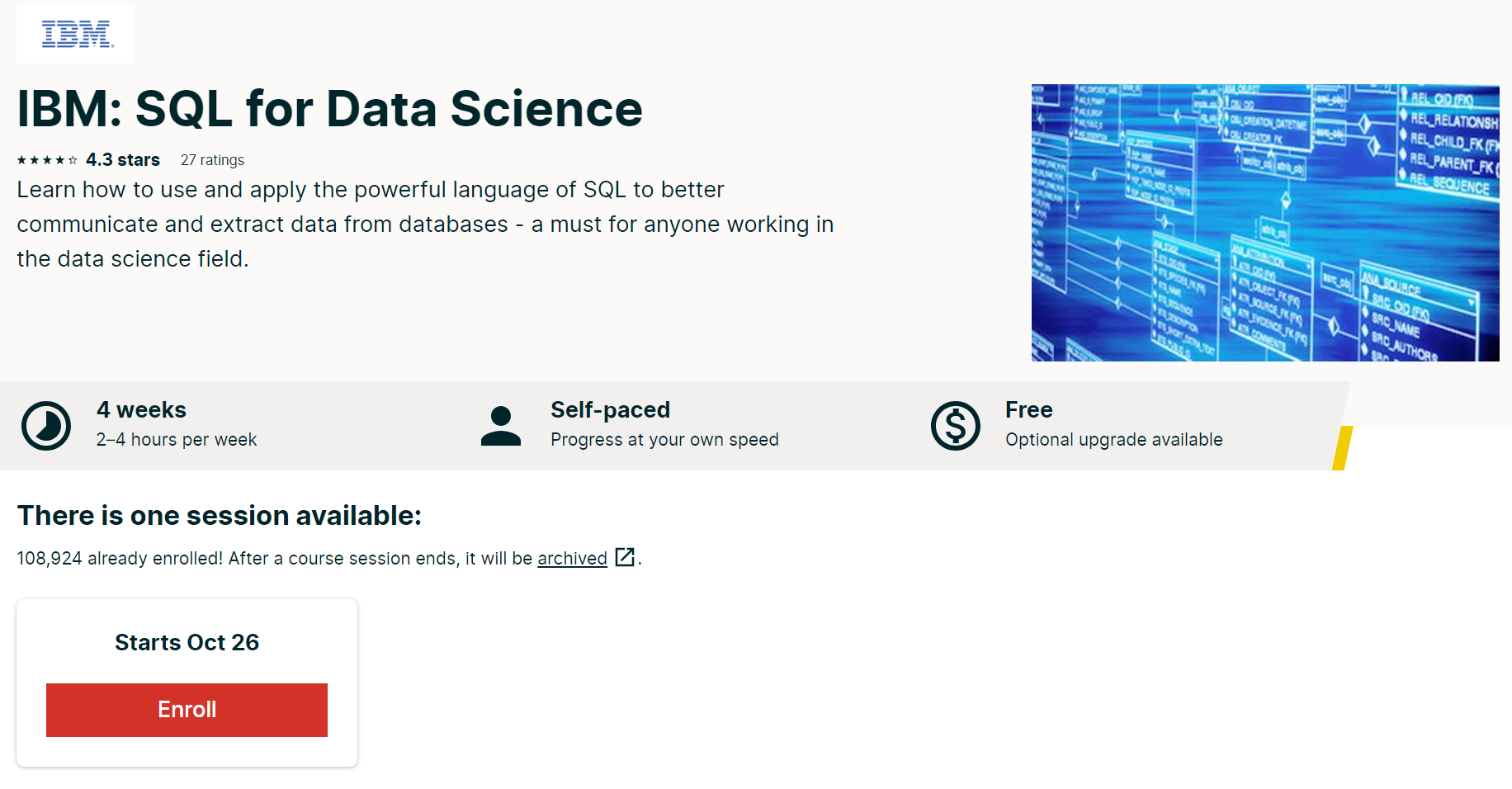
Learn how to use and apply the powerful language of SQL to better communicate and extract data from databases - a must for anyone working in the data science field.
Please Note: Learners who successfully complete this IBM course can earn a skill badge — a detailed, verifiable and digital credential that profiles the knowledge and skills you’ve acquired in this course. Enroll to learn more, complete the course and claim your badge!
Much of the world's data lives in databases. SQL (or Structured Query Language) is a powerful programming language that is used for communicating with and extracting various data types from databases. A working knowledge of databases and SQL is necessary to advance as a data scientist or a machine learning specialist. The purpose of this course is to introduce relational database concepts and help you learn and apply foundational knowledge of the SQL language. It is also intended to get you started with performing SQL access in a data science environment.
The emphasis in this course is on hands-on, practical learning. As such, you will work with real databases, real data science tools, and real-world datasets. You will create a database instance in the cloud. Through a series of hands-on labs, you will practice building and running SQL queries. You will also learn how to access databases from Jupyter notebooks using SQL and Python.
No prior knowledge of databases, SQL, Python, or programming is required.
Learn and apply foundational knowledge of the SQL language
How to create a database in the cloud
How to use string patterns and ranges to query data
How to sort and group data in result sets and by data type
How to analyze data using Python
Python Coding October 25, 2023 Python No comments
a = [1, 2, 3, 4, 5]
print(a[:4].pop())
This code will print 4. Here's what happens:
a[:4] creates a new list slice containing the elements [1, 2, 3, 4].
Then, pop() is called on this new list slice, which removes and returns the last element of the slice, which is 4.
The print() function then displays the value returned by pop(), which is 4.
Python Coding October 25, 2023 Course No comments
There are 10 courses in this program
Python Coding October 24, 2023 Python No comments
k = [2, 1, 0, 3, 0, 2, 1]
print(k.count(k.index(0)))
The given list is k = [2, 1, 0, 3, 0, 2, 1].
k.index(0) finds the index of the first occurrence of the value 0 in the list k. In this case, the first occurrence of 0 is at index 2.
The result of k.index(0) is 2.
k.count(2) counts how many times the value 2 appears in the list k.
In the list k, the value 2 appears twice, at index 0 and index 5.
So, the final result is 2 because the index of the first occurrence of 0 (which is 2) appears twice in the list k.
Python Coding October 24, 2023 Python No comments
Yes, Python developers are in high-demand.
Python software engineers are also among the highest-paid software developers today, earning an average income of $150,000 a year.
The Python language is easy to learn, yet POWERFUL.
YouTube, Dropbox, Google, Instagram, Spotify, Reddit, Netflix, Pinterest - they are all developed using Python.
And most recently, ChatGPT is also written in Python.
Learning Python opens up the possibilities of a whole new career in Data Science.
This book contains only the first 10 chapters (Chapters 1 to 10) of my online Python course as a Udemy instructor.
Python Coding October 24, 2023 Python No comments
Gain hands-on experience and practice using Python to solve real data science challenges
Practice Python coding for modeling, statistics, and storytelling
Utilize popular libraries such as Pandas, numPy, matplotlib, and SKLearn
Run basic machine learning models using Python, evaluate how those models are performing, and apply those models to real-world problems
Build a foundation for the use of Python in machine learning and artificial intelligence, preparing you for future Python study
Every single minute, computers across the world collect millions of gigabytes of data. What can you do to make sense of this mountain of data? How do data scientists use this data for the applications that power our modern world?
Data science is an ever-evolving field, using algorithms and scientific methods to parse complex data sets. Data scientists use a range of programming languages, such as Python and R, to harness and analyze data. This course focuses on using Python in data science. By the end of the course, you’ll have a fundamental understanding of machine learning models and basic concepts around Machine Learning (ML) and Artificial Intelligence (AI).
Using Python, learners will study regression models (Linear, Multilinear, and Polynomial) and classification models (kNN, Logistic), utilizing popular libraries such as sklearn, Pandas, matplotlib, and numPy. The course will cover key concepts of machine learning such as: picking the right complexity, preventing overfitting, regularization, assessing uncertainty, weighing trade-offs, and model evaluation. Participation in this course will build your confidence in using Python, preparing you for more advanced study in Machine Learning (ML) and Artificial Intelligence (AI), and advancement in your career.
Learners must have a minimum baseline of programming knowledge (preferably in Python) and statistics in order to be successful in this course. Python prerequisites can be met with an introductory Python course offered through CS50’s Introduction to Programming with Python, and statistics prerequisites can be met via Fat Chance or with Stat110 offered through HarvardX.
Python Coding October 24, 2023 Python No comments
Here are 10 advanced Python Command Line Interface (CLI) tricks and techniques that can help you save time and effort when working with CLI applications:
Click is a powerful Python library for creating command-line interfaces. It simplifies the process of defining and parsing command-line arguments and options. By using Click, you can create well-structured and user-friendly CLI applications with minimal code.
import click
@click.command()
@click.option('--name', prompt='Your name', help='Your name')
def hello(name):
click.echo(f'Hello, {name}!')
if __name__ == '__main__':
hello()
If your CLI application has multiple subcommands, use the argparse library to define and manage them. Subcommands allow you to organize your CLI tools logically.
The Colorama library makes it easy to add colored text to your CLI application's output. This can help highlight important information and make your tool more user-friendly.
from colorama import Fore, Style
print(f'{Fore.GREEN}Success!{Style.RESET_ALL} Operation completed.')
Use the tqdm library to add progress bars to your CLI applications, especially for time-consuming tasks. It provides a visual indicator of progress.
from tqdm import tqdm
import time
for i in tqdm(range(10)):
time.sleep(1)
The configparser library allows you to read and write configuration files for your CLI application. This is useful for storing settings and user preferences.
Implement robust logging using Python's built-in logging module. It helps you track errors, debug your application, and provide better user feedback.
import logging
logging.basicConfig(filename='myapp.log', level=logging.INFO)
If your CLI application has a menu-driven interface, use libraries like inquirer or prompt_toolkit to create interactive menus for user input.
You can execute shell commands from within your Python CLI application using the subprocess module. This is useful for running external commands and integrating them into your tool.
import subprocess
result = subprocess.run(['ls', '-l'], capture_output=True, text=True)
print(result.stdout)
Use libraries like tabulate or PrettyTable to format data into tables for better presentation, especially when dealing with tabular data in your CLI application.
Make use of Python's unittest or pytest to create unit tests for your CLI application. Proper testing ensures that your code is robust and reliable.
These advanced Python CLI tricks should help you streamline the development and improve the user experience of your command-line applications. Remember to choose the right tools and techniques based on your specific requirements.
Python Coding October 23, 2023 Python No comments
q = [47, 28, 33, 54, 15]
q.reverse()
print(q[:3])
Python Coding October 23, 2023 Python No comments
What Python is and why Python is relevant to automation
How to write short Python scripts to perform automated actions
How to use the basic Python structures: strings, lists, and dictionaries
How to create your own Python objects
This course is designed to teach you the foundations in order to write simple programs in Python using the most common structures. No previous exposure to programming is needed. By the end of this course, you'll understand the benefits of programming in IT roles; be able to write simple programs using Python; figure out how the building blocks of programming fit together; and combine all of this knowledge to solve a complex programming problem.
We'll start off by diving into the basics of writing a computer program. Along the way, you’ll get hands-on experience with programming concepts through interactive exercises and real-world examples. You’ll quickly start to see how computers can perform a multitude of tasks — you just have to write code that tells them what to do.
Python Coding October 23, 2023 Python No comments
Identify text mining approaches needed to identify and extract different kinds of information from health-related text data.
Differentiate how training deep learning models differ from training traditional machine learning models.
In this MOOC, you will be introduced to advanced machine learning and natural language
processing techniques to parse and extract information from unstructured text documents in
healthcare, such as clinical notes, radiology reports, and discharge summaries. Whether you are an aspiring data scientist or an early or mid-career professional in data science or information technology in healthcare, it is critical that you keep up-to-date your skills in information extraction and analysis.
To be successful in this course, you should build on the concepts learned through other intermediate-level MOOC courses and specializations in Data Science offered by the University of Michigan, so you will be able to delve deeper into challenges in recognizing medical entities in health-related documents, extracting clinical information, addressing ambiguity and polysemy to tag them with correct concept types, and develop tools and techniques to analyze new genres of health information.
By the end of this course, you will be able to:
Identify text mining approaches needed to identify and extract different kinds of information from health-related text data
Create an end-to-end NLP pipeline to extract medical concepts from clinical free text using one terminology resource
Differentiate how training deep learning models differ from training traditional machine learning models
Configure a deep neural network model to detect adverse events from drug reviews
List the pros and cons of Deep Learning approaches."
Python Coding October 22, 2023 Python No comments
n = [76, 24]
p = n.copy()
n.pop()
print(p, n)
Python Coding October 22, 2023 Python No comments
Demonstrate your skills to employers, and leverage industry tools to solve real-world challenges
Load, clean, analyze, process, and visualize data using Python and Jupyter Notebooks
Produce an end-to-end exploratory data analysis using Python and Jupyter Notebooks
In this project, you'll serve as a data analyst at an online retail company helping interpret real-world data to help make key business decisions. Your task is to explore and analyze this dataset to gain insights into the store's sales trends, customer behavior, and popular products.
Upon completion, you’ll be able to demonstrate your ability to perform a comprehensive data analysis project that involves critical thinking, extensive data analysis and visualization, and making data-driven business decisions.
There isn’t just one right approach or solution in this scenario, which means you can create a truly unique project that helps you stand out to employers.
ROLE: Data Analyst
SKILLS: Python
PREREQUISITES:
Python, Numpy, Matplotlib or Seaborn, Git, Jupyter Notebook
This project requires you to independently complete the following steps:
Import required libraries
Load and explore the data
Clean the data
Visualize and analyze the data
Python Coding October 22, 2023 Python No comments
import matplotlib.pyplot as plt
# Define the data for the funnel chart
labels = ['Step 1', 'Step 2', 'Step 3', 'Step 4', 'Step 5']
values = [100, 75, 50, 30, 10]
# Calculate the cumulative values for plotting
cumulative_values = [sum(values[:i+1]) for i in range(len(values))]
# Define colors for each segment
colors = ['blue', 'green', 'orange', 'red', 'purple']
# Create the funnel chart
fig, ax = plt.subplots()
for i in range(len(labels)):
ax.fill_betweenx([i, i + 1], 0, cumulative_values[i], step='mid', alpha=0.7, color=colors[i])
ax.set_yticks(range(len(labels)))
ax.set_yticklabels(labels)
ax.set_xlabel('Conversion Rate')
# Add labels to the bars
for i, value in enumerate(cumulative_values):
ax.annotate(str(value), xy=(value, i), xytext=(5, 5), textcoords='offset points')
plt.title('Funnel Chart')
plt.show()
#clcoding.com
Python Coding October 21, 2023 Python No comments
g = [1, 2, 3, 2, 5]
g.remove(2)
print(g)
Python Coding October 21, 2023 Django No comments
Build & deploy rich web applications using Django. Learn the fundamentals of building a full-featured web site using Django
Install and deploy a Django application; build HTML web pages styled by CSS
Describe and build a data model in Django, applying model query and template tags/code of Django Template Language
Apply built-in login functionality in Django; define sessions, cookies, and one-to-many models
Build objects and write syntactically correct JavaScript language; explain basic elements of low-level jQuery
Learn in-demand skills from university and industry experts
Master a subject or tool with hands-on projects
Develop a deep understanding of key concepts
Earn a career certificate from University of Michigan
Python Coding October 21, 2023 Python No comments
Python courses for developers on Coursera. Keep in mind that new courses may have been added since then, so it's a good idea to explore Coursera's website for the most up-to-date options. Here are a few courses that were well-regarded at the time:
"Python for Everybody" by the University of Michigan: This is a beginner-friendly course that covers the fundamentals of Python programming.
"Python 3 Programming" by the University of Michigan: This is a more advanced Python course that delves into topics like data structures and web scraping.
"Google IT Automation with Python" by Google: This specialization covers Python programming and automation, making it suitable for those interested in IT and system administration.
"Applied Data Science with Python" by the University of Michigan: This is a series of courses that covers various aspects of data science using Python, including data visualization, machine learning, and natural language processing.
"Machine Learning" by Stanford University: While not exclusively a Python course, this is a popular choice for those interested in machine learning with Python.
"Django for Everybody" by the University of Michigan: If you're interested in web development with Python, this course covers the Django framework.
"Advanced Machine Learning Specialization" by the National Research University Higher School of Economics: This specialization focuses on more advanced machine learning techniques using Python.
Python Coding October 20, 2023 Python No comments
lis = [10, 20, 30, 40]
for m in lis:
print(m, end=' ')
if m >= 30:
break
Python Coding October 19, 2023 Python No comments
Gain an immersive understanding of the practices and processes used by a junior or associate data analyst in their day-to-day job
Learn key analytical skills (data cleaning, analysis, & visualization) and tools (spreadsheets, SQL, R programming, Tableau)
Understand how to clean and organize data for analysis, and complete analysis and calculations using spreadsheets, SQL and R programming
Learn how to visualize and present data findings in dashboards, presentations and commonly used visualization platforms
Receive professional-level training from Google
Demonstrate your proficiency in portfolio-ready projects
Earn an employer-recognized certificate from Google
Qualify for in-demand job titles: Data Analyst, Junior Data Analyst, Associate Data Analyst
Python Coding October 19, 2023 Python No comments
for x in range(3):
print(x, end=' ')
Python Coding October 19, 2023 Python No comments
Statistics
Lean Six Sigma
Data Analysis
Minitab
Python Coding October 19, 2023 Python No comments
Apply Python, spreadsheets, and BI tooling proficiently to create visually compelling and interactive data visualizations.
Formulate and communicate data-driven insights and narratives through impactful visualizations and data storytelling.
Assess and select the most suitable visualization tools and techniques to address organizational data needs and objectives.
In today's data-driven world, the ability to create compelling visualizations and tell impactful stories with data is a crucial skill. This comprehensive course will guide you through the process of visualization using coding tools with Python, spreadsheets, and BI (Business Intelligence) tooling. Whether you are a data analyst, a business professional, or an aspiring data storyteller, this course will provide you with the knowledge and best practices to excel in the art of visual storytelling.
Throughout the course, a consistent dataset will be used for exercises, enabling you to focus on mastering the visualization tools rather than getting caught up in the intricacies of the data. The emphasis is on practical application, allowing you to learn and practice the tools in a real-world context. To fully leverage the Python sections of this course, prior experience programming in Python is recommended. Additionally, a solid understanding of high-school level math is expected. Familiarity with the Pandas library will also be beneficial.
By the end of this course, you will possess the necessary skills to become a proficient data storyteller and visual communicator. With the ability to create compelling visualizations and leverage the appropriate tools, you will be well-equipped to navigate the world of data and make informed decisions that drive meaningful impact.
Python Coding October 18, 2023 Python No comments
You define a variable a and set it to the value 10.
a = 10
You have a while loop. The condition for this loop is a > 8, which means the loop will continue executing as long as a is greater than 8.
In the first iteration of the loop, a is indeed greater than 8 (it's 10), so the loop's code block will be executed.
Inside the loop, you print the current value of a using the print function. The end=' ' argument ensures that the values are printed with a space between them.
print(a, end=' ')
After printing the value of a, you decrement a by 1 using the expression a = a - 1. This reduces the value of a by 1 in each iteration, effectively counting down.
a = a - 1
The loop then returns to the condition a > 8. If the condition is still true (which it is as long as a is greater than 8), the loop continues to the next iteration. Steps 3 to 5 are repeated.
This process repeats until a is no longer greater than 8. When a becomes 8, the condition a > 8 is no longer true, and the loop terminates.
The output of this code will be the numbers from 10 down to 9, each separated by a space:
10 9
Once a reaches 8, the loop stops, and the program continues with any code that follows this loop.
Python Coding October 18, 2023 Python No comments
An introduction to computer science as a tool to solve real-world analytical problems using Python 3.5.
Python Coding October 17, 2023 Python No comments
A step-by-step explanation of the code:
for i in range(1):
print(i, end=' ')
Python Coding October 17, 2023 Python No comments
Python is a general-purpose programming language that is becoming ever more popular for data science. Companies worldwide are using Python to harvest insights from their data and gain a competitive edge. Unlike other Python tutorials, this course focuses on Python specifically for data science. In our Introduction to Python course, you’ll learn about powerful ways to store and manipulate data, and helpful data science tools to begin conducting your own analyses. Start DataCamp’s online Python curriculum now.
An introduction to the basic concepts of Python. Learn how to use Python interactively and by using a script. Create your first variables and acquaint yourself with Python's basic data types.
Python Coding October 16, 2023 Python No comments
Data science courses contain math—no avoiding that! This course is designed to teach learners the basic math you will need in order to be successful in almost any data science math course and was created for learners who have basic math skills but may not have taken algebra or pre-calculus. Data Science Math Skills introduces the core math that data science is built upon, with no extra complexity, introducing unfamiliar ideas and math symbols one-at-a-time.
Learners who complete this course will master the vocabulary, notation, concepts, and algebra rules that all data scientists must know before moving on to more advanced material.
Topics include:
~Set theory, including Venn diagrams
~Properties of the real number line
~Interval notation and algebra with inequalities
~Uses for summation and Sigma notation
~Math on the Cartesian (x,y) plane, slope and distance formulas
~Graphing and describing functions and their inverses on the x-y plane,
~The concept of instantaneous rate of change and tangent lines to a curve
~Exponents, logarithms, and the natural log function.
~Probability theory, including Bayes’ theorem.
While this course is intended as a general introduction to the math skills needed for data science, it can be considered a prerequisite for learners interested in the course, "Mastering Data Analysis in Excel," which is part of the Excel to MySQL Data Science Specialization. Learners who master Data Science Math Skills will be fully prepared for success with the more advanced math concepts introduced in "Mastering Data Analysis in Excel."
Good luck and we hope you enjoy the course!
Python Coding October 15, 2023 Python No comments
This Python code will iterate over the list lis using a for loop. Within each iteration, it will unpack the sublists into the variables p and q. Then it will print the sum of p and q followed by an ampersand (&). Let's go through the steps:
p and q will take the values from the sublists in lis successively.
In the first iteration, p will be 8 and q will be 7. The sum will be 15. So, it will print 15&.
In the second iteration, p will be 6 and q will be 5. The sum will be 11. So, it will print 11&.
Therefore, the output of the code will be: 15&11&
Python Coding October 15, 2023 Books, Python No comments
(2nd Edition: Covers Object Oriented Programming) Learn Python Fast and Learn It Well. Master Python Programming with a unique Hands-On Project
Have you always wanted to learn computer programming but are afraid it'll be too difficult for you? Or perhaps you know other programming languages but are interested in learning the Python language fast? This book is for you. You no longer have to waste your time and money learning Python from lengthy books, expensive online courses or complicated Python tutorials.
Python for Beginners Complex concepts are broken down into simple steps to ensure that you can easily master the Python language even if you have never coded before. Carefully Chosen Python Examples Examples are carefully chosen to illustrate all concepts. In addition, the output for all examples are provided immediately so you do not have to wait till you have access to your computer to test the examples. Careful selection of topics Topics are carefully selected to give you a broad exposure to Python, while not overwhelming you with information overload. These topics include object-oriented programming concepts, error handling techniques, file handling techniques and more. Learn The Python Programming Language Fast Concepts are presented in a "to-the-point" style to cater to the busy individual. With this book, you can learn Python in just one day and start coding immediately.
The best way to learn Python is by doing. This book includes a complete project at the end of the book that requires the application of all the concepts taught previously. Working through the project will not only give you an immense sense of achievement, it"ll also help you retain the knowledge and master the language. Are you ready to dip your toes into the exciting world of Python coding? This book is for you. With the first edition of this book being a #1 best-selling programming ebook on Amazon for more than a year, you can rest assured that this new and improved edition is the perfect book for you to learn the Python programming language fast. Click the BUY button and download it now.
- What is Python? - What software you need to code and run Python programs? - What are variables? - What are the common data types in Python? - What are Lists and Tuples? - How to format strings - How to accept user inputs and display outputs - How to control the flow of program with loops - How to handle errors and exceptions - What are functions and modules? - How to define your own functions and modules - How to work with external files - What are objects and classes - How to write your own class - What is inheritance - What are properties - What is name mangling .. and more... Finally, you'll be guided through a hands-on project that requires the application of all the topics covered. Click the BUY button and download the book now to start learning Python. Learn it fast and learn it well.
Python Coding October 15, 2023 Books, Python No comments
Learn to code like a professional with Python - an open source, versatile, and powerful programming language
Learning Python has a dynamic and varied nature. It reads easily and lays a good foundation for those who are interested in digging deeper. It has a practical and example-oriented approach through which both the introductory and the advanced topics are explained. Starting with the fundamentals of programming and Python, it ends by exploring very different topics, like GUIs, web apps and data science. The book takes you all the way to creating a fully fledged application.
The book begins by exploring the essentials of programming, data structures and teaches you how to manipulate them. It then moves on to controlling the flow of a program and writing reusable and error proof code. You will then explore different programming paradigms that will allow you to find the best approach to any situation, and also learn how to perform performance optimization as well as effective debugging. Throughout, the book steers you through the various types of applications, and it concludes with a complete mini website built upon all the concepts that you learned.
Python is the most popular introductory teaching language in U.S. top computer science universities, so if you are new to software development, or maybe you have little experience, and would like to start off on the right foot, then this language and this book are what you need. Its amazing design and portability will help you become productive regardless of the environment you choose to work with.
Python Coding October 14, 2023 Python No comments
The code is a simple Python while loop that starts with the variable cl set to 4. It increments cl by 1 in each iteration and prints the updated value of cl followed by a hyphen ("-") until cl is no longer less than 9. Here's the output of the code: 5-6-7-8-9-
Python Coding October 14, 2023 Data Science No comments
Prepare for a career as a data analyst. Gain the in-demand skills and hands-on experience to get job-ready in as little as 4 months. No prior experience required.
Master the most up-to-date practical skills and tools that data analysts use in their daily roles
Learn how to visualize data and present findings using various charts in Excel spreadsheets and BI tools like IBM Cognos Analytics & Tableau
Develop working knowledge of Python language for analyzing data using Python libraries like Pandas and Numpy, and invoke APIs and Web Services
Gain technical experience through hands on labs and projects and build a portfolio to showcase your work
Receive professional-level training from IBM
Demonstrate your proficiency in portfolio-ready projects
Earn an employer-recognized certificate from IBM
Qualify for in-demand job titles: Data Analyst, Associate Data Analyst, Business Analyst
Python Coding October 13, 2023 Python No comments
py = 2 + 3: In this line, you're creating a variable named py and assigning it the result of the addition of 2 and 3, which is 5. So, py now holds the value 5.
print('py'): In this line, you are using the print() function to display the string 'py'. This code will not print the value of the variable py but will directly print the string 'py' as it is enclosed in single quotes.
Here's your code with step-by-step explanations:
# Step 1: Calculate the sum of 2 and 3
py = 2 + 3 # py is assigned the value 5
# Step 2: Print the string 'py'
print('py') # This will print the string 'py' to the console
Python Coding October 13, 2023 Course, Coursera, Cybersecurity No comments
Cybersecurity is no longer just a concern for IT professionals and security experts. Today, everyone who uses the internet, smartphones, computers, or digital services needs to understand the basics of cybersecurity.
From protecting personal information to securing business networks, cybersecurity plays an important role in our digital lives.
If you want to understand how cyber threats work, why security matters, and how organizations manage cybersecurity risks, the Cybersecurity for Everyone course on Coursera is an excellent place to start.
Cybersecurity for Everyone is an online course offered by the University of Maryland, College Park, through Coursera.
The course is taught by Dr. Charles Harry, who brings experience in cybersecurity, national security, and advising organizations on cybersecurity risk management.
Unlike highly technical cybersecurity courses, this program introduces cybersecurity from a broader perspective. It covers technical foundations, internet infrastructure, cyber threats, governance, privacy, and risk management.
It is designed for beginners as well as professionals who want to understand the bigger picture of cybersecurity.
The course is divided into six modules covering important cybersecurity concepts.
Understand the foundations of cybersecurity.
Topics include:
What is cyberspace?
What does security mean?
Understanding cybersecurity challenges
The modern cyber threat landscape
Real-world cyber incidents
Cybersecurity policies
Learn how the internet developed into the global infrastructure we use today.
Topics include:
Early development of the internet
Government and private-sector contributions
Development of the World Wide Web
Internet privatization and expansion
The internet as a global commons
Understand how information travels across networks and how internet infrastructure is managed.
Topics include:
How data moves across networks
Encapsulation
Application layer
Network layer
Physical layer
Internet governance
Explore the different individuals and groups involved in cyber threats.
Topics include:
Who are hackers?
Cybercrime organizations
Hacktivists
Hobbyist hackers
Advanced Persistent Threats (APTs)
Real-world cybercrime case studies
Understand the different stages of a cyberattack.
Topics include:
Reconnaissance
Weaponization
Delivery
Exploitation
Installation
Command and Control
Effects of cyberattacks
You will also explore the Cyber Kill Chain and MITRE ATT&CK Framework.
Learn about the consequences of cybersecurity incidents and why security strategies matter.
Topics include:
Direct effects of cyberattacks
Indirect consequences
Secondary effects
Strategic cybersecurity planning
Cybersecurity risk management
| Details | Information |
|---|---|
| Course | Cybersecurity for Everyone |
| Platform | Coursera |
| University | University of Maryland |
| Instructor | Dr. Charles Harry |
| Level | Beginner |
| Modules | 6 |
| Duration | Approximately 2 weeks |
| Weekly commitment | 10 hours |
| Language | English |
| Certificate | Shareable certificate available |
| Prerequisites | No prior experience required |
This course is suitable for:
Students interested in cybersecurity.
Beginners exploring information security.
Software developers and programmers.
IT professionals.
Business owners and entrepreneurs.
Anyone interested in online privacy and digital safety.
Professionals who want to understand cybersecurity risks.
You don't need an advanced technical background to get started.
Cybersecurity knowledge is becoming increasingly important as businesses and individuals depend on digital technologies.
Learning cybersecurity can help you:
Understand how cyberattacks happen.
Recognize common security threats.
Protect personal and organizational information.
Understand network security fundamentals.
Learn how organizations manage cyber risks.
Build a foundation for further cybersecurity studies.
It is also a useful starting point if you want to explore careers in cybersecurity, security analysis, information security, or risk management.
You can access the course through Coursera.
Course Link:
Cybersecurity for Everyone (Free Course)
Visit the course page, review the enrollment options, and start learning.
Note: Coursera may offer free enrollment or selected free-access options, but certificate access and graded assessments may require payment depending on the enrollment option available to you.
Want to learn more about cybersecurity? Check out these additional learning resources on CLCODING:
Cybersecurity is not only about hacking, firewalls, or security tools. It is also about understanding risks, protecting information, securing digital infrastructure, and making better decisions in an increasingly connected world.
The Cybersecurity for Everyone course from the University of Maryland provides a beginner-friendly introduction to these important concepts.
If you are starting your cybersecurity journey, this course is worth exploring.
Start learning cybersecurity today!
Python Coding October 12, 2023 Python No comments
Solutions -
In the code a function f that takes two parameters, value and values. The function then modifies the value at the first index of the values list to be 44 and assigns 1 to a variable v, but this v variable is not used anywhere in the function.
After defining the function f, you have a variable t set to 3 and a list v with three elements: [1, 2, 3]. You then call the function f with the arguments t and v, and finally, you print the values of t and the first element of v after the function call.
Here's a step-by-step explanation of what happens:
t is initially set to 3.
v is initially set to [1, 2, 3].
The function f is called with the arguments t and v.
Inside the function, the value at the first index of the values list (which is the same list as v) is modified to be 44. So, v becomes [44, 2, 3]. However, the variable v declared in the function and set to 1 is not used.
After the function call, you print the values of t and the first element of v, which is v[0].
As a result, when you run the code, it will print: 3 44
Python Coding October 12, 2023 Python No comments
Use the Create, Read, Update, and Delete operations to manage databases
Explain the basics of Object Oriented Python
Understand how data is stored across multiple tables in a database
Utilize the Google Maps API to visualize data
This course is part of the Python for Everybody Specialization
When you enroll in this course, you'll also be enrolled in this Specialization.
Learn new concepts from industry experts
Gain a foundational understanding of a subject or tool
Develop job-relevant skills with hands-on projects
Earn a shareable career certificate
Free Books Python Programming for Beginnershttps://t.co/uzyTwE2B9O
— Python Coding (@clcoding) September 11, 2023
Top 10 Python Data Science book
— Python Coding (@clcoding) July 9, 2023
๐งต:
Top 4 free Mathematics course for Data Science ! pic.twitter.com/s5qYPLm2lY
— Python Coding (@clcoding) April 26, 2024
Web Development using Python
— Python Coding (@clcoding) December 2, 2023
๐งต: