

.png)
Solutions -
The above code will extend the list x with individual characters from the string '234', resulting in the list x containing each character as a separate element. Here's the code execution step by step:
x = ['1']: Initializes the list x with one element, which is the string '1'.
x.extend('234'): Extends the list x with the characters from the string '234'. After this line of code, the list x will contain the following elements: ['1', '2', '3', '4'].
print(x): Prints the contents of the list x, which will output: ['1', '2', '3', '4']
.png)
Solutions -
The above code uses Python's slice notation to extract a portion of the string s using the slice object x. Here's how it works:

Python has gone to be one of the most popular programming languages in the world, and you will be one of the few people left out if you don’t add this knowledge to your arsenal. If you’re looking to learn Python, now is an excellent time to do so. But where do you begin?
You can start right here, right now, with this audiobook. It makes learning Python simple, fast, and easy, taking away the confusion from learning a new language. When learning a new language, it's easy to be overwhelmed and not know where to start or what to focus on. You can spend a long time pursuing tutorials online only to find out you don't really understand any of the concepts they covered. That won't be a problem here! This audiobook follows a step-by-step guide, walking you through everything you need to know about Python in an easy to follow fashion. It will teach you all the basics of Python, and even some of the more advanced Python concepts, taking you from beginner to intermediate Python programmer.
The exercises in this audiobook are designed to help you practice using the skills you’ve learned in the various sections. The final two projects will let you practice putting everything you’ve learned together and teaching you how to manipulate text, work with images, and create a simple Graphical User Interface (GUI).
.png)
The above code will split the string r into a list using the default whitespace separator, but since there are no whitespace characters in the string '123', it will not split the string, and you will get a list with the original string as its only element. Here's the output you would get: ['123']

Construct regex patterns
Validate passwords and user input in web forms
Extract patterns and replace strings with regex
In a video that plays in a split-screen with your work area, your instructor will walk you through these steps:
Introduction to Regular Expressions in Python
Intermediate Regular Expressions in Python
Password Validation with Regular Expressions
Form and User Input Validation with Regular Expressions
Extraction and Word Replacement from Server Logs
Increase client reach and engagement
Gain valuable insights that will help improve social media performance
Achieve their social media goals and provide data-driven recommendations
This project requires you to independently complete the following steps:
.png)
The above code provided is creating two sets, st1 and st2, and then using the - operator to find the difference between st2 and st1. The - operator in this context performs a set difference operation, which returns a new set containing the elements that are in st2 but not in st1.
Here's the step-by-step breakdown of the code:
st1 is a set containing the elements {1, 2, 3}.
st2 is a set containing the elements {2, 3, 4}.
st2 - st1 calculates the set difference between st2 and st1.
The result of st2 - st1 will be a new set containing the elements that are in st2 but not in st1. In this case, it will be {4}, because 4 is in st2 but not in st1.
So, when you run the code, it will output: 4

There are many free Python programming books available online that can help you learn Python or improve your Python skills. Here are some notable ones:
Download - Free Python Programming books
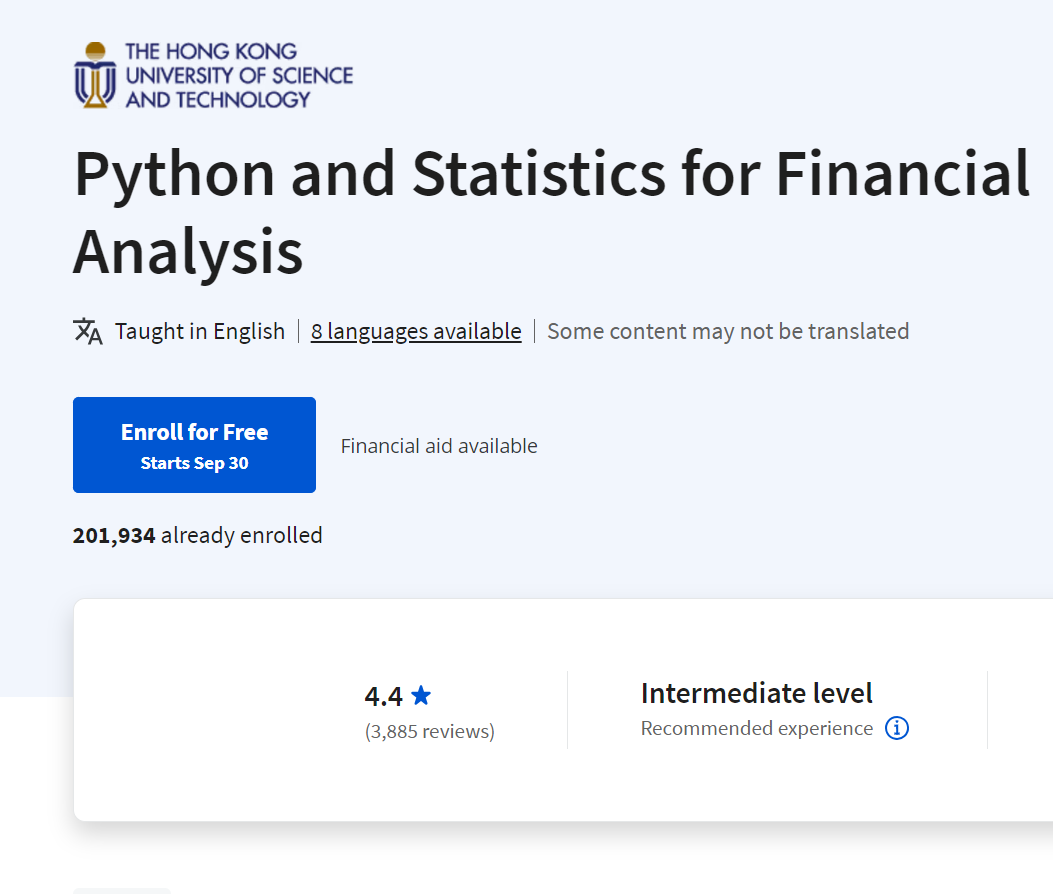
Python is now becoming the number 1 programming language for data science. Due to python’s simplicity and high readability, it is gaining its importance in the financial industry. The course combines both python coding and statistical concepts and applies into analyzing financial data, such as stock data.
By the end of the course, you can achieve the following using python:
- Import, pre-process, save and visualize financial data into pandas Dataframe
- Manipulate the existing financial data by generating new variables using multiple columns
- Recall and apply the important statistical concepts (random variable, frequency, distribution, population and sample, confidence interval, linear regression, etc. ) into financial contexts
- Build a trading model using multiple linear regression model
- Evaluate the performance of the trading model using different investment indicators
Jupyter Notebook environment is configured in the course platform for practicing python coding without installing any client applications.

Define and explain the key concepts of data clustering
Demonstrate understanding of the key constructs and features of the Python language.
Implement in Python the principle steps of the K-means algorithm.
Design and execute a whole data clustering workflow and interpret the outputs.

Implement a stack data structure in Python. A stack is a linear data structure that follows the Last-In, First-Out (LIFO) principle, where the last element added to the stack is the first one to be removed.
Your task is to create a Python class called Stack that has the following methods:
push(item): Adds an item to the top of the stack.
pop(): Removes and returns the item from the top of the stack.
peek(): Returns the item currently at the top of the stack without removing it.
is_empty(): Returns True if the stack is empty, and False otherwise.
size(): Returns the number of items in the stack.
You can implement the stack using a list as the underlying data structure.
Here's a basic structure for the Stack class:
class Stack:
def __init__(self):
# Initialize an empty stack
pass
def push(self, item):
# Add item to the top of the stack
pass
def pop(self):
# Remove and return the item from the top of the stack
pass
def peek(self):
# Return the item at the top of the stack without removing it
pass
def is_empty(self):
# Return True if the stack is empty, False otherwise
pass
def size(self):
# Return the number of items in the stack
pass
A) It marks a method as a property, allowing it to be accessed like an attribute.
B) It defines a new class.
C) It marks a method as static, meaning it can only be called on the class and not on instances of the class.
D) It marks a method as a class method.
A) It defines a new instance variable.
B) It initializes the class object.
C) It specifies the return type of a method.
D) It defines a string representation of the object when using `str()`.
10 New AI tools you will regret not knowing:
1. 10web.io: An AI-powered website builder that likely simplifies the process of creating websites using artificial intelligence.
2. Docus.ai: An AI health assistant, which could potentially help with healthcare-related tasks such as patient data analysis or medical research.
3. Postwise.ai: An AI tool for content creation, which can be useful for generating written content efficiently.
4. Stockimg.ai: An AI tool for creating logos and images, possibly using AI to generate or enhance visual content.
5. Tabnine.com: A coding assistant powered by AI, which can assist developers in writing code more efficiently and effectively.
6. Longshot.ai: Potentially an AI tool for generating blog posts or other written content.
7. Voicemaker.in: An AI tool that might help with generating artificial voices or assisting with voice-related tasks.
8. Franks.ai: An AI search engine, which could provide advanced search capabilities using artificial intelligence algorithms.
9. Gling.ai: An AI video editor, likely designed to simplify the process of editing and enhancing videos.
10. Perplexity.ai: This is related to research
1. "Python for Data Analysis" by Wes McKinney - This book focuses on data manipulation and analysis using Python's pandas library.
Get the definitive handbook for manipulating, processing, cleaning, and crunching datasets in Python. Updated for Python 3.10 and pandas 1.4, the third edition of this hands-on guide is packed with practical case studies that show you how to solve a broad set of data analysis problems effectively. You'll learn the latest versions of pandas, NumPy, and Jupyter in the process.
Download - Python for Data Analysis

2. "Hands-On Machine Learning with Scikit-Learn, Keras, and TensorFlow" by Aurélien Géron - A practical guide to machine learning using Python libraries like Scikit-Learn, Keras, and TensorFlow.
Through a recent series of breakthroughs, deep learning has boosted the entire field of machine learning. Now, even programmers who know close to nothing about this technology can use simple, efficient tools to implement programs capable of learning from data. This bestselling book uses concrete examples, minimal theory, and production-ready Python frameworks (Scikit-Learn, Keras, and TensorFlow) to help you gain an intuitive understanding of the concepts and tools for building intelligent systems.
With this updated third edition, author Aurélien Géron explores a range of techniques, starting with simple linear regression and progressing to deep neural networks. Numerous code examples and exercises throughout the book help you apply what you've learned. Programming experience is all you need to get started.
Use Scikit-learn to track an example ML project end to end
Explore several models, including support vector machines, decision trees, random forests, and ensemble methods
Exploit unsupervised learning techniques such as dimensionality reduction, clustering, and anomaly detection
Dive into neural net architectures, including convolutional nets, recurrent nets, generative adversarial networks, autoencoders, diffusion models, and transformers
Use TensorFlow and Keras to build and train neural nets for computer vision, natural language processing, generative models, and deep reinforcement learning
Download - Hands-On Machine Learning with Scikit-Learn, Keras, and TensorFlow
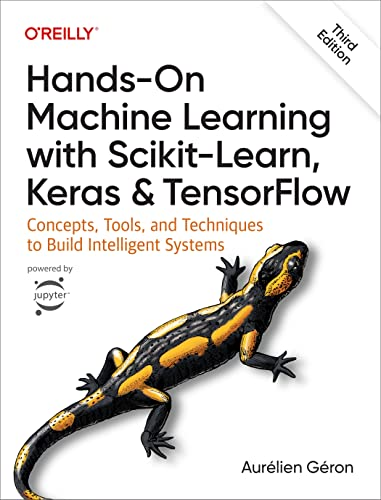
3. "Data Science from Scratch" by Joel Grus - A beginner-friendly introduction to data science concepts and tools using Python.
To really learn data science, you should not only master the tools—data science libraries, frameworks, modules, and toolkits—but also understand the ideas and principles underlying them. Updated for Python 3.6, this second edition of Data Science from Scratch shows you how these tools and algorithms work by implementing them from scratch.
If you have an aptitude for mathematics and some programming skills, author Joel Grus will help you get comfortable with the math and statistics at the core of data science, and with the hacking skills you need to get started as a data scientist. Packed with new material on deep learning, statistics, and natural language processing, this updated book shows you how to find the gems in today’s messy glut of data.
Get a crash course in Python
Learn the basics of linear algebra, statistics, and probability—and how and when they’re used in data science
Collect, explore, clean, munge, and manipulate data
Dive into the fundamentals of machine learning
Implement models such as k-nearest neighbors, Naïve Bayes, linear and logistic regression, decision trees, neural networks, and clustering
Explore recommender systems, natural language processing, network analysis, MapReduce, and databases
Download - Data Science from Scratch: First Principles with Python
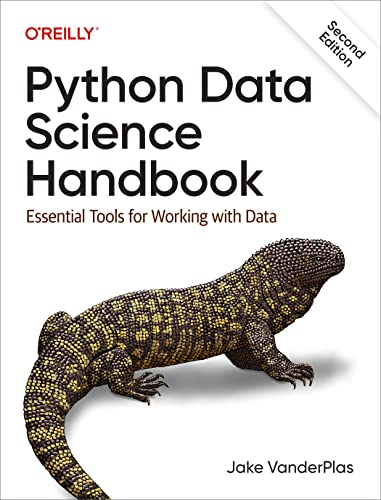
4. "Python Data Science Handbook" by Jake VanderPlas - Covers essential data science libraries in Python, such as NumPy, pandas, Matplotlib, and Scikit-Learn.
Python is a first-class tool for many researchers, primarily because of its libraries for storing, manipulating, and gaining insight from data. Several resources exist for individual pieces of this data science stack, but only with the new edition of Python Data Science Handbook do you get them all--IPython, NumPy, pandas, Matplotlib, scikit-learn, and other related tools.
Working scientists and data crunchers familiar with reading and writing Python code will find the second edition of this comprehensive desk reference ideal for tackling day-to-day issues: manipulating, transforming, and cleaning data; visualizing different types of data; and using data to build statistical or machine learning models. Quite simply, this is the must-have reference for scientific computing in Python.
With this handbook, you'll learn how:
IPython and Jupyter provide computational environments for scientists using Python
NumPy includes the ndarray for efficient storage and manipulation of dense data arrays
Pandas contains the DataFrame for efficient storage and manipulation of labeled/columnar data
Matplotlib includes capabilities for a flexible range of data visualizations
Scikit-learn helps you build efficient and clean Python implementations of the most important and established machine learning algorithms
Download - Python Data Science Handbook
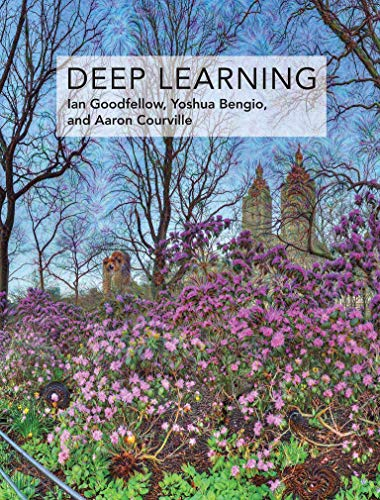
"Deep Learning" by Ian Goodfellow, Yoshua Bengio, and Aaron Courville - A comprehensive reference on deep learning techniques and applications.
Deep learning is a form of machine learning that enables computers to learn from experience and understand the world in terms of a hierarchy of concepts. Because the computer gathers knowledge from experience, there is no need for a human computer operator to formally specify all the knowledge that the computer needs. The hierarchy of concepts allows the computer to learn complicated concepts by building them out of simpler ones; a graph of these hierarchies would be many layers deep. This book introduces a broad range of topics in deep learning.
The text offers mathematical and conceptual background, covering relevant concepts in linear algebra, probability theory and information theory, numerical computation, and machine learning. It describes deep learning techniques used by practitioners in industry, including deep feedforward networks, regularization, optimization algorithms, convolutional networks, sequence modeling, and practical methodology; and it surveys such applications as natural language processing, speech recognition, computer vision, online recommendation systems, bioinformatics, and videogames. Finally, the book offers research perspectives, covering such theoretical topics as linear factor models, autoencoders, representation learning, structured probabilistic models, Monte Carlo methods, the partition function, approximate inference, and deep generative models.
Deep Learning can be used by undergraduate or graduate students planning careers in either industry or research, and by software engineers who want to begin using deep learning in their products or platforms. A website offers supplementary material for both readers and instructors.
Download - Deep Learning (Adaptive Computation and Machine Learning series)
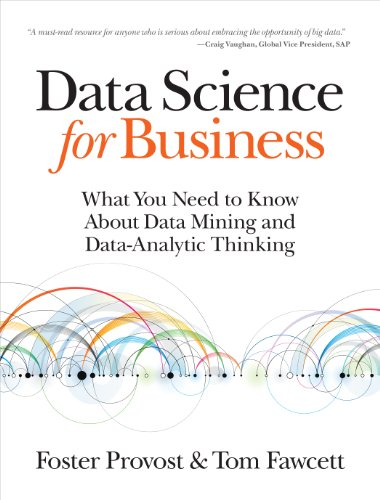
"Data Science for Business" by Foster Provost and Tom Fawcett - Explores the intersection of data science and business decision-making.
Written by renowned data science experts Foster Provost and Tom Fawcett, Data Science for Business introduces the fundamental principles of data science, and walks you through the "data-analytic thinking" necessary for extracting useful knowledge and business value from the data you collect. This guide also helps you understand the many data-mining techniques in use today.
Based on an MBA course Provost has taught at New York University over the past ten years, Data Science for Business provides examples of real-world business problems to illustrate these principles. You’ll not only learn how to improve communication between business stakeholders and data scientists, but also how participate intelligently in your company’s data science projects. You’ll also discover how to think data-analytically, and fully appreciate how data science methods can support business decision-making.
Understand how data science fits in your organization—and how you can use it for competitive advantage
Treat data as a business asset that requires careful investment if you’re to gain real value
Approach business problems data-analytically, using the data-mining process to gather good data in the most appropriate way
Learn general concepts for actually extracting knowledge from data
Apply data science principles when interviewing data science job candidates
Download - Data Science for Business: What You Need to Know about Data Mining and Data-Analytic Thinking
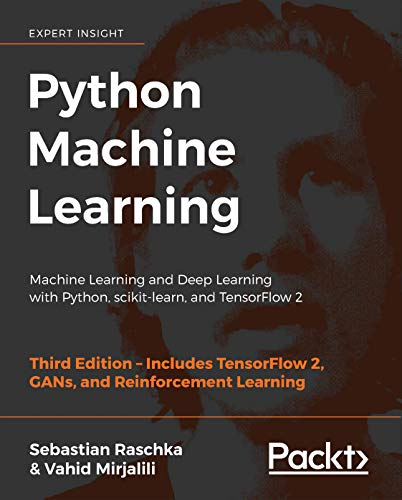
"Python Machine Learning" by Sebastian Raschka and Vahid Mirjalili - A hands-on guide to machine learning with Python and its libraries.
Python Machine Learning, Third Edition is a comprehensive guide to machine learning and deep learning with Python. It acts as both a step-by-step tutorial, and a reference you'll keep coming back to as you build your machine learning systems.
Packed with clear explanations, visualizations, and working examples, the book covers all the essential machine learning techniques in depth. While some books teach you only to follow instructions, with this machine learning book, Raschka and Mirjalili teach the principles behind machine learning, allowing you to build models and applications for yourself.
Updated for TensorFlow 2.0, this new third edition introduces readers to its new Keras API features, as well as the latest additions to scikit-learn. It's also expanded to cover cutting-edge reinforcement learning techniques based on deep learning, as well as an introduction to GANs. Finally, this book also explores a subfield of natural language processing (NLP) called sentiment analysis, helping you learn how to use machine learning algorithms to classify documents.
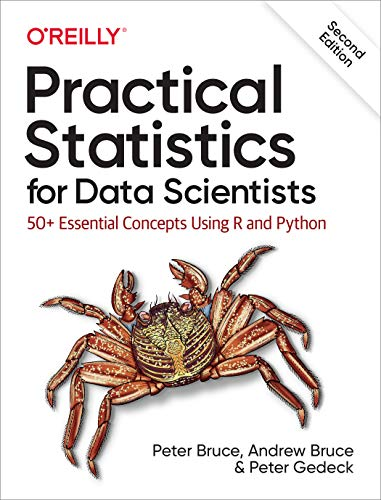
"Practical Statistics for Data Scientists" by Andrew Bruce and Peter Bruce - Provides a practical understanding of statistical concepts for data analysis.
Statistical methods are a key part of data science, yet few data scientists have formal statistical training. Courses and books on basic statistics rarely cover the topic from a data science perspective. The second edition of this popular guide adds comprehensive examples in Python, provides practical guidance on applying statistical methods to data science, tells you how to avoid their misuse, and gives you advice on what’s important and what’s not.
Many data science resources incorporate statistical methods but lack a deeper statistical perspective. If you’re familiar with the R or Python programming languages and have some exposure to statistics, this quick reference bridges the gap in an accessible, readable format.
With this book, you’ll learn:
Why exploratory data analysis is a key preliminary step in data science
How random sampling can reduce bias and yield a higher-quality dataset, even with big data
How the principles of experimental design yield definitive answers to questions
How to use regression to estimate outcomes and detect anomalies
Key classification techniques for predicting which categories a record belongs to
Statistical machine learning methods that "learn" from data
Unsupervised learning methods for extracting meaning from unlabeled data
Download - Practical Statistics for Data Scientists: 50+ Essential Concepts Using R and Python

Code :
import pyfiglet
import random
font = random.choice(pyfiglet.FigletFont.getFonts())
ascii_art = pyfiglet.figlet_format("Eid-ul-Adha", font=font)
greeting = f"{ascii_art}\nEid-ul-Adha Mubarak!\n{ascii_art}"
print(greeting)
#clcoding.com
Python libraries commonly used in oceanographic research:
NumPy and SciPy: These libraries provide powerful numerical and scientific computing capabilities, including array manipulation, linear algebra, optimization, and signal processing.
Pandas: Pandas is a library used for data manipulation and analysis. It provides data structures and functions for efficient handling and processing of structured data, such as time series or oceanographic datasets.
Matplotlib and Seaborn: These libraries are used for data visualization in Python. Matplotlib provides a wide range of plotting functions, while Seaborn offers a high-level interface for creating attractive statistical graphics.
Cartopy: Cartopy is a library for geospatial data processing and mapping. It allows you to create maps, plot geographical data, and perform geospatial transformations.
Xarray and NetCDF4: These libraries are commonly used for handling and analyzing multidimensional gridded data, such as ocean model outputs or satellite observations. They provide efficient I/O operations, metadata handling, and mathematical operations on multidimensional arrays.
Ocean Data View (ODV): ODV is a popular software tool for oceanographic data visualization and analysis. While not a Python library, it can be integrated with Python using the PyODV package, allowing you to import, analyze, and plot ODV data files.

Variable vs. Value: Beginners often confuse variables and values in Python. A variable is a name used to store a value, while a value is the actual data stored in the variable. For example, in the statement x = 5, x is the variable, and 5 is the value assigned to it.
List vs. Tuple: Beginners may struggle with understanding the differences between lists and tuples in Python. A list is a mutable sequence of elements enclosed in square brackets ([]), while a tuple is an immutable sequence enclosed in parentheses (()). This means that you can modify a list by adding, removing, or changing elements, but you cannot do the same with a tuple once it is created.
Function vs. Method: Beginners sometimes confuse functions and methods. A function is a block of reusable code that performs a specific task, while a method is a function that belongs to an object and is called using the dot notation (object.method()). Functions can be called independently, whereas methods are invoked on specific objects.
Syntax Error vs. Runtime Error: Beginners often mix up syntax errors and runtime errors. A syntax error occurs when the code violates the language's grammar rules and prevents it from being compiled or interpreted correctly. On the other hand, a runtime error occurs when the code is syntactically correct, but an error is encountered while the program is running.
Index vs. Slice: Understanding the difference between indexing and slicing can be confusing for beginners. Indexing refers to accessing a specific element in a sequence, such as a string or a list, by specifying its position using square brackets ([]). Slicing, on the other hand, allows you to extract a portion of a sequence by specifying a range of indices using the colon (:) notation.
Mutable vs. Immutable: Beginners may struggle with grasping the concept of mutable and immutable objects in Python. Mutable objects can be modified after they are created, while immutable objects cannot. For example, lists are mutable, so you can change their elements, whereas strings are immutable, so you cannot modify their characters once they are created.
Importing Modules vs. Installing Packages: Beginners sometimes confuse importing modules and installing packages. Importing a module allows you to use its predefined functions, classes, or variables in your code by using the import statement. On the other hand, installing a package refers to downloading and setting up additional libraries or modules that are not included in the Python standard library, usually using package managers like pip.
Syntax vs. Semantics: Beginners may have difficulty understanding the distinction between syntax and semantics. Syntax refers to the rules and structure of a programming language, including the correct placement of punctuation, keywords, and symbols. Semantics, on the other hand, relates to the meaning and interpretation of the code. Syntax errors occur when the code violates the language's syntax rules, while semantic errors occur when the code produces unexpected or incorrect results due to logical or conceptual mistakes.
Class vs. Object: Beginners often struggle with the concepts of classes and objects in object-oriented programming. A class is a blueprint or template that defines the structure and behavior of objects, while an object is an instance of a class. In simpler terms, a class can be thought of as a blueprint for creating multiple objects with similar characteristics and behaviors.
Global vs. Local Variables: Understanding the scope of variables can be confusing for beginners. Global variables are defined outside of any function or class and can be accessed from any part of the program. Local variables, on the other hand, are defined within a function or a block of code and can only be accessed within that specific function or block. Beginners may encounter issues when they unintentionally create variables with the same name in different scopes, leading to unexpected behavior or errors.
.png)

The future of Python programming looks bright and promising. Python has been steadily growing in popularity over the years and has become one of the most widely used programming languages across various domains. Here are some key aspects that shape the future of Python programming:
Continued Growth: Python's popularity is expected to continue growing as more developers and organizations recognize its simplicity, readability, and versatility. It has a vast ecosystem of libraries and frameworks that make it suitable for a wide range of applications.
Data Science and Machine Learning: Python has become the go-to language for data science and machine learning. Popular libraries like NumPy, Pandas, and scikit-learn have established Python as a powerful tool for data analysis, modeling, and machine learning. With the growing demand for data-driven insights and AI solutions, Python's role in these fields is expected to expand further.
Web Development: Python's web development frameworks, such as Django and Flask, have gained significant traction in recent years. Python's simplicity and ease of use make it an attractive choice for web development projects. As web applications continue to evolve and grow in complexity, Python is likely to remain a preferred language for web development.
Artificial Intelligence and Automation: Python is heavily used in artificial intelligence (AI) and automation. Libraries like TensorFlow and PyTorch are widely adopted for building and deploying AI models. Python's flexibility and ease of integration with other technologies make it well-suited for AI-related tasks.
DevOps and Infrastructure: Python's role in DevOps and infrastructure automation is also expected to increase. Tools like Ansible, Fabric, and SaltStack leverage Python for automation and configuration management. Python's scripting capabilities and extensive library support make it a valuable language in the DevOps domain.
Education and Beginner-Friendly Nature: Python's simplicity and readability make it an excellent choice for teaching programming to beginners. Many educational institutions and coding bootcamps have adopted Python as their primary teaching language. This trend is likely to continue, fostering a growing community of Python developers.
Performance Improvements: Python's performance has been a topic of discussion, particularly in high-performance computing and real-time applications. Efforts like PyPy, Numba, and Cython have been made to optimize Python's execution speed. As these optimizations progress, Python's performance is expected to improve further.
Community and Ecosystem: Python has a vibrant and active community, contributing to its growth and development. The Python Package Index (PyPI) hosts an extensive collection of open-source libraries, enabling developers to easily leverage existing code and accelerate their development process. The community's continuous contributions and collaborations are likely to drive Python's progress.
Overall, Python's future seems promising, driven by its versatility, simplicity, and strong ecosystem. It will continue to be a popular choice for a wide range of applications, from web development and data science to AI and automation. As technology advances and new trends emerge, Python is expected to adapt and remain a relevant and influential language in the programming landscape.

100 Days Python Loop Challenge
The 100 Days of Code Python Loop Challenge is a coding challenge designed to help you improve your coding skills by coding every day for 100 days. The challenge focuses on loops in Python, which are a fundamental building block of many programs.
The challenge involves writing code every day for 100 days, with each day building on the previous day's work. The challenge provides you with a set of tasks to complete each day, with the aim of helping you to gradually build up your skills and knowledge of loops in Python.
The challenge is designed to be flexible, so you can start it at any time and work at your own pace. You can also choose to work on the challenge for more or less than 100 days, depending on your schedule and availability.
To participate in the challenge, you can join the 100 Days of Code community, which provides support and resources for participants. You can also use the #100DaysOfCode hashtag on social media to connect with other participants and share your progress.
If you are interested in improving your coding skills and learning more about loops in Python, the 100 Days of Code Python Loop Challenge is a great way to get started.

In Python, classes and functions are two fundamental programming constructs, each with its own unique purpose and characteristics.
Functions are blocks of code that take input, perform operations on that input, and then return an output. Functions can be defined and called within a program, making it possible to reuse code and simplify the development process. Functions are also useful for encapsulating logic and making code more modular, as well as improving code readability.
Classes, on the other hand, are a way to define new types of objects in Python. They provide a blueprint for creating objects that have a specific set of attributes and methods. In other words, classes define the structure and behavior of objects, and allow you to create multiple instances of those objects.
Here are some key differences between classes and functions in Python:
Overall, both classes and functions are important programming constructs in Python, but they serve different purposes and are used in different ways. Understanding the differences between classes and functions is key to writing effective Python code.
In Python, the yield keyword is used to create a generator function. When a function includes a yield statement, it becomes a generator function, which returns an iterator object that can be iterated over with a loop.
The yield statement suspends the function's execution and sends a value back to the caller, but unlike return, the function state is saved, and the function can be resumed later from where it left off.
Here's an example to demonstrate the use of yield:
def countdown(num):
while num > 0:
yield num
num -= 1


.png)





.png)


%20by%20Allen%20B.%20Downey.jpg)





.png)


 Posts
All Comments
Posts
All Comments


%20of%20square%20wave.png)
%20of%20square%20wave%20(2).png)


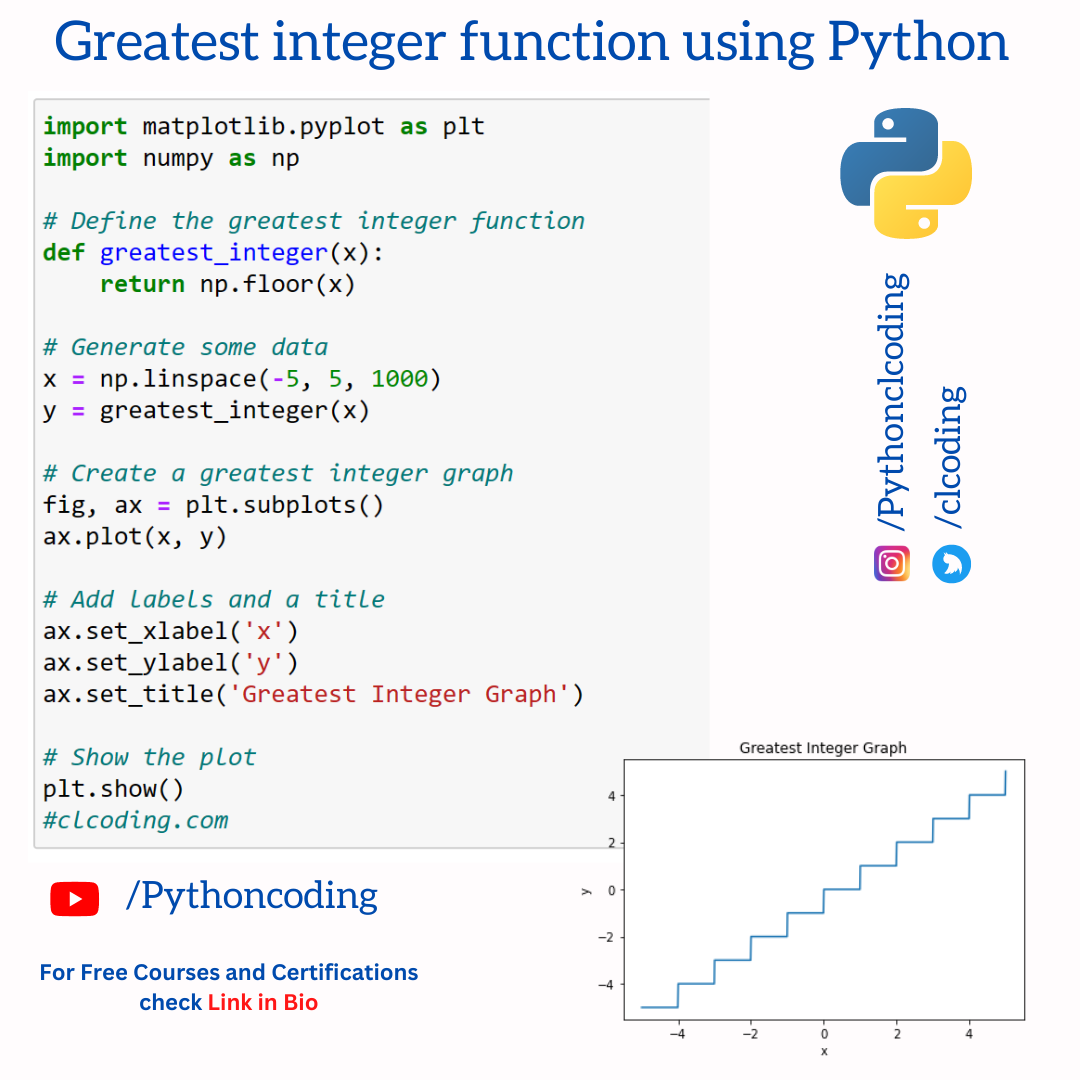


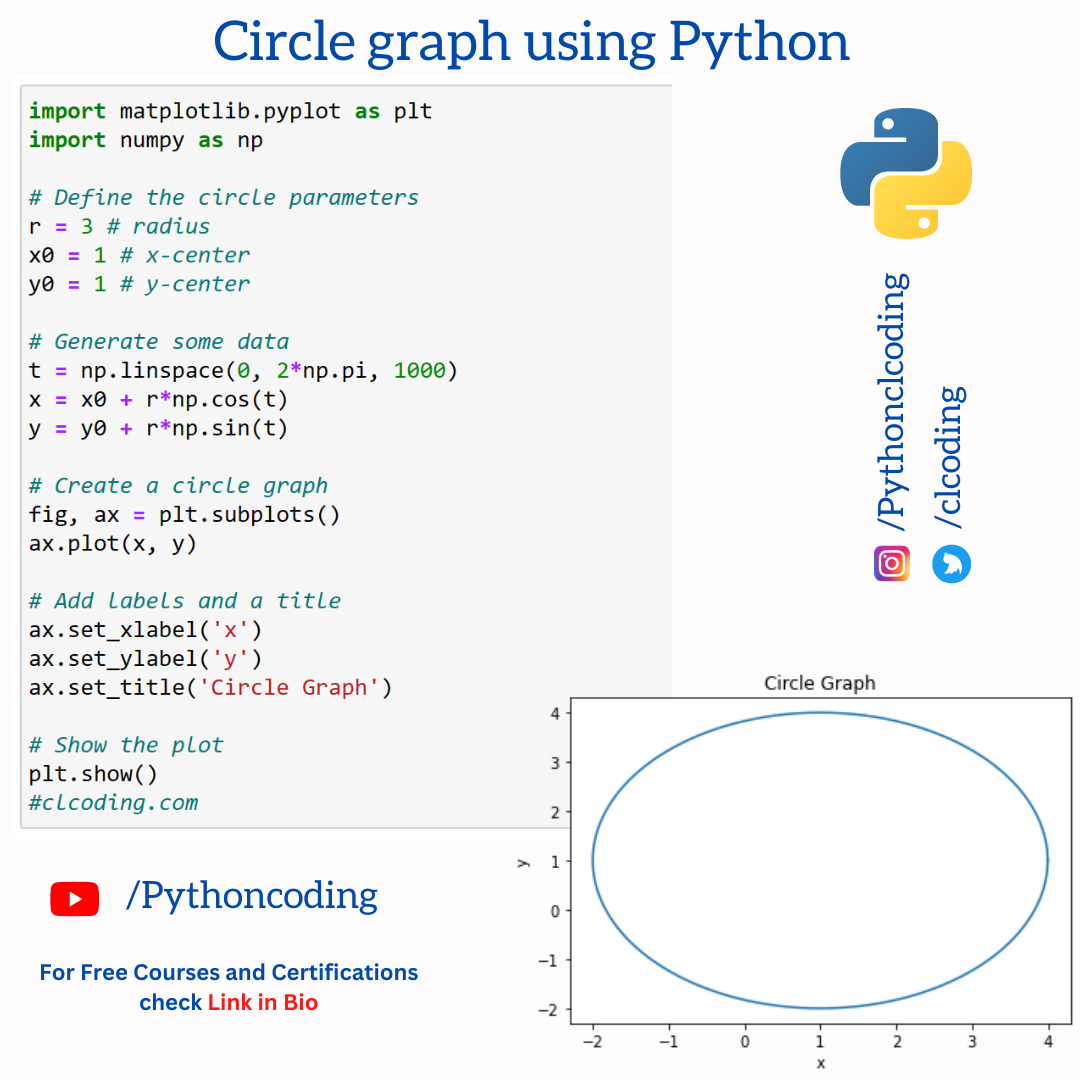
.png)
.png)
.png)


