Sunday, 16 November 2025

Python Coding challenge - Day 851| What is the output of the following Python Code?


Code Explanation:

1. Defining Class R
class R:

You begin by creating a class named R, which will have an initializer and a private attribute.

2. Constructor of Class R
    def __init__(self):
        self.__v = 10

__init__ runs automatically when an object of R (or its child class) is created.

self.__v is a private attribute because it starts with double underscore __.

Python performs name-mangling, converting __v into _R__v internally.

This means subclasses cannot directly access __v using the name __v.

3. Defining Class S that Inherits R
class S(R):

Class S is a child class of R.

It inherits the constructor of class R, so __v is still created inside objects of class S (but as _R__v).

4. Method show() Inside Class S
    def show(self):
        return hasattr(self, "__v")

The method checks: Does the object have an attribute named "__v"?

Because of name-mangling, the actual attribute name is _R__v, not __v.

So hasattr(self, "__v") will return False.

5. Creating an Object of S and Calling show()
print(S().show())

An object of S is created → this also runs R’s constructor → _R__v is created.

Now show() is called.

hasattr(self, "__v") checks for "__v" exactly.

Since "__v" does not exist (only _R__v does), the result is:

False

Final Output: False

500 Days Python Coding Challenges with Explanation

Algorithmic Trading A-Z with Python, Machine Learning & AWS


 Why This Course Is Important

Algorithmic trading is one of the most powerful applications of data science and machine learning in finance. With the right strategy, you can automate trading, minimize emotional decision-making, and scale your approach. This course helps you do exactly that — it teaches you how to build data-driven trading bots using Python, machine learning, and deploy them on the cloud (AWS).

By mastering algorithmic trading, you’re not just learning to trade — you’re learning to build systems that trade for you. This is increasingly valuable in modern finance, where quantitative strategies dominate and automation is a key differentiator.


Course Structure & Format

  • The course is self-paced, which means you can learn according to your schedule.

  • It offers lifetime access, so you can revisit lessons or update your knowledge later. 

  • According to course details, it includes 44+ hours of on-demand video, along with downloadable resources. 

What You’ll Learn

The curriculum is very rich — combining trading fundamentals, coding, data science, and cloud deployment. Here are key themes and modules:

Trading Fundamentals & Day Trading

  • Basics of day trading: understanding of bid-ask spread, leverage, margin, order types, and more. 

  • Working with popular brokers like OANDA, Interactive Brokers (IBKR), and FXCM to place real (or simulated) trades.

Strategy Design & Machine Learning

  • Building trading strategies using technical indicators (moving averages, momentum, etc.). 

  • Creating machine learning- and deep learning-based strategies to predict market movement or make trade decisions. 

  • Using Python libraries such as NumPy, Pandas, Matplotlib, scikit-learn, Keras, and TensorFlow to code these strategies. 

Backtesting & Forward Testing

  • Rigorous backtesting: test your strategy on historical data to see how it would have performed. 

  • Forward testing or “walk-forward analysis”: simulate what happens when you deploy the strategy going forward, using new data. 

  • Live testing (paper trading): run your strategy in real-time using virtual money before risking real capital.

Automation & Deployment on AWS

  • How to set up a virtual server on AWS EC2 for algorithmic trading. 

  • Automating your trading scripts: schedule trading sessions, run trades, and monitor your bot. 

  • Truly automated trading: once deployed, your bot can run 24/7 (within market hours) without manual intervention.


Strengths of the Course

  • End-to-End Learning: From foundational trading concepts to advanced ML models and cloud deployment — the course offers a full roadmap.

  • Hands-On Development: You don’t just learn theory. You build real bots using Python, backtest them, and automate them on AWS.

  • Real Broker Integration: Working with real broker APIs (like OANDA, IBKR, FXCM) gives you real-world trading experience.

  • Machine Learning Applied to Trading: Learning to apply ML / deep learning to strategy generation is a big plus — it’s not just rule-based trading.

  • Cloud Deployment Expertise: Many trading algo courses stop at backtesting. This one goes further, teaching you how to run your bot in the cloud, which is essential for robustness and scalability.


Challenges / Considerations

  • Learning Curve: The course covers a broad set of skills — trading, Python, ML, AWS. If you're new to any of these, it can feel challenging.

  • Risk Factor: Algorithmic trading involves financial risk. Even with backtesting, strategy performance in the real world can differ.

  • Cost of AWS: Running bots on AWS can incur costs (depending on EC2 instance type, data usage, etc.), so budget accordingly.

  • Data Requirements: Good strategies need good data. Historical data, clean feature engineering, and proper labeling are crucial.

  • Broker API Complexity: Using broker APIs (like IBKR or OANDA) for automated trading adds complexity (authentication, order types, error-handling).


Who Should Take This Course?

This course is ideal for:

  • Aspiring Quant Traders: If you want to build algorithmic trading strategies, this is a very practical, hands-on path.

  • Data Scientists / ML Engineers: If you already know ML and Python, this course helps you apply your skills to finance.

  • Python Developers: For coders who want to move into the finance world, build bots, and automate workflows.

  • Entrepreneurs & Fintech Enthusiasts: Anyone interested in building algo-trading products or services.

  • Cloud Learners: If you’re also keen to learn how to deploy Python apps on AWS, this is a great use-case.


Why This Course Is Relevant in 2025

  • Algorithmic Trading Growth: Quantitative and algorithmic trading continues to grow in retail and institutional finance.

  • ML in Finance: Machine learning strategies are increasingly common; knowing how to build them is a very valuable skill.

  • Cloud-Native Automation: Deploying trading algorithms on the cloud ensures scalability, lower latency, and continuous trading.

  • Democratization of Tools: With Python, Keras/TensorFlow, and broker APIs, building algo bots is more accessible now than ever.

  • Competitive Edge: Automating your strategies gives you an edge in fast-moving markets, reduces manual errors, and helps build scalable systems.


Join Now: Algorithmic Trading A-Z with Python, Machine Learning & AWS

Final Thoughts

The “Algorithmic Trading A-Z with Python, Machine Learning & AWS” course is a comprehensive, future-facing course for anyone who wants to combine programming, data science, and finance. It’s not just about writing code — it’s about building strategies, testing them rigorously, and deploying them in a real-world environment.

If you’re serious about building a quant trading system or want to use data-driven approaches to trade, this course offers tremendous value.

Deep Learning A-Z 2025: Neural Networks, AI & ChatGPT Prize


Introduction: Why This Course Matters

In 2025, deep learning continues to be the driving force behind the global AI revolution. From image recognition and natural language processing to generative AI systems like ChatGPT, neural networks play a central role in powering next-generation applications across industries.

The Udemy course “Deep Learning A-Z 2025: Neural Networks, AI & ChatGPT Prize” is built to meet this demand. It teaches both the theoretical foundations and hands-on implementation of deep learning, while also covering modern AI applications — including how to create ChatGPT-style conversational systems.


Course Instructors & Format

This course is taught by Kirill Eremenko and his team, who are well-known for their engaging teaching style in the Data Science community.

Key format features:

  • Self-paced learning, allowing you to study at your own speed

  • Lifetime access, so you can revisit lessons anytime

  • 22+ hours of video content, along with articles and downloadable resources

The structure makes it easy to learn even if you have a busy schedule.


What You Will Learn

The curriculum is broad, balanced, and crafted to develop both your intuition and coding ability. Key topics include:

Artificial Neural Networks (ANNs)

Learn the fundamentals of neural networks and build them from scratch.

Convolutional Neural Networks (CNNs)

Master image classification and computer vision tasks.

Recurrent Neural Networks (RNNs)

Work on sequential data problems such as time-series forecasting and stock prediction.

Self-Organizing Maps (SOMs)

Explore unsupervised learning and clustering for anomaly detection.

Boltzmann Machines

Build recommender systems and understand deep belief networks.

Autoencoders

Dive into dimensionality reduction, reconstruction, and anomaly detection.

ChatGPT / Conversational AI

A special module teaches you how chatbots and conversational models like ChatGPT work — and how to build your own.

The course stands out by emphasizing intuition tutorials, helping you understand why models work the way they do, not just how to code them.


Hands-On Projects & Real-World Use Cases

The course shines through its practical projects that simulate real business problems. You’ll build:

  • Customer Churn Prediction using ANNs

  • Image Recognition Models using CNNs

  • Stock Price Forecasting using RNNs and LSTMs

  • Fraud Detection Systems using Self-Organizing Maps

  • Recommender Systems using Boltzmann Machines and Autoencoders

These projects bridge the gap between theory and real-world application — helping you build a strong portfolio.


Tools & Libraries Used

You’ll work with popular and industry-standard tools, including:

  • TensorFlow & Keras for building and training deep learning models

  • PyTorch as a modern alternative for flexible neural network development

  • Theano to understand lower-level computational graphs

  • Scikit-learn for preprocessing and evaluation

  • NumPy, Pandas, Matplotlib for data analysis and visualization

This gives you hands-on experience with the full AI ecosystem.


Strengths of the Course

Balanced Theory + Practice

You understand both how models work and how to implement them.

Real-World Relevance

Case studies are drawn from real business scenarios, not toy examples.

Diverse Topic Coverage

Covers both supervised and unsupervised deep learning models.

Up-to-Date Content

Includes a module on ChatGPT and modern conversational AI.

Broad Tool Exposure

Gives you experience with multiple frameworks used across the industry.


Possible Drawbacks / Challenges

  • Pace for beginners may feel fast in mathematically heavy sections

  • Breadth vs depth: covering many topics means some areas won’t go extremely deep

  • Project complexity may challenge absolute beginners

  • Instructor interaction is limited to Udemy’s Q&A format

Still, the course is very beginner-friendly compared to alternatives.


Who Is This Course For?

This course is ideal for:

  • Beginners seeking a structured path into deep learning

  • Data scientists wanting to expand into neural networks

  • Developers aiming to build AI-powered applications

  • Anyone curious about conversational AI or ChatGPT-style models

Whether you're starting fresh or enhancing your AI skills, this course provides strong foundations.


Why Take This Course in 2025?

  • Deep learning skills remain in high demand across industries

  • ChatGPT-style applications are booming, and understanding them opens career doors

  • AI jobs are growing rapidly, making this training highly relevant

  • Lifetime access means you can learn and revisit the content at your pace


Join Now: Deep Learning A-Z 2025: Neural Networks, AI & ChatGPT Prize

Conclusion

“Deep Learning A-Z 2025: Neural Networks, AI & ChatGPT Prize” is a holistic and practical deep learning course that blends:

  • Intuition-driven understanding

  • Hands-on implementation

  • Real-world projects

Machine Learning and Deep Learning Bootcamp in Python


Why This Course Is Worth It

In today’s AI-driven world, machine learning (ML) and deep learning (DL) are more than just buzzwords — they’re foundational technologies that power everything from recommendation systems to smart assistants. The “Machine Learning and Deep Learning Bootcamp in Python” on Udemy provides a comprehensive introduction to both ML and DL, making it ideal for learners who want to master these tools in a cohesive, structured way.

Whether you're a beginner wanting to break into AI or someone with some programming experience looking to deepen your ML knowledge, this course equips you with theoretical understanding and practical implementation skills using Python.


Who’s Teaching & How the Course Is Structured

  • The course is created by Holczer Balazs, a software engineer with a strong background in quantitative modeling, simulation, and algorithms. 

  • It’s completely self-paced, so you can learn on your own schedule.

  • You get lifetime access to over 150+ lectures, including slides and source code. 

  • The tools you’ll use include scikit-learn, TensorFlow, and Keras, allowing you to implement both ML and DL models hands-on. 


What You’ll Learn: Course Curriculum

This bootcamp covers a wide range of topics — from classic ML algorithms to state-of-the-art deep learning and reinforcement learning. Here are some highlights:

Machine Learning Fundamentals

  • Regression: Learn linear regression (with cost functions, gradient descent) and logistic regression. 

  • Classification: Dive into K-Nearest Neighbors, Naive Bayes, Support Vector Machines (SVMs). 

  • Ensemble Methods: Understand decision trees, random forests, bagging, and boosting (like AdaBoost). 

  • Clustering: Explore clustering algorithms such as k-means, DBSCAN, and hierarchical clustering.

Deep Learning

  • Feed-Forward Neural Networks: Build single-layer perceptrons, apply activation functions, understand backpropagation. 

  • Deep Neural Networks (DNNs): Handle training deep models, and learn about vanishing gradients and ReLU, cost functions, optimizers. 

  • Convolutional Neural Networks (CNNs): Learn how convolution, pooling, and flattening layers work for image tasks. 

  • Recurrent Neural Networks (RNNs): Understand sequence models, LSTM / GRUs, and how to apply them to time-series data. 

  • Transformers: Learn about embeddings, attention (query/key/value), and building transformer-based models — even touching on ChatGPT-style architectures

  • Generative Adversarial Networks (GANs): Build simple GAN architectures (generator + discriminator). 

Reinforcement Learning

  • Q-learning & Deep Q-learning: Learn value iteration, policy iteration, exploration vs exploitation, and train agents (for example, in games). 

  • Multi-Armed Bandits: Understand exploration-exploitation trade-offs. 

Optimization Techniques

  • Detailed look at gradient descent, stochastic gradient descent, and optimizers like ADAM, RMSProp, AdaGrad

Projects & Real-World Applications

  • Face detection using OpenCV

  • Reinforcement learning project like training an agent to play tic-tac-toe using Q-learning. 


Strengths of This Course

  • Broad Coverage: One of the biggest advantages — you don’t just learn a few ML algorithms, but also deep neural networks, GANs, and reinforcement learning.

  • Theory + Hands-On: Each concept is explained theoretically and then implemented using Python libraries.

  • Modern Relevance: The inclusion of transformer architectures (used in ChatGPT) makes the course very up-to-date.

  • Practical Projects: Real-world applications (like face detection, game-playing agents) help reinforce learning.

  • Optimization Focus: Learning about different optimizers gives you insight into how neural networks are effectively trained.


Challenges / Limitations

  • Beginner Challenge: Despite being well-structured, the depth of topics (especially in DL + RL) can feel overwhelming for complete beginners.

  • Math Requirements: Some modules (like optimization or deep networks) assume a basic understanding of calculus / linear algebra for full clarity.

  • Time Commitment: With 150+ lectures, completing the course thoroughly will require significant investment.

  • Resource Intensity: Deep learning (especially with TensorFlow / Keras) may need good hardware (GPU recommended for training complex models).


Who Should Take This Course?

  • Beginners to ML/DL: If you’re new to machine learning but know basic Python, this is a very good starting point.

  • Intermediate Programmers: Python developers who want to dive into AI and build practical models.

  • Aspiring Data Scientists: Those looking to add machine learning and deep learning to their skill set for jobs in data science.

  • AI Enthusiasts: Anyone curious about reinforcement learning, GANs, or transformer-based models.


Why This Course Is Relevant in 2025

  • AI Demand: AI careers continue to dominate tech hiring — understanding both ML and DL gives you a big advantage.

  • Transformer Boom: With conversational AI (like ChatGPT) being very popular, knowing transformers is a huge plus.

  • Versatility: Reinforcement learning and GANs are very applicable in gaming, simulation, finance, and creative AI.

  • Long-Term Value: The foundational skills you acquire here will be useful for building more advanced AI systems or research work.


Join Now: Machine Learning and Deep Learning Bootcamp in Python

Final Thoughts

The Machine Learning & Deep Learning Bootcamp in Python is powerful, comprehensive, and up-to-date. It’s not just a “python + ML” crash course — it dives into advanced topics like GANs and RL while staying grounded through practical implementation.

If you’re serious about building a strong foundation in AI (and want to code real ML/DL models), this course is definitely worth considering.


Introducciรณn a DEEP LEARNING: Algoritmos, Arquitecturas y Aplicaciones Prรกcticas en Python


Introduction

Deep learning has become one of the most powerful and transformative technologies shaping modern artificial intelligence. From computer vision and language understanding to robotics and predictive analytics, deep learning is the backbone of many advanced systems. Introducciรณn a DEEP LEARNING: Algoritmos, Arquitecturas y Aplicaciones Prรกcticas en Python serves as a comprehensive guide for learners, especially Spanish-speaking readers, who want to understand how deep learning works and how to apply it in Python. The book blends theory and hands-on coding to make complex concepts easier to grasp.


Why This Book is Valuable

This book stands out because it makes deep learning accessible without oversimplifying the concepts. It is written specifically for learners who prefer Spanish explanations, reducing language barriers in a technical subject. The balance between theoretical discussions and practical exercises helps readers not only understand the principles but also gain real coding experience. By the end, readers have the knowledge and confidence to build neural networks and experiment with AI models.


Fundamentals of Deep Learning

The book begins with the essential building blocks of deep learning. Readers learn what neural networks are, how artificial neurons function, and how layers stack to form deep architectures. It explains key concepts like activation functions, forward propagation, backward propagation, and why deep networks excel at learning complex patterns. This section provides the foundation needed to understand how deep learning models learn from data and improve through training.


Core Learning Algorithms

Deep learning relies heavily on optimization algorithms, and the book explains them in a practical way. It covers gradient descent, the engine behind neural network learning, and advanced optimizers like Adam and RMSProp, which speed up and stabilize training. The reader also learns about loss functions — the metrics that guide a model’s learning — and regularization techniques such as dropout and batch normalization. These tools are essential for preventing overfitting and building more reliable models.


Neural Network Architectures

One of the strengths of the book is its detailed explanation of modern neural network architectures. It begins with feedforward networks, the simplest form of neural networks, and gradually introduces more advanced types. Convolutional Neural Networks (CNNs) are explored for their role in image processing, while Recurrent Neural Networks (RNNs) and LSTMs are introduced for handling sequential data like text and time-series signals. Each architecture is explained with diagrams, examples, and Python implementations.


Practical Deep Learning with Python

The practical aspect of this book is what brings deep learning concepts to life. Using Python libraries such as TensorFlow and Keras, readers learn how to build, train, evaluate, and improve different models. The book walks through dataset preparation, model creation, training loops, performance evaluation, and debugging techniques. It also teaches how to use visualizations to understand training behavior, such as accuracy and loss curves. This hands-on approach ensures that readers gain real development experience.


Real-World Applications

Beyond coding, the book emphasizes how deep learning is used in real-world scenarios. Readers explore applications such as image classification, sentiment analysis, object detection, forecasting, and other practical use cases. These examples help learners understand how deep learning models are applied in industries like healthcare, finance, retail, and autonomous systems. Each example shows the journey from data preparation to model deployment.


Deployment and Model Optimization

To complete the learning path, the book also covers advanced skills such as model deployment and tuning. Readers learn how to save trained models, use them for inference, and integrate them into real applications. It also discusses hyperparameter tuning techniques, model evaluation strategies, and best practices for improving performance. This section is useful for anyone aiming to use deep learning in professional or production environments.


Who Should Read This Book?

This book is perfect for students, data science beginners, AI enthusiasts, and working professionals wanting to expand into deep learning. While some basic knowledge of Python and math is helpful, the explanations are clear enough for motivated learners to follow along. It is especially beneficial for Spanish-speaking readers who prefer a native-language resource but want to master globally relevant technologies.


Hard Copy: Introducciรณn a DEEP LEARNING: Algoritmos, Arquitecturas y Aplicaciones Prรกcticas en Python

Conclusion

Introducciรณn a DEEP LEARNING: Algoritmos, Arquitecturas y Aplicaciones Prรกcticas en Python is an excellent resource for anyone wanting to learn deep learning from scratch and apply it directly using Python. It combines theory, architecture explanations, and hands-on programming to provide a complete learning experience. By the end of the book, learners can confidently build neural networks, train deep models, understand their behavior, and apply them to real problems. This makes the book a valuable investment for anyone serious about entering the world of artificial intelligence.

Python Coding challenge - Day 850| What is the output of the following Python Code?


Code Explanation:

1. Class Definition Begins
class Demo:

A new class named Demo is created.
This class will contain attributes and methods.

2. Class-Level Attribute
    nums = []

nums is a class variable (shared by all objects of the class).

It is an empty list [] initially.

Any object of Demo will use this same list unless overridden.

3. Method Definition
    def add(self, val):
        self.nums.append(val)

The method add() takes self (object) and a value val.

It appends val to self.nums.

Since nums is a class list, appending through any object affects the same list.

4. Creating First Object
d1 = Demo()

Creates object d1 of class Demo.

d1 does not have its own nums; it uses the shared class list.

5. Creating Second Object
d2 = Demo()

Creates another object d2.

d2 also uses the same class-level list nums as d1.

6. Adding a Number Using d1
d1.add(4)

Calls the add() method on d1.

This executes self.nums.append(4).

Since nums is shared, the list becomes:
[4]

7. Printing Length of nums from d2
print(len(d2.nums))

d2 looks at the same shared list.

That list contains one element: 4

So length is:

1

Final Output:
1

Python Coding challenge - Day 849| What is the output of the following Python Code?


Code Explanation:

1. Class Definition Begins
class A:

You define a class A.
This is a blueprint for creating objects.

2. Method Inside Class A
    def show(self):
        return "A"

A method named show() is created.

When this method is called, it returns the string "A".

3. Class B Inherits Class A
class B(A):

Class B is created.

It inherits from class A, meaning B gets all attributes/methods of A unless overridden.

4. Overriding the show() Method in Class B
    def show(self):
        return super().show() + "B"

Class B overrides the show() method of class A.

super().show() calls the show() method from the parent class A, which returns "A".

Then "B" is added.

So the full returned string becomes: "A" + "B" = "AB".

5. Creating an Object of Class B
obj = B()

An object named obj is created using class B.

This object can use all methods of B, and inherited methods from A.

6. Calling the show() Method
print(obj.show())

Calls B’s version of show().

That method calls super().show() → returns "A"

Adds "B" → becomes "AB"

Finally prints:

AB

Final Output: AB

500 Days Python Coding Challenges with Explanation

Python Coding Challenge - Question with Answer (01161125)

 Explanation:

List Initialization
a = [1, 4, 7, 10]

You create a list a that contains four numbers:
1, 4, 7, 10


Variable Initialization
s = 0

You create a variable s to store the sum.
Initially, sum = 0.

Loop Through Each Value
for v in a:

This loop will pick each value from list a, one by one.
So v becomes:
1 → 4 → 7 → 10

Check Condition
if v % 3 == 1:

You check if the number leaves remainder 1 when divided by 3.

Let’s check each:

v v % 3 Remainder Condition v%3==1?
1 1             Yes             ✔ Add
4 1             Yes             ✔ Add
7 1             Yes             ✔ Add
10 1             Yes             ✔ Add

All numbers satisfy the condition.

Add to Sum
s += v

Add all numbers that passed the condition.

s = 1 + 4 + 7 + 10 = 22

Print the Final Sum
print(s)

This prints:

22

Final Output: 22

Python Interview Preparation for Students & Professionals

Saturday, 15 November 2025

Maximizing Business Potential With AI: Protection And Growth Strategies To Multiply Your Business Faster While Avoiding AI Pitfalls


Maximizing Business Potential With AI: A Strategic Guide to Growth and Protection

Artificial Intelligence (AI) isn’t just a futuristic concept reserved for tech giants — it is a practical, powerful tool that can propel businesses forward while simultaneously protecting them from emerging risks. When used intelligently, AI offers a dual promise: accelerating growth and strengthening defenses. But without properly designed strategies, it can backfire or become a liability.

1. The Growth Engine: How AI Multiplies Business Potential

AI’s ability to analyze massive volumes of data allows businesses to make smarter, faster, and more informed decisions. Predictive analytics enables firms to forecast trends, customer demand, and market shifts, letting them stay one step ahead. Companies can use generative AI to scale marketing, automatically creating personalized content, targeted campaigns, and even product ideas — freeing human teams to focus on higher-level strategy and innovation.

Moreover, AI streamlines operations. From automating routine tasks like customer support (via chatbots) to optimizing inventory and supply chain logistics, AI helps reduce costs and improve efficiency. In human resources, AI-powered tools can help in recruitment, talent matching, and even predicting employee attrition, thereby making workforce planning more strategic.

Finally, AI fosters innovation. Businesses can experiment with new business models — for example, “AI as a service” or usage-based models that dynamically adjust pricing based on behavior. AI-driven insights can reveal unmet customer needs, and companies can prototype products faster using simulation and data-driven feedback.

2. The Protective Shield: Guarding Your Business With AI

Growth is exciting, but unguarded AI adoption carries risks — and smart companies need safeguards. AI-powered security systems can monitor networks for anomalies, detect cyberthreats in real time, and initiate preventive actions. This proactive defense reduces vulnerability and ensures business continuity.

On the compliance and risk front, AI helps too. By scanning regulatory changes, modeling risk scenarios, and assessing credit or fraud risk, AI tools enable businesses to stay ahead of compliance challenges. This not only protects from financial loss but also strengthens trust among stakeholders.

Moreover, building a governance framework around AI is critical. This includes setting ethical guidelines, establishing accountability, and ensuring transparency in AI decision-making. Businesses should audit AI systems regularly for bias, correctness, and fairness. Human oversight remains essential to verify AI outputs before critical decisions are made.

3. Avoiding the Pitfalls: Common Risks and Mitigation

Many AI projects fail because they are misaligned with business goals. Without clearly defined objectives and KPIs, AI initiatives can become expensive experiments with little return. It’s crucial to align AI deployment with the core strategic priorities of the business — whether that’s reducing costs, increasing revenue, or improving customer experience.

Poor data quality is another major risk. AI models trained on biased, incomplete, or noisy data can lead to flawed decisions — which can damage customers’ trust or even lead to regulatory penalties. Businesses must invest in robust data infrastructure, data cleaning, and data governance.

There’s also the risk of over‑reliance on AI. Blindly trusting AI-generated recommendations without human checks can lead to serious mistakes. Therefore, AI systems should be used as decision-support tools, not as fully autonomous decision-makers — especially in high-stakes areas.

Lastly, “AI washing” or exaggerating the role of AI in your products or services can damage credibility. Transparent communication about what AI actually does in your business builds trust and sets more realistic expectations.

4. Building an AI-Driven Business Culture

Adopting AI isn’t just a technology shift — it's a cultural transformation. To maximize value, businesses must build AI literacy across teams. Training employees, not just in how to use AI tools but in understanding their limits, helps build a mindset of experimentation tempered with responsibility.

Start with pilot projects in low-risk areas. Use these as learning grounds, measure success rigorously, and scale what works. Creating cross-functional teams — combining business experts, data scientists, and domain specialists — ensures that AI initiatives are grounded in real business value.

Feedback loops are vital. Use customer feedback, data insights, and model performance metrics to iterate on your AI models. This iterative approach helps refine AI applications and ensures they remain aligned with evolving business needs.

5. Future-Proofing With Responsible AI Strategy

The AI landscape is changing fast. To stay ahead, businesses need not only a strategy for adoption but a framework for governance and continuous evaluation. That means:

  • Defining ethical principles for AI aligned with your company values.

  • Setting up monitoring and auditing processes to check for bias, fairness, and accuracy.

  • Ensuring transparency so that AI-driven decisions can be explained and justified.

  • Being ready to adapt as regulations, technology, and business contexts evolve.

By embedding these practices, companies can enjoy the full potential of AI — growth, innovation, efficiency — without falling prey to the risks.


Hard Copy: Maximizing Business Potential With AI: Protection And Growth Strategies To Multiply Your Business Faster While Avoiding AI Pitfalls

Kindle: Maximizing Business Potential With AI: Protection And Growth Strategies To Multiply Your Business Faster While Avoiding AI Pitfalls

Conclusion
AI offers an extraordinary opportunity to multiply business potential and build stronger defenses, but only if used thoughtfully. With the right strategy, governance, and culture, businesses can leverage AI to scale faster, work smarter, and navigate both the opportunities and the risks. The key is not just to adopt AI — but to maximize its potential responsibly.

AI AND MACHINE LEARNING : A Comprehensive Guide


Introduction to AI

Artificial Intelligence (AI) is the science of building machines that can perform tasks that typically require human intelligence, such as problem-solving, perception, decision-making, and language understanding. The goal of AI is to create systems that can reason, adapt, and respond intelligently to complex scenarios. Over the past decade, advances in computing power, availability of large datasets, and sophisticated algorithms have accelerated AI’s development, making it an integral part of modern technology.

Understanding Machine Learning

Machine Learning (ML) is a subset of AI that enables machines to learn from data rather than relying on explicit programming. ML algorithms identify patterns in data, build predictive models, and improve their performance over time. The adaptability of ML makes it highly powerful, allowing systems to evolve as new data becomes available. ML is broadly categorized into supervised learning, unsupervised learning, and reinforcement learning, each serving different types of problems. Supervised learning relies on labeled data to predict outcomes, unsupervised learning detects hidden patterns in unlabeled data, and reinforcement learning involves learning optimal strategies through feedback from the environment.

Deep Learning and Neural Networks

Deep Learning is an advanced branch of Machine Learning that uses neural networks with multiple layers to process complex data like images, speech, and text. Inspired by the human brain, these networks can recognize intricate patterns, making them highly effective for tasks such as image classification, natural language processing, and speech recognition. Training deep neural networks requires large datasets and significant computational resources, with careful tuning of parameters to optimize accuracy and prevent overfitting or underfitting.

Real-World Applications of AI and ML

AI and ML are applied across numerous industries, transforming the way we live and work. In healthcare, predictive models improve diagnostics and enable personalized treatment plans. Finance sectors use AI for fraud detection, risk analysis, and automated trading. Retailers leverage recommendation engines to enhance customer experience, while autonomous vehicles rely on AI for real-time navigation and safety. AI also powers virtual assistants, chatbots, and translation systems, improving human-computer interaction, while robotics benefits from AI-driven learning and adaptability.

Challenges and Ethical Considerations

Despite its potential, AI and ML face significant challenges. Technical issues include overfitting, underfitting, and the high computational cost of advanced models. Data quality is critical; biased or incomplete datasets can produce inaccurate predictions. Ethical considerations are equally important, as AI can perpetuate societal biases, compromise privacy, and create opaque decision-making processes. Ensuring transparency, fairness, and responsible use of AI is essential to mitigate these risks.

Building a Career in AI and ML

Developing expertise in AI and ML requires a strong foundation in mathematics, statistics, and computer science, coupled with hands-on experience with real-world datasets and algorithms. Practical skills in programming, model building, and evaluation are crucial. Engaging in projects, joining AI communities, and staying updated with the latest research are vital for continuous growth. As AI evolves, emerging areas like explainable AI, edge computing, and AI governance offer new opportunities and challenges for professionals.

Kindle: AI AND MACHINE LEARNING : A Comprehensive Guide

Conclusion

AI and Machine Learning are more than technological innovations; they represent a paradigm shift in how we approach problem-solving, human-computer interaction, and innovation. Their potential is vast, offering improvements in efficiency, decision-making, and daily life. Mastery of these fields requires both theoretical understanding and practical application, alongside a strong commitment to ethical responsibility. By balancing innovation with accountability, AI can enhance human capabilities and shape a smarter, more efficient future.

Friday, 14 November 2025

Python Coding Challenge - Question with Answer (01151125)


Explanation:

Line 1: Initialization
count = 0

A variable count is created and initialized to 0.

This variable will act as the loop counter.

Line 2: Start of While Loop
while count < 5:

The loop will continue as long as count is less than 5.

The condition is checked before each iteration.

Line 3: Increment Counter
count += 1

In each iteration, count is increased by 1.

Equivalent to count = count + 1.

So count will take values: 1, 2, 3, 4, 5 during the iterations.

Line 4: Continue Condition
if count == 4:
    continue

If count equals 4, the continue statement executes.

continue means: skip the rest of this iteration and move to the next iteration.

Here, print(count) will be skipped when count == 4.

Line 5: Print Statement
print(count, end=" ")

If count is not 4, it will be printed.

end=" " ensures that the output is printed on the same line separated by a space.

Execution Flow
Iteration count value if count==4? Action Output so far
1             1                     No         print 1         1
2             2                     No         print 2         1 2
3             3                     No         print 3 1 2 3
4             4                     Yes continue (skip) 1 2 3
5             5                     No print 5 1 2 3 5

Final Output
1 2 3 5

HANDS-ON STATISTICS FOR DATA ANALYSIS IN PYTHON

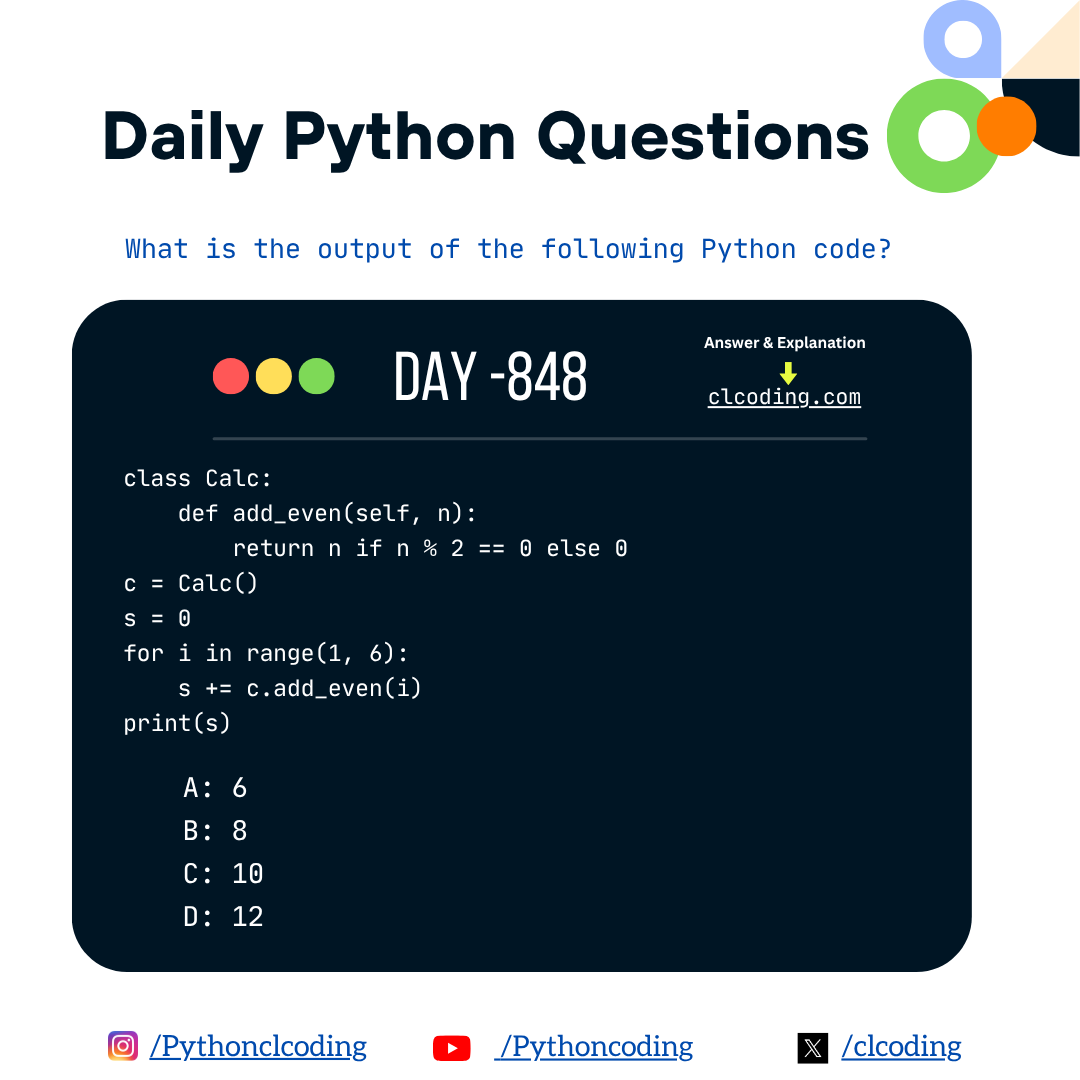
Python Coding challenge - Day 848| What is the output of the following Python Code?


Code Explanation:

1. Defining the Class
class Calc:

Creates a class named Calc.

A class acts as a blueprint to define objects and their behavior (methods).

2. Defining a Method
def add_even(self, n):
    return n if n % 2 == 0 else 0

Defines a method called add_even that takes one number n.

self refers to the object that will call this method.

The method uses a ternary operator:

If n is even → returns n

If n is odd → returns 0

3. Creating an Object
c = Calc()

Creates an object c of the Calc class.

This object can now call the add_even() method.

4. Initializing the Sum
s = 0

Initializes a variable s to 0.

This will store the sum of even numbers.

5. Looping from 1 to 5
for i in range(1, 6):
    s += c.add_even(i)

range(1, 6) generates numbers 1, 2, 3, 4, 5.

For each i, the method add_even(i) is called.

Only even numbers are added to s.

Step-by-step trace:

i c.add_even(i) s after addition
1 0 0
2 2 2
3 0 2
4 4 6
5 0 6

6. Printing the Result
print(s)

Prints the final accumulated sum of even numbers from 1 to 5.

Final Output
6


Python Coding challenge - Day 847| What is the output of the following Python Code?


Code Explanation:

1. Defining the Class

class A:

Creates a class named A.

A class acts as a blueprint for creating objects (instances).

2. Declaring a Class Variable

count = 0

count is a class variable, shared across all instances of class A.

Initially, A.count = 0.

3. Defining the Constructor

def __init__(self):

    A.count += 1

__init__ is the constructor, executed automatically when an object is created.

Each time a new object is created, A.count increases by 1.

This tracks how many objects have been created.

4. Loop to Create Objects

for i in range(3):

    a = A()

The loop runs 3 times (i = 0, 1, 2).

Each iteration creates a new object of class A, calling the constructor.

After each iteration, A.count increases:

Iteration Action A.count

1 new A() 1

2 new A() 2

3 new A() 3

Variable a always refers to the last object created.

5. Printing the Class Variable

print(A.count)

Accesses the class variable count directly through the class A.

Since 3 objects were created, A.count = 3.

Prints 3.

Final Output

3


Practical Deep Learning: Master PyTorch in 15 Days


Introduction

Deep learning is one of the most in-demand skills in tech right now — powering everything from image classification and natural language processing to recommendation systems and autonomous driving. The challenge for many learners is: how do you actually build, train and deploy deep learning models — especially if you're short on time or want a structured roadmap.

This course addresses that need by offering a 15-day roadmap to mastering PyTorch, one of the leading deep-learning frameworks. It targets learners who want a hands-on, project-based path rather than purely theoretical content.


Why This Course Matters

  • It gives you a clear timeline: 15 consecutive days of focused deep-learning work — which helps maintain momentum and avoids getting lost in sprawling content.

  • It emphasises practical, deployable projects: you don’t just learn what CNNs or transfer learning are — you use them to build real models (spam filter, image classifier, price predictor) that you can show.

  • It uses PyTorch — which is highly relevant, both in research and industry. Mastering PyTorch gives you a strong edge.

  • It includes not just model building, but also deployment (e.g., using Gradio for interactive applications). That means you move from prototype to something usable.

  • Because many deep-learning courses are either too theoretical (heavy maths) or too superficial (just “click and run”) this course strikes a balance: teaching you what you need, coding what you need, deploying what you need.


What You’ll Learn

Here’s a breakdown of how the 15-day path is typically structured (based on the syllabus) and what knowledge/skills you’ll acquire.

Days 1-2: Foundations of Neural Networks & PyTorch

  • Basics of tensors, neural network structure (neurons → layers → networks), forward propagation, loss functions.

  • Get familiar with PyTorch: tensors, autograd (automatic differentiation), building simple networks.

  • From those days, you’ll build the confidence to start modelling.

Days 3-6: Regression & Binary Classification Projects

  • Example projects: predicting used car prices (regression), spam detection in SMS (binary classification).

  • You’ll learn data preprocessing, train/test split, loss choice (MSE for regression, cross‐entropy for classification), basic network architecture design.

  • You’ll gain exposure to how to handle real data: preparation, feature handling, evaluation.

Days 7-10: Multi-Class Classification & Convolutional Neural Networks

  • Projects: classification of handwritten digits, fashion items (multi-class).

  • You’ll dive into convolutional neural networks (CNNs): understanding convolution, pooling, channels, image data pipelines.

  • Learn transfer learning: using pre-trained models (like ResNet) for new tasks to boost performance.

  • At this stage you’ll build more complex architectures and understand how deeper networks differ.

Days 11-14: Transfer Learning, Model Optimisation & Deployment

  • Deepen your knowledge of transfer learning: fine-tuning, freezing layers, data augmentation.

  • Model optimisation: choosing architectures, regularisation techniques, monitoring overfitting, evaluating performance.

  • Projects culminate in building a strong image classification model for a domain (e.g., a real-world dataset) using transfer learning.

Day 15: Deploying Your Model

  • Learn how to deploy models into an interactive application: e.g., using Gradio (or similar) for an end-user interface.

  • Packaging your model, creating web interface for predictions.

  • Final exam or project presentation to consolidate what you’ve built.


Who Should Take This Course?

This course is ideal for:

  • Learners with basic Python knowledge (loops, functions, lists/dictionaries) who want to move into deep learning.

  • Data analysts or developers who know some machine-learning fundamentals and now want to specialise in neural networks, image/text modelling and deployment.

  • Hobbyists or career-changers eager to build real projects in deep learning and add them to their portfolio.

  • If you are completely new to programming or highly inexperienced, you may need to spend extra time on Python basics—but the course starts from the ground up so it’s still accessible.


How to Get the Most Out of It

  • Code along every day: Because it’s a daily roadmap, try to follow the schedule strictly—complete each day’s content, build the project, run the code, tweak it.

  • Modify the projects: Don’t just run the example as is—change datasets, change architecture, add or remove layers, change hyperparameters. Experimenting helps you learn deeper.

  • Deploy early and often: Building a deployable model makes learning concrete. Even a simple interface is a strong addition to your portfolio.

  • Document your work: For each project, write what you did, what you changed, what results you got. This becomes your portfolio and helps you reflect.

  • Review difficult concepts: Some days might involve more complexity (CNNs, transfer learning). Pause if needed and review until you feel confident.

  • Use a decent hardware setup: While many tasks can be done on CPU, using GPU (local or cloud) will accelerate training and make experimentation more feasible.

  • Extend beyond the syllabus: After finishing the 15-day roadmap, pick one project of your own choosing (e.g., classify your own image dataset, predict stock prices with CNNs/RNNs) to reinforce and deepen learning.


What You’ll Walk Away With

By the end of the course you should be able to:

  • Build, train and evaluate neural networks in PyTorch—regression, binary classification, multi-class classification, image classification.

  • Understand and apply advanced techniques like CNNs, transfer learning, data augmentation, and deploy models for real-world usage.

  • Take the code you build, adapt it, build new projects and demonstrate competence in deep learning workflows.

  • Have at least several mini-projects in your portfolio (spam filter, image classifier, price predictor, deployed app) that you can show to employers or for personal use.

  • Be equipped to explore more advanced deep learning topics (e.g., sequence models, generative networks) with confidence.


Join Now: Practical Deep Learning: Master PyTorch in 15 Days

Conclusion

“Practical Deep Learning: Master PyTorch in 15 Days” is an excellent choice if you want a structured, hands-on path into deep learning with PyTorch. It provides a manageable timeframe, real projects, deployment experience and relevant skills—all of which are beneficial whether you’re up-skilling, transitioning or building your portfolio.

Popular Posts

Categories

100 Python Programs for Beginner (118) AI (159) Android (25) AngularJS (1) Api (6) Assembly Language (2) aws (27) Azure (8) BI (10) Books (254) Bootcamp (1) C (78) C# (12) C++ (83) Course (84) Coursera (299) Cybersecurity (28) Data Analysis (24) Data Analytics (16) data management (15) Data Science (223) Data Strucures (14) Deep Learning (72) Django (16) Downloads (3) edx (21) Engineering (15) Euron (30) Events (7) Excel (17) Finance (9) flask (3) flutter (1) FPL (17) Generative AI (48) Git (6) Google (47) Hadoop (3) HTML Quiz (1) HTML&CSS (48) IBM (41) IoT (3) IS (25) Java (99) Leet Code (4) Machine Learning (193) Meta (24) MICHIGAN (5) microsoft (9) Nvidia (8) Pandas (12) PHP (20) Projects (32) Python (1219) Python Coding Challenge (895) Python Quiz (346) Python Tips (5) Questions (2) R (72) React (7) Scripting (3) security (4) Selenium Webdriver (4) Software (19) SQL (45) Udemy (17) UX Research (1) web application (11) Web development (7) web scraping (3)

Followers

Python Coding for Kids ( Free Demo for Everyone)