Tuesday, 30 January 2024
Monday, 29 January 2024
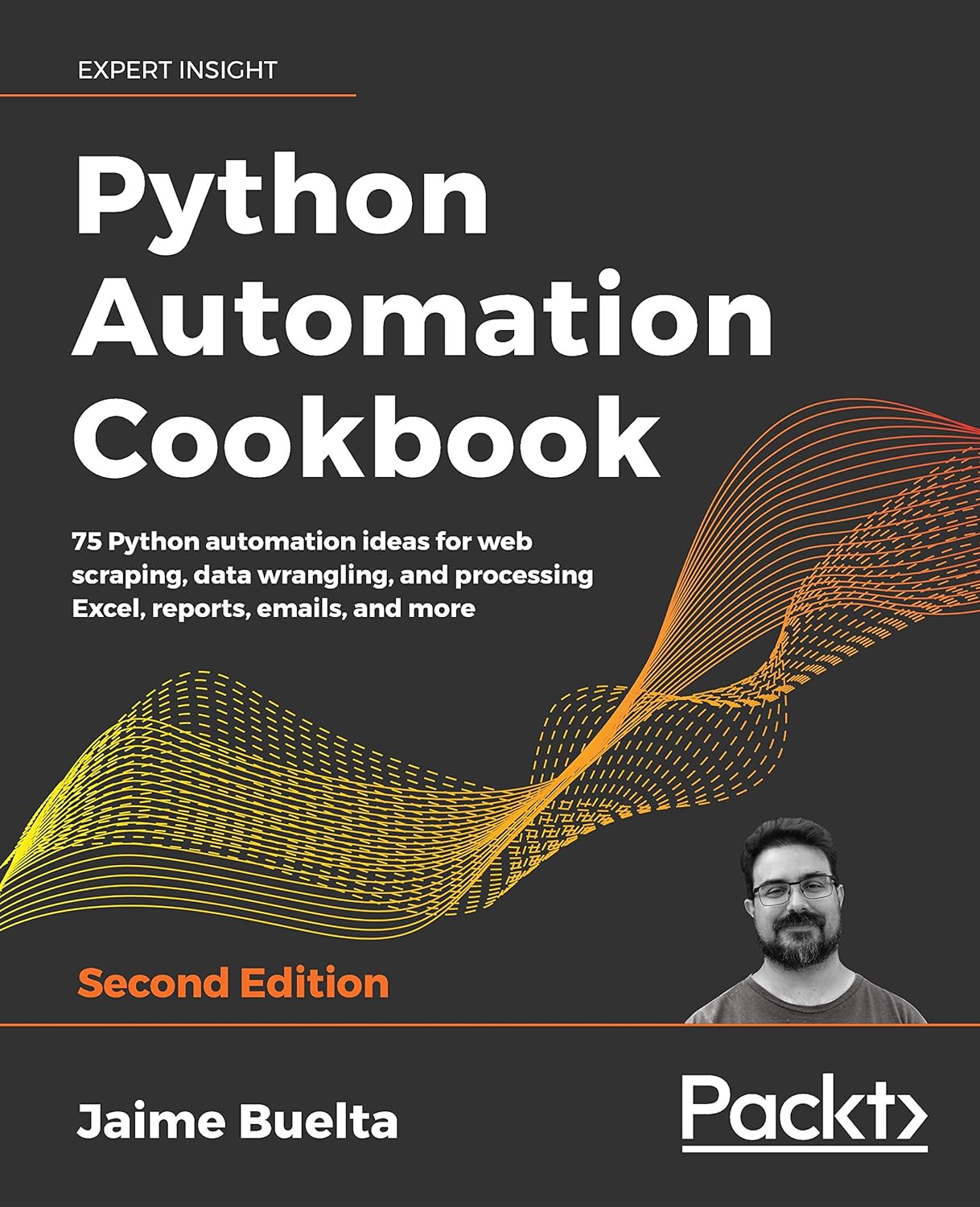
Python Automation Cookbook: 75 Python automation ideas for web scraping, data wrangling, and processing Excel, reports, emails, and more, 2nd Edition
Python Coding January 29, 2024 Books, Python No comments
Get a firm grip on the core processes including browser automation, web scraping, Word, Excel, and GUI automation with Python 3.8 and higher
Key Features
Automate integral business processes such as report generation, email marketing, and lead generation
Explore automated code testing and Python’s growth in data science and AI automation in three new chapters
Understand techniques to extract information and generate appealing graphs, and reports with Matplotlib
Book Description
In this updated and extended version of Python Automation Cookbook, each chapter now comprises the newest recipes and is revised to align with Python 3.8 and higher. The book includes three new chapters that focus on using Python for test automation, machine learning projects, and for working with messy data.
This edition will enable you to develop a sharp understanding of the fundamentals required to automate business processes through real-world tasks, such as developing your first web scraping application, analyzing information to generate spreadsheet reports with graphs, and communicating with automatically generated emails.
Once you grasp the basics, you will acquire the practical knowledge to create stunning graphs and charts using Matplotlib, generate rich graphics with relevant information, automate marketing campaigns, build machine learning projects, and execute debugging techniques.
By the end of this book, you will be proficient in identifying monotonous tasks and resolving process inefficiencies to produce superior and reliable systems.
What you will learn
Learn data wrangling with Python and Pandas for your data science and AI projects
Automate tasks such as text classification, email filtering, and web scraping with Python
Use Matplotlib to generate a variety of stunning graphs, charts, and maps
Automate a range of report generation tasks, from sending SMS and email campaigns to creating templates, adding images in Word, and even encrypting PDFs
Master web scraping and web crawling of popular file formats and directories with tools like Beautiful Soup
Build cool projects such as a Telegram bot for your marketing campaign, a reader from a news RSS feed, and a machine learning model to classify emails to the correct department based on their content
Create fire-and-forget automation tasks by writing cron jobs, log files, and regexes with Python scripting
Who this book is for
Python Automation Cookbook - Second Edition is for developers, data enthusiasts or anyone who wants to automate monotonous manual tasks related to business processes such as finance, sales, and HR, among others. Working knowledge of Python is all you need to get started with this book.
Table of Contents
Let's Begin Our Automation Journey
Automating Tasks Made Easy
Building Your First Web Scraping Application
Searching and Reading Local Files
Generating Fantastic Reports
Fun with Spreadsheets
Cleaning and Processing Data
Developing Stunning Graphs
Dealing with Communication Channels
Why Not Automate Your Marketing Campaign?
Machine Learning for Automation
Automatic Testing Routines
Debugging Techniques
Hard Copy : Python Automation Cookbook: 75 Python automation ideas for web scraping, data wrangling, and processing Excel, reports, emails, and more, 2nd Edition
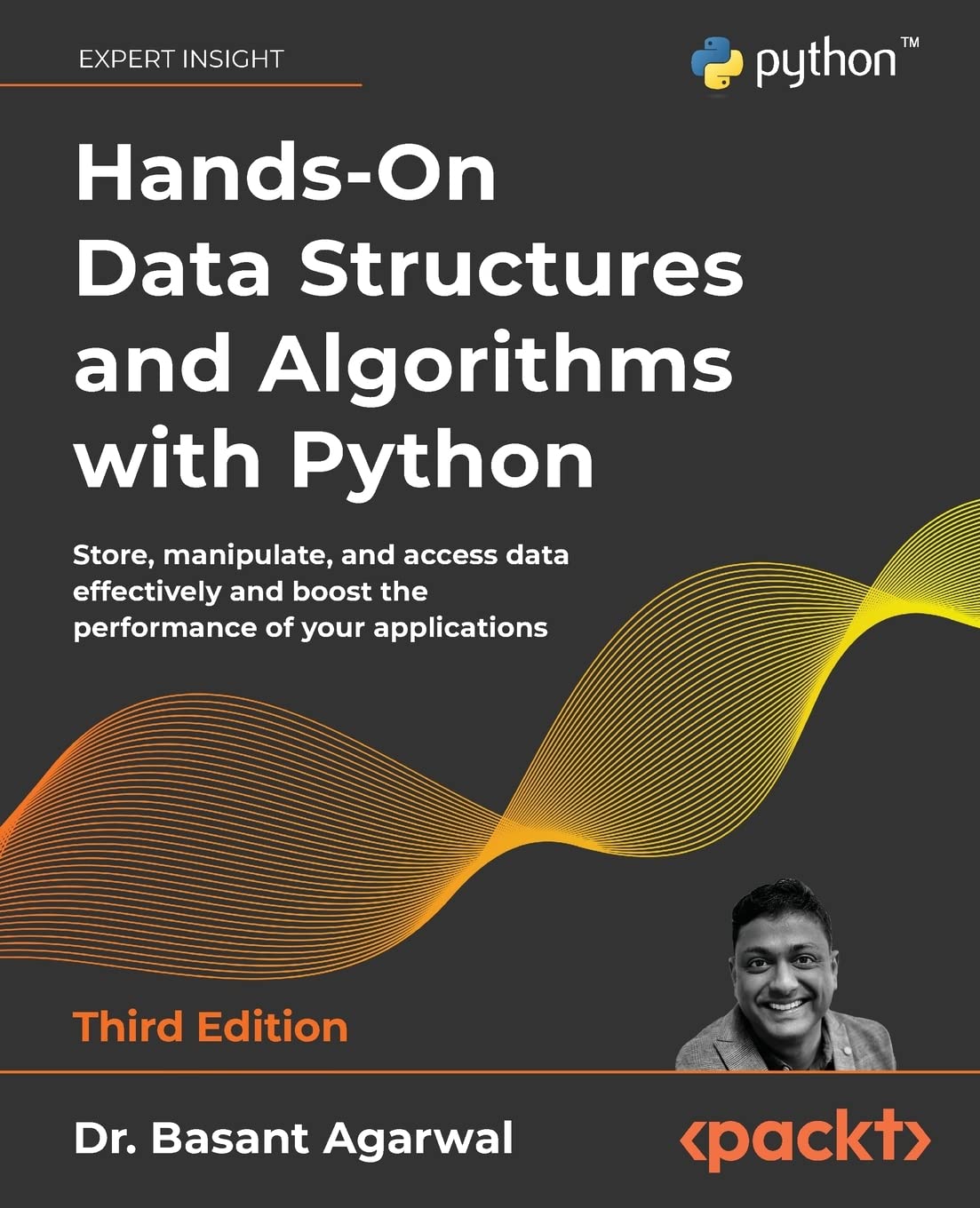
Hands-On Data Structures and Algorithms with Python: Store, manipulate, and access data effectively and boost the performance of your applications, 3rd Edition
Python Coding January 29, 2024 Books, Python No comments
Understand how implementing different data structures and algorithms intelligently can make your Python code and applications more maintainable and efficient
Key Features
Explore functional and reactive implementations of traditional and advanced data structures
Apply a diverse range of algorithms in your Python code
Implement the skills you have learned to maximize the performance of your applications
Book Description
Choosing the right data structure is pivotal to optimizing the performance and scalability of applications. This new edition of Hands-On Data Structures and Algorithms with Python will expand your understanding of key structures, including stacks, queues, and lists, and also show you how to apply priority queues and heaps in applications. You'll learn how to analyze and compare Python algorithms, and understand which algorithms should be used for a problem based on running time and computational complexity. You will also become confident organizing your code in a manageable, consistent, and scalable way, which will boost your productivity as a Python developer.
By the end of this Python book, you'll be able to manipulate the most important data structures and algorithms to more efficiently store, organize, and access data in your applications.
What you will learn
Understand common data structures and algorithms using examples, diagrams, and exercises
Explore how more complex structures, such as priority queues and heaps, can benefit your code
Implement searching, sorting, and selection algorithms on number and string sequences
Become confident with key string-matching algorithms
Understand algorithmic paradigms and apply dynamic programming techniques
Use asymptotic notation to analyze algorithm performance with regard to time and space complexities
Write powerful, robust code using the latest features of Python
Who this book is for
This book is for developers and programmers who are interested in learning about data structures and algorithms in Python to write complex, flexible programs. Basic Python programming knowledge is expected.
Table of Contents
Python Data Types and Structures
Introduction to Algorithm Design
Algorithm Design Techniques and Strategies
Linked Lists
Stacks and Queues
Trees
Heaps and Priority Queues
Hash Tables
Graphs and Algorithms
Searching
Sorting
Selection Algorithms
String Matching Algorithms
Appendix: Answers to the Questions
Hard Copy: Hands-On Data Structures and Algorithms with Python: Store, manipulate, and access data effectively and boost the performance of your applications, 3rd Edition
Mastering Python: Write powerful and efficient code using the full range of Python's capabilities, 2nd Edition
Python Coding January 29, 2024 Books, Python No comments
Use advanced features of Python to write high-quality, readable code and packages
Key Features
Extensively updated for Python 3.10 with new chapters on design patterns, scientific programming, machine learning, and interactive Python
Shape your scripts using key concepts like concurrency, performance optimization, asyncio, and multiprocessing
Learn how advanced Python features fit together to produce maintainable code
Book Description
Even if you find writing Python code easy, writing code that is efficient, maintainable, and reusable is not so straightforward. Many of Python's capabilities are underutilized even by more experienced programmers. Mastering Python, Second Edition, is an authoritative guide to understanding advanced Python programming so you can write the highest quality code. This new edition has been extensively revised and updated with exercises, four new chapters and updates up to Python 3.10.
Revisit important basics, including Pythonic style and syntax and functional programming. Avoid common mistakes made by programmers of all experience levels. Make smart decisions about the best testing and debugging tools to use, optimize your code's performance across multiple machines and Python versions, and deploy often-forgotten Python features to your advantage. Get fully up to speed with asyncio and stretch the language even further by accessing C functions with simple Python calls. Finally, turn your new-and-improved code into packages and share them with the wider Python community.
If you are a Python programmer wanting to improve your code quality and readability, this Python book will make you confident in writing high-quality scripts and taking on bigger challenges
What you will learn
Write beautiful Pythonic code and avoid common Python coding mistakes
Apply the power of decorators, generators, coroutines, and metaclasses
Use different testing systems like pytest, unittest, and doctest
Track and optimize application performance for both memory and CPU usage
Debug your applications with PDB, Werkzeug, and faulthandler
Improve your performance through asyncio, multiprocessing, and distributed computing
Explore popular libraries like Dask, NumPy, SciPy, pandas, TensorFlow, and scikit-learn
Extend Python's capabilities with C/C++ libraries and system calls
Who this book is for
This book will benefit more experienced Python programmers who wish to upskill, serving as a reference for best practices and some of the more intricate Python techniques. Even if you have been using Python for years, chances are that you haven't yet encountered every topic discussed in this book. A good understanding of Python programming is necessary
Table of Contents
Getting Started – One Environment per Project
Interactive Python Interpreters
Pythonic Syntax and Common Pitfalls
Pythonic Design Patterns
Functional Programming – Readability Versus Brevity
Decorators – Enabling Code Reuse by Decorating
Generators and Coroutines – Infinity, One Step at a Time
Metaclasses – Making Classes (Not Instances) Smarter
Documentation – How to Use Sphinx and reStructuredText
Testing and Logging – Preparing for Bugs
Debugging – Solving the Bugs
Performance – Tracking and Reducing Your Memory and CPU Usage
asyncio – Multithreading without Threads
Multiprocessing – When a Single CPU Core Is Not Enough
Scientific Python and Plotting
Artificial Intelligence
Extensions in C/C++, System Calls, and C/C++ Libraries
Packaging – Creating Your Own Libraries or Applications
Hard Copy : Mastering Python: Write powerful and efficient code using the full range of Python's capabilities, 2nd Edition
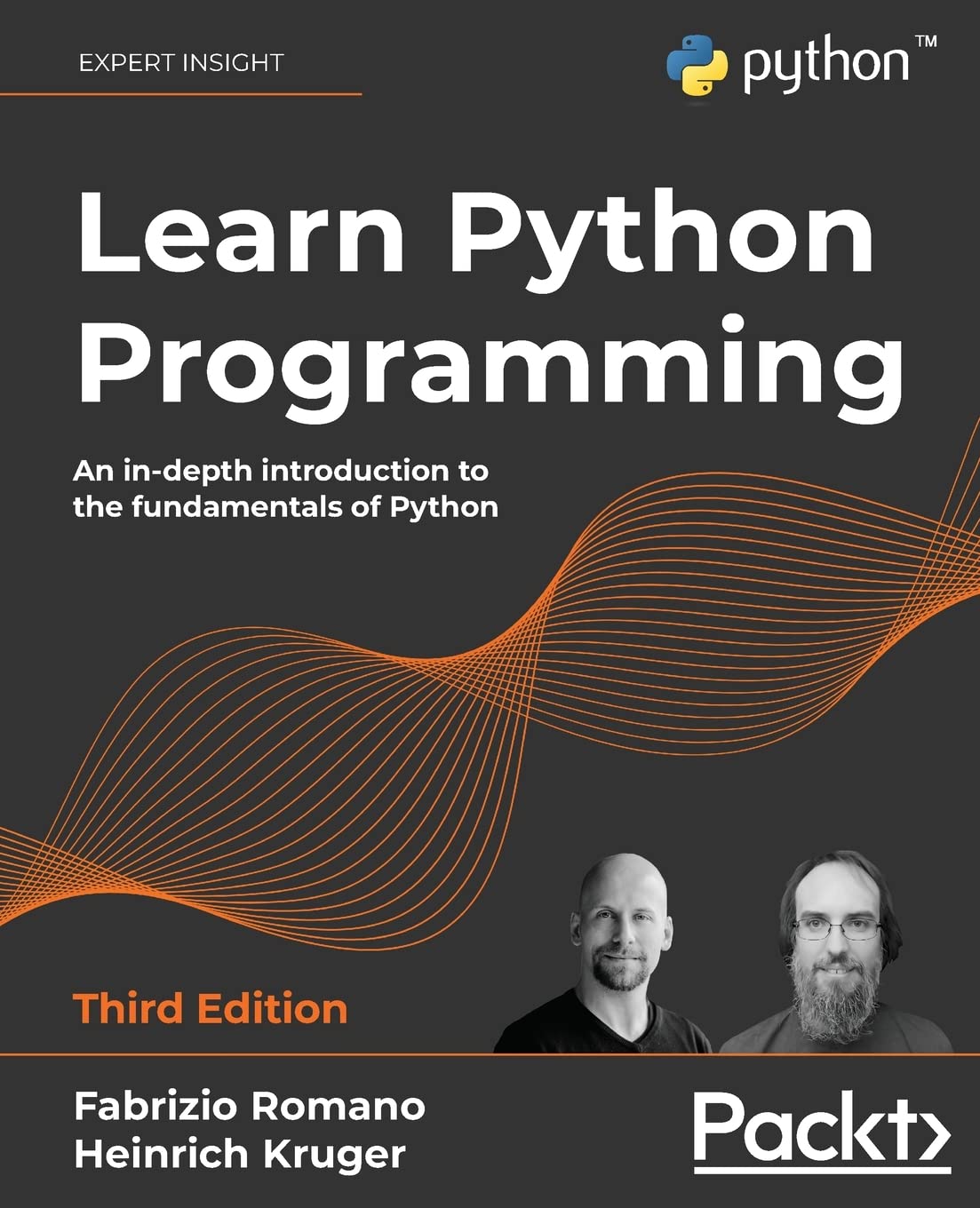
Learn Python Programming: An in-depth introduction to the fundamentals of Python, 3rd Edition
Python Coding January 29, 2024 Books, Python No comments
Get up and running with Python 3.9 through concise tutorials and practical projects in this fully updated third edition.
Purchase of the print or Kindle book includes a free eBook in PDF format.
Key Features
Extensively revised with richer examples, Python 3.9 syntax, and new chapters on APIs and packaging and distributing Python code
Discover how to think like a Python programmer
Learn the fundamentals of Python through real-world projects in API development, GUI programming, and data science
Book Description
Learn Python Programming, Third Edition is both a theoretical and practical introduction to Python, an extremely flexible and powerful programming language that can be applied to many disciplines. This book will make learning Python easy and give you a thorough understanding of the language. You'll learn how to write programs, build modern APIs, and work with data by using renowned Python data science libraries.
This revised edition covers the latest updates on API management, packaging applications, and testing. There is also broader coverage of context managers and an updated data science chapter.
The book empowers you to take ownership of writing your software and become independent in fetching the resources you need. You will have a clear idea of where to go and how to build on what you have learned from the book.
Through examples, the book explores a wide range of applications and concludes by building real-world Python projects based on the concepts you have learned.
What you will learn
Get Python up and running on Windows, Mac, and Linux
Write elegant, reusable, and efficient code in any situation
Avoid common pitfalls like duplication, complicated design, and over-engineering
Understand when to use the functional or object-oriented approach to programming
Build a simple API with FastAPI and program GUI applications with Tkinter
Get an initial overview of more complex topics such as data persistence and cryptography
Fetch, clean, and manipulate data, making efficient use of Python’s built-in data structures
Who this book is for
This book is for everyone who wants to learn Python from scratch, as well as experienced programmers looking for a reference book. Prior knowledge of basic programming concepts will help you follow along, but it’s not a prerequisite.
Table of Contents
A Gentle Introduction to Python
Built-In Data Types
Conditionals and Iteration
Functions, the Building Blocks of Code
Comprehensions and Generators
OOP, Decorators, and Iterators
Exceptions and Context Managers
Files and Data Persistence
Cryptography and Tokens
Testing
Debugging and Profiling
GUIs and Scripting
Data Science in Brief
Introduction to API Development
Packaging Python Applications
Hard Copy : Learn Python Programming: An in-depth introduction to the fundamentals of Python, 3rd Edition
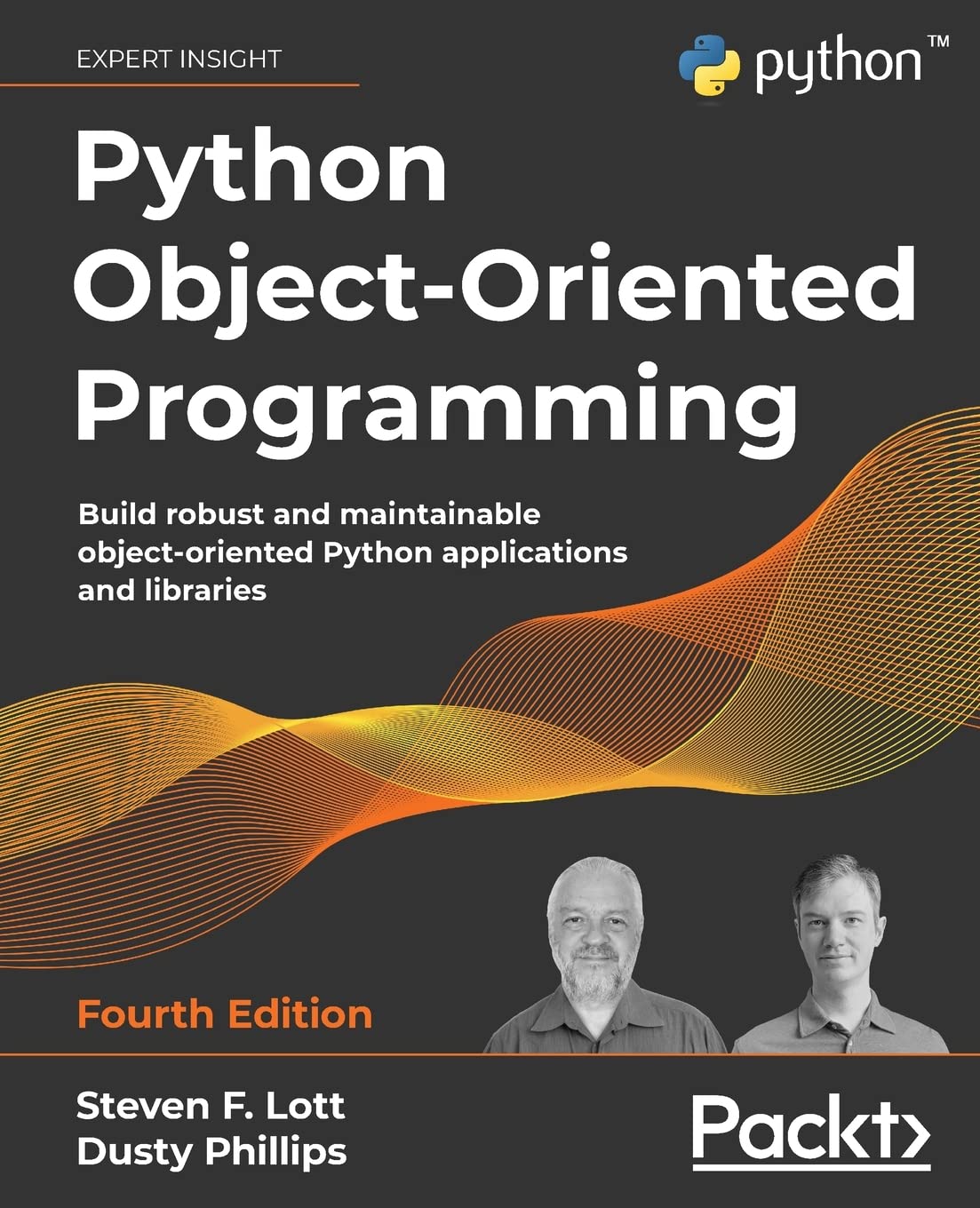
Python Object-Oriented Programming: Build robust and maintainable object-oriented Python applications and libraries, 4th Edition
Python Coding January 29, 2024 Books, Python No comments
A comprehensive guide to exploring modern Python through data structures, design patterns, and effective object-oriented techniques
Key Features
Build an intuitive understanding of object-oriented design, from introductory to mature programs
Learn the ins and outs of Python syntax, libraries, and best practices
Examine a machine-learning case study at the end of each chapter
Book Description
Object-oriented programming (OOP) is a popular design paradigm in which data and behaviors are encapsulated in such a way that they can be manipulated together. Python Object-Oriented Programming, Fourth Edition dives deep into the various aspects of OOP, Python as an OOP language, common and advanced design patterns, and hands-on data manipulation and testing of more complex OOP systems. These concepts are consolidated by open-ended exercises, as well as a real-world case study at the end of every chapter, newly written for this edition. All example code is now compatible with Python 3.9+ syntax and has been updated with type hints for ease of learning.
Steven and Dusty provide a comprehensive, illustrative tour of important OOP concepts, such as inheritance, composition, and polymorphism, and explain how they work together with Python's classes and data structures to facilitate good design. In addition, the book also features an in-depth look at Python's exception handling and how functional programming intersects with OOP. Two very powerful automated testing systems, unittest and pytest, are introduced. The final chapter provides a detailed discussion of Python's concurrent programming ecosystem.
By the end of the book, you will have a thorough understanding of how to think about and apply object-oriented principles using Python syntax and be able to confidently create robust and reliable programs.
What you will learn
Implement objects in Python by creating classes and defining methods
Extend class functionality using inheritance
Use exceptions to handle unusual situations cleanly
Understand when to use object-oriented features, and more importantly, when not to use them
Discover several widely used design patterns and how they are implemented in Python
Uncover the simplicity of unit and integration testing and understand why they are so important
Learn to statically type check your dynamic code
Understand concurrency with asyncio and how it speeds up programs
Who this book is for
If you are new to object-oriented programming techniques, or if you have basic Python skills and wish to learn how and when to correctly apply OOP principles in Python, this is the book for you. Moreover, if you are an object-oriented programmer coming from other languages or seeking a leg up in the new world of Python, you will find this book a useful introduction to Python. Minimal previous experience with Python is necessary.
Table of Contents
Object-Oriented Design
Objects in Python
When Objects Are Alike
Expecting the Unexpected
When to Use Object-Oriented Programming
Abstract Base Classes and Operator Overloading
Python Data Structures
The Intersection of Object-Oriented and Functional Programming
Strings, Serialization, and File Paths
The Iterator Pattern
Common Design Patterns
Advanced Design Patterns
Testing Object-Oriented Programs
Concurrency
Hard Copy: Python Object-Oriented Programming: Build robust and maintainable object-oriented Python applications and libraries, 4th Edition
Sunday, 28 January 2024
Coding for Kids: Python: Learn to Code with 50 Awesome Games and Activities
Python Coding January 28, 2024 Books, Python No comments
Games and activities that teach kids ages 10+ to code with Python
Learning to code isn't as hard as it sounds—you just have to get started! Coding for Kids: Python starts kids off right with 50 fun, interactive activities that teach them the basics of the Python programming language. From learning the essential building blocks of programming to creating their very own games, kids will progress through unique lessons packed with helpful examples—and a little silliness!
Kids will follow along by starting to code (and debug their code) step by step, seeing the results of their coding in real time. Activities at the end of each chapter help test their new knowledge by combining multiple concepts. For young programmers who really want to show off their creativity, there are extra tricky challenges to tackle after each chapter. All kids need to get started is a computer and this book.
This beginner's guide to Python for kids includes:
50 Innovative exercises—Coding concepts come to life with game-based exercises for creating code blocks, drawing pictures using a prewritten module, and more.
Easy-to-follow guidance—New coders will be supported by thorough instructions, sample code, and explanations of new programming terms.
Engaging visual lessons—Colorful illustrations and screenshots for reference help capture kids' interest and keep lessons clear and simple.
Encourage kids to think independently and have fun learning an amazing new skill with this coding book for kids.
Hard Copy : Coding for Kids: Python: Learn to Code with 50 Awesome Games and Activities
Sprial Bound : Coding for Kids: Python: Learn to Code with 50 Awesome Games and Activities [Spiral-bound] Adrienne Tacke
PDF : Coding for Kids: Python: Learn to Code with 50 Awesome Games and Activities [Spiral-bound] Adrienne Tacke
Saturday, 27 January 2024
Image Processing in Python using Pillow
Python Coding January 27, 2024 Python No comments
Image Processing in Python
#original Image
1. Image Resizing:
2. Image Rotation with Pillow:
3. Image Translation (using crop) with Pillow:
4. Image Shearing (using affine transform) with Pillow:
5. Image Normalization (simple contrast adjustment) with Pillow:
6. Image Blurring (using a filter) with Pillow:
Google Project Management: Professional Certificate
Python Coding January 27, 2024 Coursera, Google No comments
What you'll learn
Gain an immersive understanding of the practices and skills needed to succeed in an entry-level project management role
Learn how to create effective project documentation and artifacts throughout the various phases of a project
Learn the foundations of Agile project management, with a focus on implementing Scrum events, building Scrum artifacts, and understanding Scrum roles
Practice strategic communication, problem-solving, and stakeholder management through real-world scenarios
Join Free:
Professional Certificate - 6 course series
Join FREE : Google Project Management: Professional Certificate
10 different data charts using Python
Python Coding January 27, 2024 Data Science, Python No comments
# 10 different data charts using Python
Friday, 26 January 2024
Build Your Own Programming Language: A programmer's guide to designing compilers, DSLs and interpreters for solving modern computing problems, 2nd Edition
Python Coding January 26, 2024 Books No comments
Written by the creator of the Unicon programming language, this book will show you how to implement programming languages to reduce the time and cost of creating applications for new or specialized areas of computing.
Key Features
- Solve pain points in your application domain by building a custom programming language
- Learn how to create parsers, code generators, semantic analyzers, and interpreters
- Target bytecode, native code, and preprocess or transpile code into another high level language
Book Description
The need for different types of computer languages is growing, as is the need for domain-specific languages. Building your own programming language has its advantages, as it can be your antidote to the ever-increasing complexity of software.
In this book, you'll start with implementing the frontend of a compiler for your language, including a lexical analyzer and parser, including the handling of parse errors. The book then covers a series of traversals of syntax trees, culminating with code generation for a bytecode virtual machine or native code. You’ll also manage data structures and output code when writing a preprocessor or a transpiler.
Moving ahead, you'll learn how domain-specific language features are often best represented by operators and functions that are built into the language, rather than library functions. We'll conclude with how to implement garbage collection. Throughout the book, Dr. Jeffery weaves in his experience from building the Unicon programming language to give better context to the concepts. Relevant examples are provided in Unicorn and Java so that you can follow the code of your choice. In this edition, code examples have been extended and further tested.
By the end of this book, you'll be able to build and deploy your own domain-specific languages, capable of compiling and running programs.
What you will learn
- Perform requirements analysis for the new language and design language syntax and semantics
- Write lexical and context-free grammar rules for common expressions and control structures
- Develop a scanner that reads source code and generate a parser that checks syntax
- Build key data structures in a compiler and use your compiler to build a syntax-coloring code editor
- Write tree traversals that insert information into the syntax tree
- Implement a bytecode interpreter and run bytecode generated by your compiler
- Write native code and run it after assembling and linking using system tools
- Preprocess and transpile code from your language into another high level language
- Implement garbage collection in your language
Who This Book Is For
This book is for software developers interested in the idea of inventing their own language or developing a domain-specific language. Computer science students taking compiler construction courses will also find this book highly useful as a practical guide to language implementation to supplement more theoretical textbooks. We assume most readers will have intermediate or better proficiency in a high level programming language such as Java or C++.
Table of Contents
- Why Build Another Programming Language?
- Programming Language Design
- Scanning Source Code
- Parsing
- Syntax Trees
- Symbol Tables
- Checking Base Types
- Checking Types on Function Calls and Structure Accesses
- Intermediate Code Generation
- Syntax Coloring in an IDE
- Preprocessors and Transpilers
- Bytecode Interpreters
- Generating Bytecode
- Native Code Generation
- Built in Operators and Functions
- Control Structures
Hard Copy : Build Your Own Programming Language: A programmer's guide to designing compilers, DSLs and interpreters for solving modern computing problems, 2nd Edition
How much do you know about functional programming in Python?
Python Coding January 26, 2024 Python Coding Challenge No comments
a. lambda function cannot be used with reduce( ) function.
Answer
False
b. lambda, map( ), filter( ), reduce( ) can be combined in one single
expression.
Answer
True
c. Though functions can be assigned to variables, they cannot be called
using these variables.
Program
False
d. Functions can be passed as arguments to function and returned from
function.
Program
True
e. Functions can be built at execution time, the way lists, tuples, etc. can
be.
Program
True
f. Lambda functions are always nameless.
Program
True
Thursday, 25 January 2024
DevOps on AWS: Release and Deploy
Python Coding January 25, 2024 aws, Coursera No comments
Build your subject-matter expertise
This course is part of the DevOps on AWS Specialization
When you enroll in this course, you'll also be enrolled in this Specialization.
Learn new concepts from industry experts
Gain a foundational understanding of a subject or tool
Develop job-relevant skills with hands-on projects
Earn a shareable career certificate
Join Free: DevOps on AWS: Release and Deploy
There are 2 modules in this course
DevOps on AWS: Operate and Monitor
Python Coding January 25, 2024 aws, Coursera No comments
Build your subject-matter expertise
This course is part of the DevOps on AWS Specialization
When you enroll in this course, you'll also be enrolled in this Specialization.
Learn new concepts from industry experts
Gain a foundational understanding of a subject or tool
Develop job-relevant skills with hands-on projects
Earn a shareable career certificate
Join Free: DevOps on AWS: Operate and Monitor
There are 2 modules in this course
Exam Prep: AWS Certified Cloud Practitioner Foundations
Python Coding January 25, 2024 aws, Coursera No comments
What you'll learn
The four domains - Cloud Concepts, Security and Compliance, Technology and Billing and Pricing - for the AWS Certified Cloud Practitioner exam
Certification exam-level practice questions written by experts from AWS
Simulations designed to solidify understanding of cloud concepts you need to know for the exam
Join Free: Exam Prep: AWS Certified Cloud Practitioner Foundations
There are 4 modules in this course
Popular Posts
-
📘 Introduction If you’re passionate about learning Python — one of the most powerful programming languages — you don’t need to spend a f...
-
Why Probability & Statistics Matter for Machine Learning Machine learning models don’t operate in a vacuum — they make predictions, un...
-
Code Explanation: 1. Class Definition: class X class X: Defines a new class named X. This class will act as a base/parent class. 2. Method...
-
How This Modern Classic Teaches You to Think Like a Computer Scientist Programming is not just about writing code—it's about developi...
-
Introduction Machine learning is ubiquitous now — from apps and web services to enterprise automation, finance, healthcare, and more. But ...
-
✅ Actual Output [10 20 30] Why didn’t the array change? Even though we write: i = i + 5 👉 This DOES NOT modify the NumPy array . What re...
-
In a world where data is everywhere and machine learning (ML) is becoming central to many industries — from finance to healthcare to e‑com...
-
Learning Machine Learning and Data Science can feel overwhelming — but with the right resources, it becomes an exciting journey. At CLC...
-
Code Explanation: 1. Class Definition class Item: A class named Item is created. It will represent an object that stores a price. 2. Initi...
-
Line-by-Line Explanation ✅ 1. Dictionary Created d = {"x": 5, "y": 15} A dictionary with: Key "x" → Val...


.png)