Wednesday, 3 December 2025

AI Mastery Bootcamp: Complete Guide with 1000 Projects


As AI becomes more integrated into industries, demand is rising for engineers who don’t just know theory — but can build, deploy, and maintain real AI systems end to end. The AI Mastery Bootcamp promises exactly that: a structured, comprehensive path from foundational skills to production-ready AI applications, using modern tools and real-world projects. It’s designed to take a learner from zero (or minimal background) to an AI-ready skill set at the end — which makes it attractive for beginners, learners transitioning fields, or anyone wanting a broad and practical introduction to AI engineering. 


What You Learn: Topics, Tools & Projects

Here’s a breakdown of the main skills and topics covered in the bootcamp:

  • Core Python & Data Preprocessing — You begin with Python programming and learn how to clean, process, and prepare data — a foundational skill for any AI/ML pipeline. 

  • Machine Learning Fundamentals — Classification, regression, clustering, evaluation metrics, data splitting — building a solid ML foundation before deep learning. 

  • Deep Learning & Neural Networks — You move into deep learning: neural networks, potentially advanced architectures, and deep learning workflows. 

  • NLP, Computer Vision, & Real-World AI Tasks — Depending on course modules, the bootcamp also includes NLP (working with text), computer vision, and probably other real-world AI applications. 

  • Use of Industry-Standard Frameworks — You’ll work with popular AI/ML frameworks and libraries (for example: TensorFlow, PyTorch, etc.) to build and train models. 

  • End-to-End Workflow: Build → Train → Deploy — The bootcamp doesn’t stop at model building; it also touches upon deploying models (e.g. via APIs), containerization (e.g. using Docker), model maintenance and lifecycle — making you familiar with production-grade AI workflows. 

  • Portfolio Through Projects — As the name suggests, the bootcamp emphasizes “real-world AI projects” — giving you hands-on practice and a portfolio that can show prospective employers or collaborators. 

In short — the bootcamp aims to cover the full AI pipeline: from raw data and preprocessing, through ML/DL modeling, to deployment and maintenance.


Who Should Take This Bootcamp — Who Benefits Most

This course is particularly well-suited for:

  • Beginners or intermediate learners who want a comprehensive, all-in-one AI education rather than scattered tutorials.

  • Software developers or engineers who know programming (or are willing to learn) and want to pivot into AI/ML.

  • Students or self-learners who want hands-on experience and a solid portfolio of AI projects — ideal if you plan to apply for jobs or freelance AI work.

  • People interested in full-cycle AI development: not just building models, but deploying, maintaining, and working with AI as part of real systems.

  • Those who prefer project-based and practical learning rather than purely theoretical or math-heavy courses.


What to Keep in Mind — Realistic Expectations & Prerequisites

  • While the bootcamp claims to be comprehensive, expect a significant workload — building full-stack AI skills (from data to deployment) takes time, dedication, and consistent practice.

  • Basic math and programming familiarity helps: even though it starts from scratch, understanding ML/AI well often requires comfort with concepts like matrices, vectors, data structures — so be ready to put in effort. 

  • Real-world projects are great for learning — but real industry-level problems are often more complex. The course gives a foundation; mastering edge-cases and scalable systems may require additional learning or real-world experience.

  • AI is a vast field: this bootcamp gives breadth; for deep specialization (say in NLP research, advanced computer vision, or cutting-edge deep learning), you may later want to supplement with specialized courses or self-study.


How This Bootcamp Could Shape Your AI Journey

If you complete it earnestly, this bootcamp can:

  • Give you hands-on skills to build, train, and deploy AI/ML models.

  • Help you build a project portfolio — very useful for job applications, freelance work, or personal projects.

  • Provide a foundation to branch into specialized fields — after learning the basics, you can explore advanced topics like generative AI, reinforcement learning, or big-data ML.

  • Make you capable of full-cycle AI engineering — from data processing to production deployment, a skill set increasingly in demand in industry.

  • Build confidence to learn independently — once you understand the full pipeline, picking up new tools or frameworks becomes much easier.


Join Now: AI Mastery Bootcamp: Complete Guide with 1000 Projects

Conclusion

The AI Mastery Bootcamp: Complete Guide with 1000 Projects offers a compelling and practical path into the world of AI engineering. It blends foundational learning, hands-on projects, and production-oriented workflows — making it ideal for anyone serious about building real-world AI skills.

If you’re at the beginning of your AI journey (or looking to deepen and structure your learning), and are ready to commit time and effort, this bootcamp can serve as a powerful launchpad.

Python Coding challenge - Day 886| What is the output of the following Python Code?


Code Explanation:

1. Class Definition
class Data:

You define a class named Data.
A class is a blueprint for creating objects that can hold data and behavior.

2. Constructor (__init__)
    def __init__(self, v):
        self.v = v

__init__ is the constructor that runs when a new Data object is created.

It accepts a parameter v and assigns it to the instance attribute self.v.

After this, every Data instance stores its value in v.

3. __repr__ Magic Method
    def __repr__(self):
        return f"<<{self.v}>>"

__repr__ is a special (magic) method that returns the “official” string representation of the object.

When you inspect the object in the REPL or use print() (if __str__ is not defined), Python will use __repr__.

This implementation returns a formatted string <<value>>, inserting the instance’s v value into the template.

4. Creating an Instance
d = Data(8)

This creates an instance d of class Data with v = 8.

The constructor stores 8 in d.v.

5. Printing the Object
print(d)

print(d) tries to convert d to a string. Because Data defines __repr__ (and no __str__), Python uses __repr__.

The __repr__ method returns the string "<<8>>", which print outputs.

Final Output
<<8>>

Python Coding challenge - Day 885| What is the output of the following Python Code?


Code Explanation:

1. Class Definition
class Box:

Defines a new class named Box — a blueprint for creating Box objects that will hold a value n and expose a computed property.

2. Constructor
    def __init__(self, n):
        self._n = n

__init__ is the constructor; it runs when you create a Box instance.

The parameter n is passed in when constructing the object.

self._n = n stores n in the instance attribute _n. By convention the single underscore (_n) signals a “protected” attribute (meant for internal use), but it is still accessible from outside.

3. Property Definition
    @property
    def triple(self):
        return self._n * 3

@property turns the triple() method into a read-only attribute called triple.

When you access b.triple, Python calls this method behind the scenes.

return self._n * 3 computes and returns three times the stored value _n. This does not change _n — it only computes a value based on it.

4. Creating an Instance
b = Box(6)

Creates a Box object named b, passing 6 to the constructor.

Inside __init__, self._n is set to 6.

5. Accessing the Property and Printing
print(b.triple)

Accessing b.triple invokes the triple property method, which computes 6 * 3 = 18.

print outputs the returned value.

Final Output
18

Python Coding Challenge - Question with Answer (ID -041225)


Line-by-Line Explanation

✅ 1. Dictionary Created

d = {"x": 5, "y": 15}
  • A dictionary with:

    • Key "x" → Value 5

    • Key "y" → Value 15


✅ 2. Initialize Sum Variable

s = 0
  • s will store the final total.


✅ 3. Loop Through Values

for v in d.values():
  • .values() returns only the values:

    5, 15

✅ 4. Conditional Addition (Ternary If-Else)

s += v if v > 10 else 2

This means:

  • If v > 10 → add v

  • Else → add 2


Loop Execution

IterationvCondition v > 10Added to sNew s
1st5❌ False+22
2nd15✅ True+1517

✅ 5. Final Output

print(s)

Output:

17

Key Concepts Used

✅ Dictionary
✅ Loop
✅ .values()
✅ Ternary if-else
✅ Accumulator variable

AUTOMATING EXCEL WITH PYTHON

Tuesday, 2 December 2025

Deep Learning in Computational Mechanics: An Introductory Course


Why This Book — and Why Computational Mechanics Matters

Computational mechanics is an area at the heart of engineering, physics, and materials science. Whether modeling stresses in a bridge, fluid flow around an aircraft wing, or deformations in biological tissues, computational mechanics helps engineers predict real-world behavior. Traditionally, these analyses rely on physics-based models, numerical methods (like finite element analysis), and substantial domain expertise.

But as deep learning advances, a new approach is emerging: using neural networks and data-driven models to accelerate, augment, or replace traditional simulations. This shift can result in faster simulations, data-driven approximations, and hybrid methods combining physics and learning. That’s where “Deep Learning in Computational Mechanics: An Introductory Course” becomes relevant — by offering a bridge between classical engineering modeling and modern machine-learning techniques.

If you’re an engineer, researcher, or student curious about how AI can reshape traditional simulation-based work, this book aims to open that path.


What the Book Covers: Main Themes & Scope

This book acts as both a gentle introduction to deep learning for engineers and a specialized guide to applying these methods within computational mechanics. Here’s a breakdown of what readers can expect:

1. Foundations: From Classical Mechanics to Data-Driven Methods

The book begins by revisiting fundamental mechanical principles — continuum mechanics, stress/strain relationships, governing equations. This ensures that readers who come from engineering or physics backgrounds (or even those new to mechanics) have a grounding before diving into data-driven approaches.

Then, the book introduces the rationale for blending traditional models with data-driven approaches. It explains where classical mechanics may be limited (complex geometries, computational cost, nonlinearity, real-world uncertainties), and how deep learning can help — for instance in surrogate modeling, approximation of constitutive relations, or speeding up simulations.

2. Deep Learning Basics (Tailored for Mechanics)

Rather than assuming you are already expert in deep learning, the book guides you through core concepts: neural networks, architectures (feedforward, convolutional, maybe recurrent or other relevant variants), training procedures, loss functions — all in the context of mechanical modeling.

By grounding these ML basics in mechanics-related tasks, the book helps bridge two distinct domains — making it easier for mechanical engineers or scientists to understand how ML maps onto their traditional workflows.

3. Application — Neural Networks for Mechanics Problems

One of the most valuable parts of the book is how it demonstrates concrete use cases: using neural networks to approximate stress-strain relationships, to predict deformation under load, or to serve as surrogate models for computationally expensive simulations.

Rather than toy examples, these applications are often closer to real-world problems, showing the reader how to structure data, design network architectures, evaluate performance, and interpret results meaningfully in a mechanical context.

4. Hybrid Methods: Combining Physics & Learning

Pure data-driven models can be powerful — but combining them with physics-based insights often yields the best results. The book explores hybrid approaches: embedding physical constraints into the learning process, using prior knowledge to regularize models, or leveraging data-driven components to accelerate parts of the simulation while retaining physical integrity.

This hybrid mindset is increasingly important in engineering domains: you don’t abandon physics, but you enhance it with data and learning.

5. Practical Workflow & Implementation Guidance

Beyond theory, the book aims to guide you through an end-to-end workflow: preparing datasets (e.g. simulation data, experimental data), preprocessing input (meshes, geometry, boundary conditions), training neural networks, validating models, and integrating predictions back into a mechanical simulation environment.

This helps bridge the often-crucial gap between academic exposition and real-world implementation.


Who This Book Is For — And Who Will Benefit Most

This book is especially useful if you are:

  • A mechanical or civil engineer curious about ML-based modeling

  • A researcher in applied mechanics or materials science exploring surrogate modeling or data-driven constitutive laws

  • A data scientist or ML engineer interested in domain adaptation — applying ML outside standard “data science” fields

  • A graduate student or academic exploring computational mechanics and modern modeling techniques

  • Anyone with basic familiarity of mechanics equations and some programming experience who wants to explore deep learning in engineering

Importantly, while some exposure to either mechanics or programming helps, the book seems structured to be approachable by learners from different backgrounds — whether you come from traditional engineering or from ML/data science.


Why This Book Stands Out — Its Strengths

Bridging Two Worlds

Few books straddle the gap so directly: combining mechanics, numerical modeling, and deep learning. That makes this book especially valuable for interdisciplinary learners or professionals.

Practical & Applied Focus

Instead of staying purely theoretical, the book emphasizes real-world applications, workflows, and challenges. This gives readers a realistic sense of what adopting ML for mechanics entails — data prep, model validation, integration, and interpretation.

Encourages Hybrid Methods, Not Dogma

The book doesn’t advocate abandoning physics-based models altogether. Instead, it promotes hybrid methods that leverage both data-driven flexibility and physical laws — often the most practical approach in complex engineering domains.

Accessible to Came-from-Anywhere Learners

Whether you come from a mechanical engineering background or from data science/ML, the book tries to bring both camps up to speed. This makes it inclusive and suitable for cross-disciplinary collaboration.


What to Keep in Mind — Limitations & Challenges

  • Learning Curve: If you have little background in mechanics and deep learning, you may need extra effort to absorb both domains.

  • Data Requirements: High-quality mechanical simulations or experimental data may be needed to train effective models — not always easy to obtain.

  • Model Interpretability & Reliability: As with any data-driven method in critical domains, it's important to validate results carefully. Neural networks may not inherently guarantee physical constraints or generalizability across very different scenarios.

  • Computational Cost for Training: While the goal may be to speed up simulations, training neural networks (especially complex ones) may itself require significant compute resources.

  • Domain-specific Challenges: Meshes, geometry, boundary conditions — typical of computational mechanics — add complexity compared to standard ML datasets (like images or tabular data). Applying ML to these domains often needs custom handling or engineering.


How Reading This Book Could Shape Your Career or Research

  • Modernize engineering workflows — By integrating ML-based surrogate models, you could greatly speed up design iterations, simulations, or analysis.

  • Pioneer hybrid modeling approaches — For research projects or complex systems where physics is incomplete or data is noisy, combining physics + learning could yield better performance or new insights.

  • Expand into interdisciplinary work — If you come from engineering and want to enter the ML world, or from ML and want to apply to engineering, this book offers a bridge.

  • Build a portfolio/project base — Through the end-to-end examples and implementations, you can build tangible projects that showcase your ability to blend ML with mechanics — a rare and desirable skill set.

  • Stay ahead in evolving fields — As industry shifts toward digital twins, AI-driven simulation, and data-augmented engineering, familiarity with ML-in-mechanics may become increasingly relevant.


Hard Copy: Deep Learning in Computational Mechanics: An Introductory Course

Conclusion

“Deep Learning in Computational Mechanics: An Introductory Course” is a timely and ambitious effort to bring together the rigor of classical mechanics with the flexibility and power of deep learning. For those willing to traverse both domains, it offers valuable insight, practical workflows, and a clear pathway toward building hybrid, data-driven engineering tools.

Fundamentals of Probability and Statistics for Machine Learning


Why Probability & Statistics Matter for Machine Learning

Machine learning models don’t operate in a vacuum — they make predictions, uncover patterns, or draw inferences from data. And data is almost always uncertain, noisy, or incomplete. Understanding probability and statistics is critical because:

  • It helps quantify uncertainty and variation in data.

  • It enables sound decisions when dealing with real-world data rather than ideal data.

  • Many ML algorithms (e.g. Bayesian models, probabilistic models, statistical tests) are grounded in statistical principles.

  • It gives you the tools to evaluate model performance, avoid overfitting/underfitting, and validate results in a robust way.

Thus, a strong grounding in probability and statistics can significantly improve your skill as an ML practitioner—not just in coding models, but building reliable, robust, and well-justified solutions.

That’s precisely why a book like Fundamentals of Probability and Statistics for Machine Learning is valuable.


What the Book Offers: Core Themes & Structure

This book provides a comprehensive foundation in probability theory and statistical methods, tailored specifically with machine learning applications in mind. Key themes include:

Probability Theory & Random Variables

You learn about the basics of probability: how to think about events, random variables, distributions, and the mathematics behind them. This sets the stage for understanding randomness and uncertainty in data.

Descriptive Statistics & Data Summarization

The book walks you through summarizing data — measures of central tendency (mean, median, mode), spread (variance, standard deviation), and other descriptive tools. These are essential for understanding data distributions before modeling.

Probability Distributions & Theorems

You get exposure to common probability distributions (normal, binomial, Poisson, etc.), along with the theorems and laws that govern them. This helps in modeling assumptions correctly and choosing appropriate statistical tools.

Statistical Inference & Hypothesis Testing

One major strength of the book is that it covers how to draw inferences from data: hypothesis testing, confidence intervals, p-values, parameter estimation — fundamentals for validating insights or model performance.

Connection to Machine Learning

Most importantly, the book doesn’t treat statistics as abstract mathematics — it demonstrates how statistical reasoning directly applies to machine learning problems, from data preprocessing and feature analysis to model evaluation and probabilistic models.


Who Should Read This Book

This book is particularly beneficial if you are:

  • A data scientist or machine-learning engineer aiming to deepen your theoretical foundation.

  • A student learning ML who wants to understand not just how to code algorithms, but why they work.

  • Someone transitioning from software engineering into data science or ML, needing to build statistical intuition.

  • Anyone interested in robust data analysis, credible model building, or research-oriented ML work.

Even if you’re already comfortable with basic ML libraries, this book helps you step back and understand the statistical backbone of ML — which is invaluable when things get complex, uncertain, or when models perform unexpectedly.


Why This Book Stands Out

  • Tailored for Machine Learning — Rather than being a generic statistics textbook, it places a constant focus on ML-relevant applications.

  • Bridges Theory and Practice — It balances rigorous statistical theory with practical implications for data-driven modeling.

  • Improves Critical Thinking — By understanding the “why” behind data phenomena and algorithm behavior, you become better equipped to interpret results, spot issues, and make better modeling choices.

  • Prepares for Advanced Topics — If you later dive into advanced ML areas (e.g. probabilistic modeling, Bayesian ML, statistical learning theory), this book gives you the foundational language and concepts.


How Reading This Book Can Shape Your ML Journey

Incorporating this book into your learning path can change how you approach ML projects:

  • You’ll evaluate data more carefully before modeling — checking distributions, understanding data quality, looking for biases or anomalies.

  • You’ll choose algorithms and model settings more thoughtfully — knowing when assumptions (e.g. normality, independence) hold, and when they don’t.

  • During model evaluation, you’ll interpret results more rigorously — using statistical metrics and inference rather than treating outputs as absolute truths.

  • You’ll be better equipped for research-level ML work, or for settings where explainability, reliability, and statistical soundness matter.


Hard Copy: Fundamentals of Probability and Statistics for Machine Learning

Kindle: Fundamentals of Probability and Statistics for Machine Learning

Conclusion

Fundamentals of Probability and Statistics for Machine Learning is more than a supplementary read — it’s a core resource for anyone who wants to go beyond “just coding ML.” In a world where data is messy and complex, statistical understanding is not optional; it’s essential.
By grounding your machine-learning practice in probability and statistics, you become a more thoughtful, reliable, and effective practitioner. Whether you are building models for business, research, or personal projects — this book helps ensure your work is not only functional, but sound.

A Hands-On Introduction to Data Science with Python


Data science has become one of the most essential and fast-growing fields in the tech world, touching everything from business analytics and machine learning to artificial intelligence and automation. For beginners entering this exciting space, having the right learning resource makes all the difference—and that’s where “A Hands-On Introduction to Data Science with Python” stands out.

This book is designed to help new learners build a strong foundation in data science using one of the most popular languages in the field—Python. What makes it particularly appealing is its practical, hands-on approach that guides you through key concepts step by step.


A Practical Learning Journey

Unlike theory-heavy textbooks, this book emphasizes learning by doing. Each chapter contains exercises, examples, and real-world scenarios that not only build technical skills but also help readers understand how data science is used in practice.

You don’t just read about data preprocessing, visualization, modeling, or analysis—you actively perform each task using Python. This experiential learning helps reinforce concepts and makes the content accessible even to those without a strong math or programming background.


Who This Book Is For

This book is ideal for:

  • Students exploring data science for the first time

  • Professionals transitioning into analytics or AI roles

  • Developers who want to strengthen their Python skills

  • Anyone curious about how data shapes modern decision-making

Even if you’ve never written a line of Python, the book provides enough introductory support to help you get started comfortably. And if you already have some experience, it builds smoothly toward more advanced concepts.


What You Will Learn

The book covers a full spectrum of beginner-friendly yet essential data science topics, including:

1. Python Basics for Data Science

You learn core Python syntax, data structures, and how to use libraries essential to data science workflows.

2. Data Cleaning and Preprocessing

You gain hands-on experience in handling missing values, transforming datasets, and ensuring data quality—critical steps before any analysis.

3. Exploratory Data Analysis (EDA)

Visualization tools and techniques help readers uncover insights, trends, and patterns within datasets.

4. Working With Popular Libraries

You get practical training in tools such as

  • Pandas for data manipulation

  • NumPy for numerical computing

  • Matplotlib and Seaborn for visualization

  • Scikit-learn for basic machine learning

5. Introduction to Machine Learning

The book introduces supervised and unsupervised learning, helping readers build their first predictive models.

6. Real-World Examples

Every concept is tied to applications such as business decisions, social trends, and technical problem-solving.


Why This Book Stands Out

Hands-On Approach

Readers don’t just learn concepts—they apply them immediately through coding exercises.

Beginner Friendly

The writing is clear, accessible, and doesn’t overwhelm new learners with unnecessary jargon.

Builds Real Skills

By the end, readers have practical experience in the tools used by professional data scientists.

Project-Driven Mindset

The text encourages working on real datasets, helping you build the confidence needed for portfolio projects.


Hard Copy: A Hands-On Introduction to Data Science with Python

Kindle: A Hands-On Introduction to Data Science with Python

Conclusion

“A Hands-On Introduction to Data Science with Python” is an excellent starting point for anyone looking to enter the world of data science. Its focus on practical exercises, real-world applications, and accessible explanations makes learning not only easier but genuinely enjoyable. By guiding readers from Python basics to actual data analysis and machine learning, the book transforms beginners into capable, confident data practitioners.

AI Agents in Python: Design Patterns, Frameworks, and End-to-End Projects with LangChain, LangGraph, and AutoGen


As AI continues to evolve, building intelligent systems goes beyond writing isolated scripts or models. Modern AI often involves agents — programs that interact with external systems, make decisions, coordinate tasks, or even act autonomously. For developers wanting to build real-world AI applications, mastering agent-oriented design and frameworks is increasingly important.

This book focuses precisely on that need. It teaches how to create robust, production-ready AI agents in Python using modern tools and design patterns. Whether your goal is building chatbots, automation tools, decision-making systems, or integrations with other software — this book offers guidance from first principles to real projects.


What This Book Covers: Key Themes & Structure

The book is designed to bridge theory and practice, covering a broad range of topics centered around AI agents and Python frameworks. Some key aspects:

1. Design Patterns for AI Agents

You’ll learn software-engineering patterns tailored for AI agents — how to structure code, manage state, handle asynchronous tasks, coordinate multiple agents, and design agents that are modular, extensible, and maintainable. This software design mindset helps avoid brittle, one-off solutions.

2. Popular Frameworks: LangChain, LangGraph, AutoGen

The book walks through modern frameworks that make working with AI agents easier:

  • LangChain — for building chains of LLM (large language model) calls, orchestrating prompts and responses, and connecting LLMs to external tools or APIs.

  • LangGraph — likely for building graph-based reasoning or agent workflows (depending on framework details).

  • AutoGen — for automating agent generation, task execution, and integrating multiple components.

By the end, you’ll have hands-on familiarity with widely used tools in the AI-agent ecosystem.

3. End-to-End Projects

Rather than just toy examples, the book guides you through full projects — from setting up environments to building agents, integrating third-party APIs or data sources, managing workflows, and deploying your system. This practical, project-based approach ensures that learning sticks.

4. Real-World Applications

Because the book isn’t purely academic, it focuses on real-world use cases: automation bots, chatbots, data-processing agents, decision engines, or AI-powered tools. This makes it valuable for developers, entrepreneurs, or researchers aiming to build actual products or prototypes.


Who Should Read This Book

This book is a good fit if you:

  • Have basic to intermediate knowledge of Python

  • Are curious about or already working with large language models (LLMs)

  • Want to build AI systems that go beyond single-model scripts — systems that interact with various data sources or tools

  • Are interested in software design and maintainable architecture for AI projects

  • Plan to build practical applications: chatbots, AI assistants, automation tools, or integrated AI systems

Even if you are new to AI — as long as you have programming experience — the book can guide you into the agent-based paradigm step by step.


Why This Book Stands Out

Practical & Up-to-Date

It reflects modern trends: use of frameworks like LangChain and AutoGen, which are gaining popularity for building AI-driven applications.

Bridges Software Engineering & AI

Rather than treating AI as isolated models, it treats it as part of a larger software architecture — encouraging maintainable, scalable design.

Project-Driven Learning

By focusing on end-to-end projects, it helps you build a portfolio and understand real challenges: state management, orchestration, tool integration, deployment, and robustness.

Flexibility for Many Use Cases

Whether you want to build chatbots, automation agents, or more complex AI orchestrators — the book gives you frameworks and patterns that adapt to many kinds of tasks.


How Reading This Book Could Shape Your AI Journey

If you work through this book, you’ll:

  • Gain confidence in building AI systems that go beyond simple script → model → prediction flows

  • Understand how to design and structure agent-based AI projects with good software practices

  • Acquire hands-on experience with popular tools/frameworks that are widely used in industry and research

  • Be better equipped to build AI-powered tools, prototypes, or products that integrate multiple components

  • Improve your ability to think about AI as part of a larger system — not just isolated models

In a landscape where AI applications are increasingly complex, this mindset and skill set could give you a significant edge.

Hard Copy: AI Agents in Python: Design Patterns, Frameworks, and End-to-End Projects with LangChain, LangGraph, and AutoGen

Kindle: AI Agents in Python: Design Patterns, Frameworks, and End-to-End Projects with LangChain, LangGraph, and AutoGen

Conclusion

“AI Agents in Python: Design Patterns, Frameworks, and End-to-End Projects with LangChain, LangGraph, and AutoGen” offers a timely, practical, and powerful introduction to building real-world AI applications. By combining agent design patterns, modern frameworks, and project-based learning, it helps bridge the gap between theoretical AI and production-grade systems.

Python Coding challenge - Day 883| What is the output of the following Python Code?


Code Explanation:

1. Class Definition

class Hidden:

A new class named Hidden is created.

This class contains a private attribute.

2. Constructor of Hidden

    def __init__(self):

        self.__secret = 9

__init__ is the constructor.

self.__secret creates a private variable because of the double underscore __secret.

Python mangles its name internally to _Hidden__secret.

3. Child Class Definition

class Reveal(Hidden):

Reveal is a subclass of Hidden.

It inherits methods and attributes from Hidden, including the private one (internally renamed).

4. Method in Reveal

    def test(self):

        return hasattr(self, "__secret")

hasattr(self, "__secret") checks if the object has an attribute named "__secret".

BUT private attributes are name-mangled, so the real attribute name is:

_Hidden__secret

Therefore, "__secret" does not exist under that name.

So the result of hasattr(...) will be False.

5. Creating Object and Printing

print(Reveal().test())

A new Reveal object is created.

.test() is called → returns False.

False is printed on the screen.

Final Output

False


400 Days Python Coding Challenges with Explanation

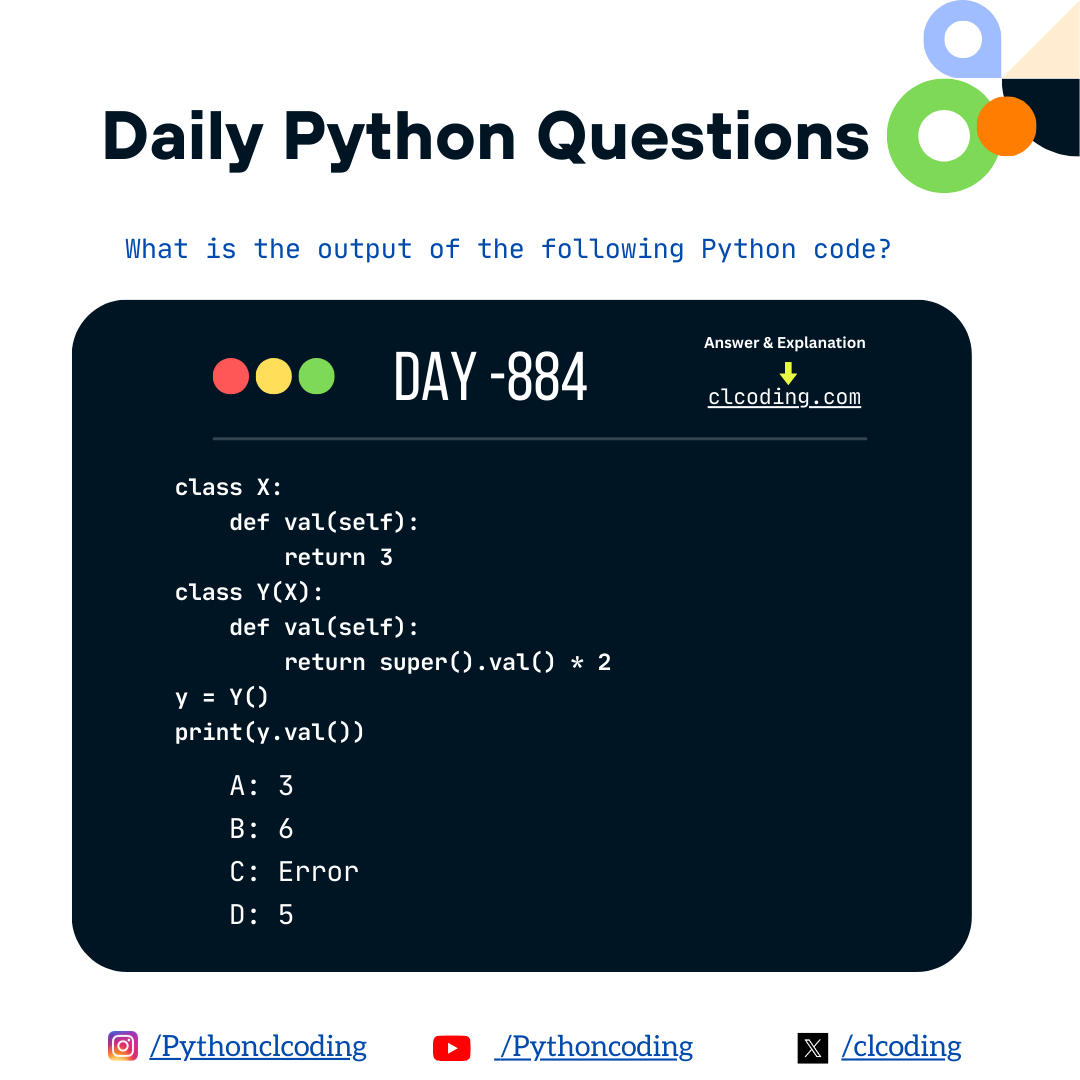
Python Coding challenge - Day 884| What is the output of the following Python Code?


Code Explanation:

1. Class Definition: class X
class X:

Defines a new class named X.

This class will act as a base/parent class.

2. Method in Class X
def val(self):
    return 3

Creates a method called val.

When called, it simply returns 3.

No parameters except self.

3. Class Definition: class Y(X)
class Y(X):

Defines class Y.

Y(X) means Y inherits from X.

So Y can access methods from X.

4. Overriding Method in Class Y
def val(self):
    return super().val() * 2

Y overrides the val() method from X.

super().val() calls the parent class (X) version of the method.

Parent method returns 3.

Then Y multiplies it by 2 → 3 * 2 = 6.

5. Creating Object of Class Y
y = Y()

Creates an object y of class Y.

6. Printing the Result
print(y.val())

Calls Y’s overridden val() method.

Computation: super().val() * 2 → 3 * 2 = 6

Output: 6

Final Output
6

Python Coding Challenge - Question with Answer (ID - 031225)


Actual Output

[10 20 30]

Why didn’t the array change?

Even though we write:

i = i + 5

๐Ÿ‘‰ This DOES NOT modify the NumPy array.

 What really happens:

StepExplanation
for i in x:i receives a copy of each value, not the original element
i = i + 5Only changes the local variable i
xThe original NumPy array stays unchanged

So this loop works like:

i = 10 → i = 15 (x unchanged) i = 20 → i = 25 (x unchanged)
i = 30 → i = 35 (x unchanged)

But x never updates, so output is still:

[10 20 30]

Correct Way to Modify the NumPy Array

✔ Method 1: Using Index

for idx in range(len(x)): x[idx] = x[idx] + 5
print(x)

✅ Output:

[15 25 35]

✔ Method 2: Best & Fastest Way (Vectorized)

x = x + 5
print(x)

✅ Output:

[15 25 35]

Key Concept (IMPORTANT for Interviews)

Loop variable in NumPy gives a copy, not a reference.

 To change NumPy arrays, use indexing or vectorized operations.

Network Engineering with Python: Create Robust, Scalable & Real-World Applications


Data Science Fundamentals: From Raw Data to Insight: A Complete Beginner’s Guide to Statistics, Feature Engineering, and Real-World Data Science Workflows ... Series – Learn. Build. Master. Book 8)


Introduction

In the world of data, raw numbers rarely tell the full story. To get meaningful insights — whether for business decisions, research, or building machine-learning models — you need a structured approach: from cleaning and understanding data, to transforming it, analyzing it, and drawing conclusions.

This book, Data Science Fundamentals, aims to be a complete guide for beginners. It walks you through the entire data-science journey: data cleaning, preprocessing, statistical understanding, feature engineering, and building real-world workflows. It’s written to help someone go from “I have some raw data” to “I have actionable insights or a clean dataset ready for modeling.”

If you’re starting out in data science, or want to build strong foundational skills before diving deep into ML or advanced analytics — this book is a solid starting point.


Why This Book Is Valuable

  • Clear, Beginner-Friendly Path: It starts from basics, so even if you have limited experience with data, statistics, or programming, you can follow along. It doesn’t assume deep math or prior ML knowledge.

  • Holistic Approach — From Data to Insight: Many books stop at statistics or simple analysis. This book covers the full pipeline: preprocessing, exploration, feature creation, and structuring data for further work.

  • Focus on Real-World Data Challenges: Real datasets are messy: missing values, inconsistencies, noise, mixed types. The guide helps you handle such data realistically — a crucial skill for any data practitioner.

  • Bridges Data Cleaning, Statistics & Feature Engineering: Understanding raw data + statistics + good features = better analysis and modeling. This book helps you build that bridge.

  • Prepares You for Next-Level Work: Once you master fundamentals, you’ll be ready for advanced topics — machine learning, predictive modeling, deep learning, data pipelines, and production analytics.


What You’ll Learn — Core Themes & Skills

Here are the main topics and skills that this book covers:

Understanding & Preprocessing Raw Data

  • Loading data from different sources (CSV, JSON, databases, etc.)

  • Handling missing values, inconsistent data, incorrect types

  • Data cleaning: normalizing formats, converting types, detecting anomalies

  • Exploratory Data Analysis (EDA): summarizing data, understanding distributions, outliers, correlations

Statistics & Data Understanding

  • Basic descriptive statistics: mean, median, variance, standard deviation, quantiles

  • Understanding distributions, skewness, outliers — how they affect analysis

  • Correlation analysis, covariance, relationships between variables — vital for insight and feature selection

Feature Engineering & Data Transformation

  • Creating new features from raw data (e.g., combining, normalizing, encoding)

  • Handling categorical data, datetime features, text features, missing values — making data model-ready

  • Scaling, normalization, discretization, binning — techniques to improve model or analysis performance

Workflow Design: From Data to Insight

  • Building repeatable, modular data pipelines: load → clean → transform → analyze

  • Documenting data transformations and decisions — making analysis reproducible and understandable

  • Preparing data for downstream use: visualization, reporting, machine learning, forecasting

Real-World Use-Cases & Practical Considerations

  • Applying skills to real datasets — business data, survey data, logs, mixed data types

  • Recognizing biases, sampling issues, data leakage — being mindful of real-world pitfalls

  • Best practices for cleanliness, versioning, and data governance (especially if data will be used repeatedly or shared)


Who Should Read This Book

The book is ideal for:

  • Beginners to Data Science — people with little or no prior experience but lots of interest.

  • Students, Researchers, or Analysts — anyone working with data (surveys, field data, business data) needing to clean, understand, or analyze datasets.

  • Aspiring Data Scientists / ML Engineers — as a foundational stepping stone before tackling machine learning, modeling, or predictive analytics.

  • Professionals in Non-Tech Domains — marketing, operations, social sciences — who frequently deal with data and want to make sense of it.

  • Anyone wanting systematic data-handling skills — even for simple tasks like data cleaning, reporting, summarization, visualization, or analysis.


What You’ll Take Away — Skills and Capabilities

After working through this book, you should be able to:

  • Load and clean messy real-world datasets robustly

  • Perform exploratory data analysis to understand structure, patterns, and anomalies

  • Engineer meaningful features and transform data for further analysis or modeling

  • Build data pipelines and workflows that are reproducible and maintainable

  • Understand statistical properties of data and how they influence analysis

  • Prepare data ready for machine learning or predictive modeling — or derive meaningful insights and reports

  • Detect common data pitfalls (bias, noise, outliers, missing values) and handle them properly

These are foundational skills — but also among the most sought-after in data, analytics, and ML roles.


Why This Book Matters — In Today’s Data-Driven World

  • Data is everywhere now — companies, organizations, and research projects generate huge volumes of data. From logs and user data to survey results. Handling raw data effectively is the first and most important step.

  • Bad data ruins models and insights — even the best ML models fail if data is poor. A solid grounding in data cleaning and preprocessing differentiates good data work from rubbish output.

  • Strong foundations make learning advanced topics easier — once you’re comfortable with data handling and feature engineering, you can more easily pick up machine learning, statistical modeling, time-series analysis, or deep learning.

  • Cross-domain relevance — whether you’re in finance, business analytics, healthcare, social research, or product development — data fundamentals are universally useful.

If you want to work with data seriously — not casually — this book offers a reliable, comprehensive foundation.


Kindle: Data Science Fundamentals: From Raw Data to Insight: A Complete Beginner’s Guide to Statistics, Feature Engineering, and Real-World Data Science Workflows ... Series – Learn. Build. Master. Book 8)

Conclusion

Data Science Fundamentals: From Raw Data to Insight is much more than a beginner’s guide — it’s a foundation builder. It teaches you not just how to handle data, but how to think about data: what makes it good, what makes it problematic, how to transform and engineer it, and ultimately how to extract insight or prepare for modeling.

If you’re new to data science or want to ensure your skills are grounded in real-world practicality, this book is a great place to start. With solid understanding of data workflows, preprocessing, statistics, and feature engineering, you’ll be ready to build meaningful analyses or robust machine learning applications.


Deep Learning with Artificial Neural Networks: A Practical Guide to Neural Network Development


Introduction

As artificial intelligence matures, neural networks have become the backbone of many modern applications — computer vision, speech recognition, recommendation engines, anomaly detection, and more. But there’s a gap between conceptual understanding and building real, reliable, maintainable neural-network systems.

Deep Learning with Artificial Neural Networks: A Practical Guide to Neural Network Development aims to close that gap. It presents neural network theory and architecture in a hands-on, accessible way and walks readers through the entire process: from data preparation to model design, from training to evaluation, and from debugging to deployment — equipping you with the practical skills needed to build robust neural-network solutions.


Why This Book Is Valuable

  • Grounded in Practice — Instead of staying at a theoretical level, this guide emphasizes real implementation: data pipelines, model building, parameter tuning, training workflows, evaluation, and deployment readiness.

  • Focus on Fundamentals — It covers the essential building blocks of neural networks: layers, activations, loss functions, optimization algorithms, initialization, regularization — giving you a solid foundation to understand how and why networks learn.

  • Bridges Multiple Use-Cases — Whether you want to work with structured data, images, or signals — the book’s generalist approach allows for adaptation across different data modalities.

  • Accessible to Diverse Skill Levels — You don’t need to start as an expert. If you know basic Python (or similar), you can follow along. For intermediate practitioners, the book offers structure, best practices, and a way to organize knowledge.

  • Prepares for Real-World Challenges — In real projects, data is messy, models overfit, computations are expensive, deployments break — this guide emphasizes robustness, reproducibility, and scalability over toy examples.


What You’ll Learn — Core Themes & Topics

Here are the major themes and topics you can expect to learn from the book — and the practical skills that come with them:

Neural Network Foundations

  • Basic building blocks: neurons, layers, activation functions, weights, biases.

  • Forward propagation, loss computation, backpropagation, and gradient descent.

  • How network initialization, activation choice, and architecture design influence learning and convergence.

Network Architectures & Use Cases

  • Designing simple feedforward networks for structured/tabular input.

  • Expanding into deeper architectures for more complex tasks.

  • (Possibly) adapting networks to specialized tasks — depending on data (tabular, signal, simple images).

Training & Optimization Workflow

  • Proper data preprocessing: normalization/scaling, train-test split, handling missing data.

  • Choosing the right optimizer, learning rate, batch size, and regularization methods.

  • Handling overfitting vs underfitting, monitoring loss and validation metrics.

Model Evaluation & Validation

  • Splitting data properly, cross-validation, performance metrics appropriate to problem type (regression / classification / anomaly detection).

  • Understanding bias/variance trade-offs, error analysis, and iterative model improvement.

Robustness, Reproducibility & Deployment Readiness

  • Writing clean, modular neural-network code.

  • Saving and loading models, versioning model checkpoints.

  • Preparing models for deployment: serialization, simple interfaces to infer on new data, preprocessing pipelines outside training environment.

  • Handling real-world data — messy inputs, missing values, inconsistencies — not just clean toy datasets.

From Prototype to Production Mindset

  • How to structure experiments: track hyperparameters, logging, evaluate performance, reproduce results.

  • Understanding limitations: when a neural network is overkill or unsuitable — making decisions based on data, problem size, and resources.

  • Combining classical ML and neural networks — knowing when to choose which depending on complexity, data, and interpretability needs.


Who Should Read This Book

This book is especially useful for:

  • Aspiring Deep Learning Engineers — people beginning their journey into neural networks and who want practical, hands-on knowledge.

  • Data Scientists & Analysts — who have experience with classical ML and want to upgrade to neural networks for more challenging tasks.

  • Software Developers — aiming to integrate neural-network models into applications or services and need to understand how networks are built and maintained.

  • Students & Researchers — who want to experiment with neural networks beyond academic toy datasets and build realistic projects.

  • Tech Professionals & Startup Builders — building AI-powered products or working on AI-based features, needing a solid guide to design, build, and deploy neural network-based solutions.

Whether you are relatively new or have some ML experience, this book offers a structured, practical route to mastering neural networks.


What You’ll Walk Away With — Skills & Readiness

By working through this guide, you will:

  • Understand core neural-network concepts in depth — not just superficially.

  • Be able to build your own neural network models tailored to specific tasks and data types.

  • Know how to preprocess real datasets, handle edge cases, and prepare data pipelines robustly.

  • Gain experience in training, evaluating, tuning, and saving models, with an eye on reproducibility and maintainability.

  • Build a neural-network project from scratch — from data ingestion to final model output — ready for deployment.

  • Develop an engineering mindset around ML: thinking about scalability, modularity, retraining, versioning, and real-world constraints.

In short: you’ll be ready to take on real AI/ML tasks in production-like settings — not just academic experiments.


Why This Book Matters — In Today’s AI Landscape

  • Many ML resources focus on narrow tasks, toy problems, or hypothetical datasets. Real-world problems are messy. A guide like this helps bridge the gap between theory and production.

  • As demand for AI solutions across industries rises — in analytics, automation, predictive maintenance, finance, healthcare — there’s a growing need for engineers and data scientists who know how to build end-to-end neural network solutions.

  • The fundamentals remain relevant even as frameworks evolve. A strong grasp of how neural networks work under the hood makes it easier to adapt to new tools, APIs, or architectures in the future.

If you want to build durable, maintainable, effective neural-network-based systems — not just “play with AI experiments” — this book offers a practical, reliable foundation.


Hard Copy: Deep Learning with Artificial Neural Networks: A Practical Guide to Neural Network Development

Kindle: Deep Learning with Artificial Neural Networks: A Practical Guide to Neural Network Development

Conclusion

Deep Learning with Artificial Neural Networks: A Practical Guide to Neural Network Development is a strong, hands-on resource for anyone serious about building AI systems — not only to learn the concepts, but to apply them in real-world contexts where data is messy, requirements are demanding, and robustness matters.

Whether you aim to prototype, build, or deploy neural-network-based applications — this book gives you the knowledge, structure, and practical guidance to do so responsibly and effectively.

Google Cloud AI Infrastructure Specialization


 As AI and machine-learning projects grow more complex, one reality has become clear: powerful models are only as good as the infrastructure supporting them. Training large models, running high-performance inference, and scaling workloads across teams all depend on a strong AI-ready infrastructure.

Google Cloud offers advanced tools—CPUs, GPUs, TPUs, storage systems, orchestration tools, and optimized compute environments—that make it possible to run demanding AI workloads efficiently. However, understanding how to select, configure, and optimize these resources is essential.

The Google Cloud AI Infrastructure Specialization focuses exactly on this need. Designed for learners who want to build scalable AI systems, it teaches how to deploy and manage the infrastructure behind successful ML projects.


What the Specialization Covers

The specialization includes three focused courses, each building toward a complete understanding of AI-optimized cloud infrastructure.

1. Introduction to AI Hypercomputer

This course explains the architecture behind modern AI systems. You learn:

  • What an AI Hypercomputer is

  • How different compute options work

  • How to choose between CPUs, GPUs, and TPUs

  • Best practices for provisioning and scaling compute resources

By the end, you understand what kind of hardware different AI workloads require.


2. Cloud GPUs for AI Workloads

This course dives deeply into GPU computing:

  • GPU architecture fundamentals

  • Selecting the right GPU machine types

  • Optimizing GPU usage for performance and cost

  • Improving model training speed and efficiency

It’s especially valuable for anyone training deep learning models or working with high-performance computing tasks.


3. Cloud TPUs for Machine Learning

TPUs are purpose-built accelerators for neural network workloads. This course covers:

  • Differences between GPU and TPU workloads

  • When to choose TPUs for training

  • TPU configuration options and performance tuning

  • Concepts like workload flexibility and accelerator selection

This gives you the confidence to decide which accelerator best fits your project.


Skills You’ll Gain

By completing the specialization, you develop key skills in:

  • Cloud AI architecture

  • Performance tuning and benchmarking

  • Selecting appropriate compute hardware

  • Deploying ML workloads at scale

  • Balancing cost vs. performance

  • Understanding large-scale AI system design

These are essential skills for engineers working with real-world AI systems—not just small experiments.


Who This Specialization Is For

This specialization is ideal if you are:

  • An aspiring or current ML engineer

  • A cloud engineer transitioning into AI

  • A developer working on deep learning projects

  • A student aiming to understand enterprise-grade AI systems

  • A professional building AI solutions at scale

Some prior knowledge of cloud concepts and ML basics is helpful but not strictly required.


Why This Specialization Is Valuable Today

AI is advancing fast, and organizations are rapidly deploying AI solutions in production. The real challenge today is not just building models—it’s deploying and scaling them efficiently.

Cloud-based AI infrastructure allows:

  • Faster experimentation

  • More reliable model operations

  • Lower cost through optimized resource usage

  • Flexibility to scale up or down instantly

This specialization prepares you for these industry needs by giving you infrastructure-level AI expertise—one of the most in-demand skill sets today.


Join Now: Google Cloud AI Infrastructure Specialization

Conclusion:

The Google Cloud AI Infrastructure Specialization stands out as a practical, well-structured program that teaches what many AI courses overlook: the infrastructure that makes modern AI possible. As models grow larger and workloads more demanding, understanding how to design and optimize cloud infrastructure becomes a competitive advantage.

Popular Posts

Categories

100 Python Programs for Beginner (118) AI (181) Android (25) AngularJS (1) Api (7) Assembly Language (2) aws (28) Azure (8) BI (10) Books (261) Bootcamp (1) C (78) C# (12) C++ (83) Course (84) Coursera (299) Cybersecurity (29) Data Analysis (25) Data Analytics (16) data management (15) Data Science (243) Data Strucures (15) Deep Learning (99) Django (16) Downloads (3) edx (21) Engineering (15) Euron (30) Events (7) Excel (18) Finance (9) flask (3) flutter (1) FPL (17) Generative AI (51) Git (9) Google (47) Hadoop (3) HTML Quiz (1) HTML&CSS (48) IBM (41) IoT (3) IS (25) Java (99) Leet Code (4) Machine Learning (220) Meta (24) MICHIGAN (5) microsoft (9) Nvidia (8) Pandas (12) PHP (20) Projects (32) Python (1238) Python Coding Challenge (973) Python Mistakes (34) Python Quiz (398) Python Tips (5) Questions (3) R (72) React (7) Scripting (3) security (4) Selenium Webdriver (4) Software (19) SQL (45) Udemy (17) UX Research (1) web application (11) Web development (8) web scraping (3)

Followers

Python Coding for Kids ( Free Demo for Everyone)