Friday, 3 January 2025

Day 74 : Python Program to Count the Number of Vowels in a String


def count_vowels(input_string):

    vowels = "aeiouAEIOU"

    count = 0

    for char in input_string:

        if char in vowels:

            count += 1

    return count

user_input = input("Enter a string: ")

vowel_count = count_vowels(user_input)

print(f"The number of vowels in the string is: {vowel_count}")

#source code --> clcoding.com

Code Explanation:

def count_vowels(input_string):
def: This keyword defines a function in Python.
count_vowels: The name of the function.
input_string: A parameter representing the string passed to the function when called.

    vowels = "aeiouAEIOU"
vowels: A string containing all vowel characters (both lowercase and uppercase: 'a', 'e', 'i', 'o', 'u' and 'A', 'E', 'I', 'O', 'U').
This list of vowels will be used to check if a character is a vowel.

    count = 0
Initializes a variable count to 0. This variable will store the number of vowels found in the input string.

    for char in input_string:
for: A loop that iterates over each character in the input_string.
char: A temporary variable that represents the current character being processed in the string.

        if char in vowels:
if: A conditional statement that checks whether the current character (char) is present in the vowels string.
char in vowels: Returns True if the character is found in the vowels string, indicating that it is a vowel.

            count += 1
If the condition (char in vowels) is True, this line increments the count variable by 1. This tracks the total number of vowels encountered.

    return count
After the loop finishes processing all characters, this line returns the total value of count (the number of vowels) to the caller of the function.

user_input = input("Enter a string: ")
input(): Prompts the user to type a string into the program. It displays the message "Enter a string: " and waits for the user to input a value.
user_input: A variable that stores the string entered by the user.

vowel_count = count_vowels(user_input)
Calls the function count_vowels, passing the user-provided string (user_input) as an argument.
The function processes the string and returns the count of vowels.
The result is stored in the variable vowel_count.

print(f"The number of vowels in the string is: {vowel_count}")
print(): Outputs the specified message to the console.
f-string: A formatted string (introduced in Python 3.6) that allows embedding variables directly inside curly braces {}.
Displays the message along with the value of vowel_count.

Day 73: Python Program to Count Number of Lowercase Characters in a String


def count_lowercase_characters(input_string):

    count = 0

    for char in input_string:

        if char.islower():

            count += 1

       return count

user_input = input("Enter a string: ")

lowercase_count = count_lowercase_characters(user_input)

print(f"The number of lowercase characters in the string is: {lowercase_count}")

#source code --> clcoding.com

Code Explanation:

def count_lowercase_characters(input_string):
def: This keyword defines a function in Python.
count_lowercase_characters: The name of the function.
input_string: A parameter that represents the string passed to the function when called.

    count = 0
Initializes a variable count to 0. This variable will store the number of lowercase characters as they are counted.

    for char in input_string:
for: A loop that iterates over each character in the input_string.
char: A temporary variable that represents the current character being processed in the string.

        if char.islower():
if: A conditional statement that checks whether the condition is true.
char.islower(): A built-in Python method that returns True if char is a lowercase letter (e.g., 'a', 'z'), and False otherwise.

            count += 1
If the condition char.islower() is True, this line increments the count variable by 1. This tracks the total number of lowercase letters encountered.

    return count
After the loop finishes processing all characters, this line returns the total value of count (the number of lowercase characters) to the caller of the function.

user_input = input("Enter a string: ")
input(): A function that allows the user to type something into the program. It displays the prompt "Enter a string: " and waits for the user to input a value.
user_input: A variable that stores the string entered by the user.

lowercase_count = count_lowercase_characters(user_input)
Calls the function count_lowercase_characters and passes the user's input (user_input) as an argument.
The function processes the input and returns the count of lowercase characters.
The result is stored in the variable lowercase_count.

print(f"The number of lowercase characters in the string is: {lowercase_count}")
print(): Outputs the specified message to the console.
f-string: A formatted string (introduced in Python 3.6) that allows embedding variables directly inside curly braces {}.
Displays the message along with the value of lowercase_count.

Myanmar Flag using Python


import matplotlib.pyplot as plt

from matplotlib.patches import Polygon

import numpy as np


fig, ax = plt.subplots(figsize=(8, 5))

ax.fill_between([0, 3], 2, 3, color="#FED100")  

ax.fill_between([0, 3], 1, 2, color="#34B233")  

ax.fill_between([0, 3], 0, 1, color="#EA2839")  


def draw_star(center_x, center_y, radius, color, rotation_deg):

    points = []

    for i in range(10):

        angle = (i * 36 + rotation_deg) * (np.pi / 180)  

        r = radius if i % 2 == 0 else radius / 2  

        x = center_x + r * np.cos(angle)

        y = center_y + r * np.sin(angle)

        points.append((x, y))

    polygon = Polygon(points, closed=True, color=color)

    ax.add_patch(polygon)


draw_star(1.5, 1.5, 0.6, "white", rotation_deg=-55)  

ax.set_xlim(0, 3)

ax.set_ylim(0, 3)

ax.axis("off")

plt.show()

print("Happy Independence Day Myanmar ")


#source code --> clcoding.com

Create a map with search using Python


import folium

from geopy.geocoders import Nominatim

from IPython.display import display, HTML


location_name = input("Enter a location: ")


geolocator = Nominatim(user_agent="geoapi")

location = geolocator.geocode(location_name)


if location:


    # Create a map centered on the user's location

    latitude = location.latitude

    longitude = location.longitude

    clcoding = folium.Map(location=[latitude, longitude], zoom_start=12)


    marker = folium.Marker([latitude, longitude], popup=location_name)

    marker.add_to(clcoding)


    display(HTML(clcoding._repr_html_()))

else:

    print("Location not found. Please try again.")


#source code --> clcoding.com

Python Coding Challange - Question With Answer(01030125)


Explanation

  1. Line 1:
    array = [21, 49, 15] initializes the list.

  2. Line 2:
    gen = (x for x in array if array.count(x) > 0) creates a generator:

    • It iterates over the current array ([21, 49, 15]).
    • array.count(x) checks the count of each element in the array. Since all elements appear once (count > 0), they all qualify to be in the generator.
  3. Line 3:
    array = [0, 49, 88] reassigns array to a new list. However, this does not affect the generator because the generator already references the original array at the time of its creation.

  4. Line 4:
    print(list(gen)) forces the generator to execute:

    • The generator still uses the original array = [21, 49, 15].
    • The condition array.count(x) > 0 is true for all elements in the original list.
    • Hence, the output is [21, 49, 15].

Day 72: Python Program to Count the Number of Words and Characters in a String


def count_words_and_characters(input_string):

    num_characters = len(input_string)

    words = input_string.split()

    num_words = len(words)

     return num_words, num_characters

input_string = input("Enter a string: ")

num_words, num_characters = count_words_and_characters(input_string)

print(f"Number of words: {num_words}")

print(f"Number of characters (including spaces): {num_characters}")

#source code --> clcoding.com 

Code Explanation:

Function Definition
def count_words_and_characters(input_string):
Purpose: Defines a function named count_words_and_characters to calculate the number of words and characters in a given string.
Parameter:
input_string: The string whose words and characters are to be counted.

Character Count
    num_characters = len(input_string)
Logic: Uses Python’s built-in len() function to determine the total number of characters in the string, including spaces and punctuation.
Result: The length of input_string is stored in the variable num_characters.

Word Count
    words = input_string.split()
    num_words = len(words)

Splitting the String:
The split() method splits the string into a list of words, separating at whitespace (spaces, tabs, or newlines).
For example, "Hello World!" becomes ['Hello', 'World!'].
The resulting list is stored in the variable words.

Counting Words:
The len() function is used again, this time to count the number of elements in the words list.
The result (number of words) is stored in the variable num_words.

Return Statement
    return num_words, num_characters
Logic: Returns two values:
num_words: The total number of words in the input string.
num_characters: The total number of characters in the input string.

Input Handling
input_string = input("Enter a string: ")
Purpose: Prompts the user to input a string and stores the input in the variable input_string.

Function Call
num_words, num_characters = count_words_and_characters(input_string)
Logic: Calls the count_words_and_characters function, passing the input_string as an argument.
Result: The returned values (number of words and characters) are unpacked into num_words and num_characters.

Output
print(f"Number of words: {num_words}")
print(f"Number of characters (including spaces): {num_characters}")
Purpose: Prints the results in a user-friendly format, showing the number of words and the number of characters (including spaces).

Thursday, 2 January 2025

Day 71: Python Program to Find the Length of a String without Library Function


def string_length(s):

    count = 0

    for _ in s:  

         count += 1

    return count

input_string = input("Enter a string: ")

length = string_length(input_string)

print(f"The length of the string is: {length}")

#source code --> clcoding.com 

Code Explanation:

Function Definition

def string_length(s):

Purpose: Defines a function named string_length to calculate the length of a string.

Parameter:

s: The string whose length is to be determined.

    count = 0

Logic:

 Initializes a variable count to 0. This variable will store the number of characters in the string.

    for _ in s:

Logic: Iterates through each character in the string s using a for loop.

The _ is a placeholder indicating the loop does not use the actual character for any operations. It simply counts the number of iterations.

        count += 1

Logic: For each iteration (i.e., for each character in the string), increments the count variable by 1.

    return count

Logic: After the loop finishes (indicating all characters have been counted), the function returns the total value of count, which is the length of the string.

Input Handling

input_string = input("Enter a string: ")

Purpose: Prompts the user to enter a string and stores the input in the variable input_string.

length = string_length(input_string)

Logic: Calls the string_length function, passing input_string as an argument. The returned value (length of the string) is stored in the variable length.


Day 70: Python Program to Determine How Many Times a Given Letter Occurs in a String Recursively


def count_letter_recursively(s, letter):

    if not s:

        return 0

    return (1 if s[0] == letter else 0) + count_letter_recursively(s[1:], letter)

input_string = input("Enter a string: ")

input_letter = input("Enter the letter to count: ")

if len(input_letter) != 1:

    print("Please enter only one letter.")

else:

    count = count_letter_recursively(input_string, input_letter)

    print(f"The letter '{input_letter}' occurs {count} times in the string.")

#source code --> clcoding.com 

Code Explanation:

Function Definition

def count_letter_recursively(s, letter):

Purpose: Defines a function named count_letter_recursively.

Parameters:

s: A string in which the letter is counted.

letter: The specific letter to count within the string.

    if not s:

        return 0

Logic: Checks if the string s is empty (base case of recursion).

If s is empty, it returns 0 because there are no letters left to count.

    return (1 if s[0] == letter else 0) + count_letter_recursively(s[1:], letter)

Logic: Processes the first character of the string (s[0]):

If s[0] matches the letter, it adds 1 to the count.

Otherwise, adds 0.

Recursively calls count_letter_recursively on the rest of the string (s[1:]), effectively reducing the problem size by one character each time.

Input Handling

input_string = input("Enter a string: ")

Purpose: Prompts the user to enter a string and stores it in the variable input_string.

input_letter = input("Enter the letter to count: ")

Purpose: Prompts the user to enter the specific letter to count and stores it in input_letter.

Validation and Execution

if len(input_letter) != 1:

    print("Please enter only one letter.")

Logic: Checks if the user entered more than one character as the letter.

If input_letter is not exactly one character long, it prints an error message and exits.

else:

    count = count_letter_recursively(input_string, input_letter)

Logic: If the input is valid, it calls count_letter_recursively with the input_string and input_letter.

Result: The result of the function (number of occurrences) is stored in the variable count.

    print(f"The letter '{input_letter}' occurs {count} times in the string.")

Purpose: Prints the result, displaying how many times the letter appears in the input string.

Add Logo in any QR Code using Python


from PIL import Image

import qrcode


data = input("Enter the data for the QR code: ")


qr = qrcode.QRCode(error_correction=qrcode.constants.ERROR_CORRECT_H)

qr.add_data(data)

qr.make(fit=True)


qr_image = qr.make_image(fill_color="black",back_color="white").convert('RGBA')


watermark = Image.open('cllogo.png')


watermark_size = (qr_image.size[0] // 4, qr_image.size[1] // 4)

watermark = watermark.resize(watermark_size, Image.Resampling.LANCZOS)


pos = ((qr_image.size[0] - watermark.size[0]) // 2, 

       (qr_image.size[1] - watermark.size[1]) // 2)


qr_image.paste(watermark, pos, watermark)


qr_image.save('qr_with_watermark.png')


Image.open('qr_with_watermark.png')

#source code --> clcoding.com

Python Coding Challange - Question With Answer(01020125)


Line-by-Line Breakdown:

  1. my_list = [5, 10, 15, 20]
    This creates a list called my_list containing the values [5, 10, 15, 20].

  2. for index, item in enumerate(my_list):
    The enumerate() function is used here. It takes the list my_list and returns an enumerate object. This object produces pairs of values:

    • index: The position (index) of each element in the list (starting from 0).
    • item: The value of the element at that index in the list.

    So for my_list = [5, 10, 15, 20], enumerate() will generate:

    • (0, 5)
    • (1, 10)
    • (2, 15)
    • (3, 20)

    These pairs are unpacked into the variables index and item.

  3. print(index, item)
    This prints the index and the item for each pair generated by enumerate().

How the Code Works:

  • On the first iteration, index is 0 and item is 5, so it prints 0 5.
  • On the second iteration, index is 1 and item is 10, so it prints 1 10.
  • On the third iteration, index is 2 and item is 15, so it prints 2 15.
  • On the fourth iteration, index is 3 and item is 20, so it prints 3 20.

Output:

0 5
1 10 2 15 3 20

This code is useful for iterating over both the index and value of items in a list, which can be handy when you need both pieces of information during the iteration.

Introduction to Networking


Introduction to Networking: Free Course by NVIDIA on Coursera

In today's digital age, networking plays a pivotal role in connecting people, devices, and systems across the globe. Whether you're a tech enthusiast, a student, or a professional looking to upskill, understanding the fundamentals of networking is essential. NVIDIA, a global leader in AI and accelerated computing, offers a free course on networking .This course is designed to help learners grasp the core concepts of networking and apply them in real-world scenarios.

Why Learn Networking?

Networking is the backbone of modern technology. From browsing the internet to enabling AI-driven applications, networks facilitate seamless communication and data transfer. Learning networking fundamentals empowers you to:

  • Understand how devices communicate.

  • Troubleshoot network-related issues.

  • Build and maintain efficient networks.

  • Enhance your career opportunities in IT, cybersecurity, and cloud computing.

What the Course Offers

The Introduction to Networking course by NVIDIA covers essential topics to build a strong foundation in networking. Here’s what you can expect:

1. Core Networking Concepts

Gain a deep understanding of:

  • How data flows across networks.

  • The role of IP addresses and protocols.

  • Networking hardware like routers and switches.

2. Hands-On Learning

The course includes practical exercises and real-world scenarios to help you apply theoretical knowledge effectively.

3. Expert Insights

Learn from industry professionals with years of experience in networking and computing.

4. Flexibility and Accessibility

Since the course is offered on Coursera, you can learn at your own pace, making it ideal for busy professionals and students.

Who Should Enroll?

This course is perfect for:

  • Beginners with no prior knowledge of networking.

  • IT professionals seeking to refresh their networking skills.

  • Students exploring a career in technology.

Benefits of Taking This Course

  • Free Enrollment: Access world-class content without spending a dime.

  • Certificate of Completion: Add a valuable credential to your resume.

  • Industry-Relevant Skills: Equip yourself with knowledge that’s in demand in the job market.

Join Free: Introduction to Networking

Conclusion

Whether you're new to networking or looking to enhance your existing skills, NVIDIA’s Introduction to Networking course on Coursera offers a comprehensive and accessible way to learn. Take the first step toward mastering networking fundamentals and unlocking new career opportunities. Enroll today and start your journey into the fascinating world of networking!

Wednesday, 1 January 2025

Day 67: Python Program to Replace Every Blank Space with Hyphen in a String


input_string = input("Enter a string: ")
output_string = input_string.replace(" ", "-")
print("Modified string:", output_string)

#source code --> clcoding.com

Code Explanation:

input_string = input("Enter a string: ")

input():
Prompts the user to enter a string.
The prompt text "Enter a string: " is displayed to the user in the console.
The user's input is returned as a string.

input_string:
The string entered by the user is stored in the variable input_string.
output_string = input_string.replace(" ", "-")

input_string.replace(" ", "-"):
The replace() method is called on the string stored in input_string.
It replaces every occurrence of a blank space (" ") in the string with a hyphen ("-").
The method returns a new string with the replacements. It does not modify the original string because strings in Python are immutable.

output_string:
The modified string (where all spaces are replaced with hyphens) is stored in the variable output_string.
print("Modified string:", output_string)

print():
Outputs the modified string to the console.
The string "Modified string:" serves as a label.

output_string:
The value of output_string (the modified string) is displayed next to the label.

Day 68: Python Program to Reverse a String using Recursion


def reverse_string(s):

    if len(s) <= 1:

        return s

     return reverse_string(s[1:]) + s[0]

input_string = input("Enter a string: ")

reversed_string = reverse_string(input_string)

print("Reversed string:", reversed_string)

#source code --> clcoding.com 

Code Explanation:

def reverse_string(s):
def reverse_string(s)::
This line defines a function named reverse_string.
The function takes a single parameter s, which represents the string to be reversed.
if len(s) <= 1:
        return s
if len(s) <= 1::

This is the base case for the recursion. It checks if the length of the string s is less than or equal to 1.
A string of length 0 (empty string) or 1 is its own reverse, so the function directly returns the string as is.
This condition prevents further recursive calls and ensures the recursion stops.
return s:

If the condition len(s) <= 1 is true, the string s is returned without any further processing.

    return reverse_string(s[1:]) + s[0]

reverse_string(s[1:]):

This is the recursive case.
The function calls itself with a smaller substring of s, obtained by slicing the string from the second character onward (s[1:]).
This effectively removes the first character of the string for the current recursive call.
+ s[0]:

The first character of the string (s[0]) is added to the end of the reversed substring returned by the recursive call.
This builds the reversed string step by step.

Recursive Process:
Each recursive call processes a smaller part of the string until the base case is reached, where the string has length 1 or 0.
The reversed parts are then combined as the recursion "unwinds."

input_string = input("Enter a string: ")

input():
This function prompts the user to enter a string. The prompt text "Enter a string: " is displayed.
The user’s input is stored in the variable input_string.

reversed_string = reverse_string(input_string)
The reverse_string function is called with input_string as the argument.
The function returns the reversed version of the input string, which is stored in the variable reversed_string.

print("Reversed string:", reversed_string)

print():
Outputs the reversed string to the console.
The string "Reversed string:" acts as a label, and the value of reversed_string is printed after it.

Python Coding challenge - Day 313| What is the output of the following Python Code?


Code Explanation:

Lambda Function:
lambda s: s == s[::-1] defines a lambda function that takes a single argument s (a string).
The function checks if the string s is equal to its reverse s[::-1].
s[::-1] uses Python slicing to reverse the string:
s[::-1] means: start at the end of the string, move backwards to the beginning, and include every character.
The expression s == s[::-1] evaluates to True if s is a palindrome (reads the same forwards and backwards), and False otherwise.

Assigning the Function:
is_palindrome = lambda s: s == s[::-1] assigns the lambda function to the variable is_palindrome.
Now, is_palindrome can be used as a function to check if a string is a palindrome.

Calling the Function:
result = is_palindrome("radar") calls the is_palindrome function with the string "radar".

Inside the function:
"radar" is compared with its reverse, which is also "radar".
Since they are the same, the function returns True.

Printing the Result:
print(result) outputs the value of result to the console, which is True.

Output:
The program prints:
True
This means that the string "radar" is a palindrome.

Tuesday, 31 December 2024

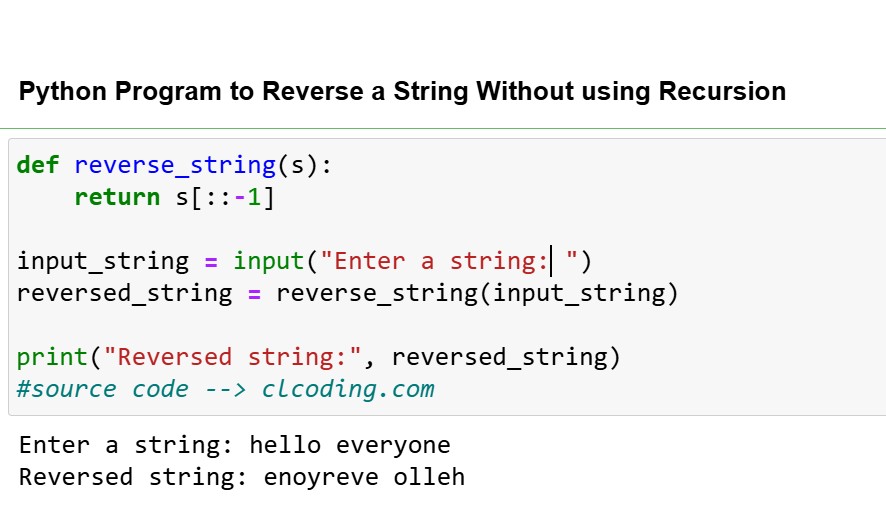
Day 69: Python Program to Reverse a String Without using Recursion


def reverse_string(s):

    return s[::-1]

input_string = input("Enter a string: ")

reversed_string = reverse_string(input_string)

print("Reversed string:", reversed_string)

#source code --> clcoding.com 

Code Explanation:

def reverse_string(s):
    return s[::-1]
This defines a function named reverse_string that takes one parameter, s (a string).
s[::-1]: This uses Python's slicing syntax to reverse the string:
s[start:end:step]: A slice of the string s is created with the given start, end, and step values.
:: without specifying start and end means to consider the entire string.
-1 as the step value means to traverse the string from the end to the beginning, effectively reversing it.
The reversed string is then returned by the function.

Getting User Input
input_string = input("Enter a string: ")
This prompts the user to enter a string.
The entered string is stored in the variable input_string.

Calling the Function
reversed_string = reverse_string(input_string)
The reverse_string function is called with input_string as the argument.
The reversed version of the string is returned by the function and stored in the variable reversed_string.

Printing the Result
print("Reversed string:", reversed_string)
This prints the reversed string to the console with the label "Reversed string:".

Python Coding challenge - Day 320| What is the output of the following Python Code?


Step-by-Step Explanation

Lambda Function Definition:

remainder is defined as a lambda function that takes two arguments, a and b.

The function calculates the remainder when a is divided by b using the modulo operator %.

The syntax for the modulo operation is:

a % b

This operation returns the remainder of the division of a by b.

Calling the Function:

The function remainder is called with a = 10 and b = 3.

Modulo Operation:

Inside the lambda function, the expression 10 % 3 is evaluated.

10 % 3 means "divide 10 by 3 and find the remainder."

When 10 is divided by 3, the quotient is 3 (since 3 * 3 = 9), and the remainder is 10 - 9 = 1.

Result Assignment:

The calculated remainder (1) is assigned to the variable result.

Printing the Result:

The print(result) statement outputs the value stored in result, which is 1.

Output

1

Python Coding challenge - Day 319| What is the output of the following Python Code?


Code Explanation:

Lambda Function Definition:

The function greater is defined using a lambda function.

The lambda function takes two arguments, a and b.

It uses a conditional expression (also called a ternary operator) to compare a and b. The structure is:

a if a > b else b

If a > b is True, the function returns a.

If a > b is False, the function returns b.

Calling the Function:

The function greater(8, 12) is called with a = 8 and b = 12.

Condition Evaluation:

Inside the lambda function, the condition a > b is evaluated, i.e., 8 > 12.

This condition is False because 8 is not greater than 12.

Returning the Result:

Since the condition a > b is False, the function returns b, which is 12.

Printing the Result:

The result 12 is stored in the variable result.

The print(result) statement outputs 12.

Output

12


Python Coding challenge - Day 318| What is the output of the following Python Code?


Code Explanation:

Function Definition:

is_positive is a lambda function that takes one argument, x.
It evaluates the condition x > 0 and returns True if x is greater than 0, and False otherwise.

Calling the Function:

The function is_positive is called with the argument -10.
Inside the lambda function, the condition -10 > 0 is evaluated.

Condition Evaluation:

The condition -10 > 0 is False because -10 is less than 0.

Assigning the Result:

The result of the condition (False) is stored in the variable result.

Printing the Result:

The print(result) statement outputs the value stored in result, which is False.

Output
False

Python Coding challenge - Day 317| What is the output of the following Python Code?


Code Explanation:

Function Definition:

multiply is defined as a lambda function that takes two arguments, a and b.
The function computes the product of a and b using the * operator.

Calling the Function:

The function multiply is called with the arguments 4 and 5.
Inside the lambda function, the expression 4 * 5 is evaluated, resulting in 20.

Assigning the Result:

The calculated value (20) is stored in the variable result.

Printing the Result:

The print(result) statement outputs the value stored in result, which is 20.

Output
20

Python Coding challenge - Day 316| What is the output of the following Python Code?


Code Explanation:

Function Definition:

add_numbers is a lambda function that takes two arguments, a and b.
It returns the sum of a and b.

Execution:

add_numbers(3, 7) is called with a = 3 and b = 7.
The lambda function calculates 3 + 7, which equals 10.

Print Statement:

print(result) outputs the result of the calculation, which is 10.

Output
10

Monday, 30 December 2024

Python Coding Challange - Question With Answer(01301224)


Step-by-Step Explanation:

  1. Assign x = 5:

    • The variable x is assigned the value 5.
  2. Assign y = (z := x ** 2) + 10:

    • The expression uses the walrus operator (:=) to:
      • Compute x ** 2 (the square of x), which is 5 ** 2 = 25.
      • Assign this value (25) to the variable z.
    • The entire expression (z := x ** 2) evaluates to 25, which is then added to 10.
    • So, y = 25 + 10 = 35.

    After this line:

      z = 25y = 35
  3. Print Statement:

    • The print function uses an f-string to display the values of x, y, and z:
      • {x=} outputs: x=5
      • {y=} outputs: y=35
      • {z=} outputs: z=25
  4. Output: The program prints:


    x=5 y=35 z=25

Key Points:

  • Walrus Operator (:=):

    • Assigns x ** 2 (25) to z and evaluates to 25 in the same expression.
    • This reduces the need for a separate assignment line for z.
  • Order of Operations:

    • First, z is assigned the value x ** 2 (25).
    • Then, y is computed as z + 10 (25 + 10 = 35).
  • Unrelated Variables:

    • x is not affected by the assignments to y or z. It remains 5 throughout.

Equivalent Code Without the Walrus Operator:

If we didn’t use the walrus operator, the code could be written as:


x = 5
z = x ** 2 y = z + 10print(f"{x=} {y=} {z=}")

This would produce the same output:

x=5 y=35 z=25

Why Use the Walrus Operator Here?

Using the walrus operator is helpful for:

  • Conciseness: It combines the assignment of z and the computation of y in one line.
  • Efficiency: It eliminates redundant code by directly assigning z during the computation.

Sunday, 29 December 2024

Day 66: Python Program to Replace All Occurrences of ‘a’ with $ in a String


def replace_a_with_dollar(input_string):

    result = input_string.replace('a', '$')

    return result

input_string = input("Enter a string: ")

output_string = replace_a_with_dollar(input_string)

print("Modified string:", output_string)

#source code --> clcoding.com

Code Explanation:

Function Definition:

def replace_a_with_dollar(input_string):
    result = input_string.replace('a', '$')
    return result
The function replace_a_with_dollar takes one parameter: input_string, which is expected to be a string.

Inside the function:
input_string.replace('a', '$') is called, which replaces every occurrence of the character 'a' in input_string with the character '$'.
The modified string is stored in the variable result.
The function returns the modified string (result).

User Input:
input_string = input("Enter a string: ")
The input() function prompts the user to enter a string. The entered string is stored in the variable input_string.

Function Call and Output:
output_string = replace_a_with_dollar(input_string)
print("Modified string:", output_string)
The replace_a_with_dollar function is called with input_string as the argument, and its result is assigned to output_string.
The modified string (output_string) is printed to the console.

Trend chart plot using Python


import matplotlib.pyplot as plt


years = [2014, 2016, 2018, 2020, 2022, 2024]

languages = ["Python", "JavaScript", "TypeScript", "Java", "C#"]

rankings = [

    [8, 6, 5, 3, 2, 1],  [1, 2, 2, 2, 3, 2],  

    [10, 9, 8, 5, 5, 3],  [2, 3, 3, 4, 4, 4],  

    [5, 4, 4, 6, 6, 5],  ]


colors = ["lime", "magenta", "purple", "orange", "cyan", ]


plt.figure(figsize=(10, 6))


for i, (language, ranking) in enumerate(zip(languages, rankings)):

    plt.plot(years, ranking, label=language, color=colors[i], linewidth=2)


plt.gca().invert_yaxis() 

plt.xticks(years, fontsize=10)

plt.yticks(range(1, 13), fontsize=10)

plt.title("Programming Language Trends (2014 - 2024)", fontsize=14)

plt.xlabel("Year", fontsize=12)

plt.ylabel("Rank", fontsize=12)

plt.legend(bbox_to_anchor=(1.05, 1), loc='upper left', fontsize=9)

plt.grid(color='gray', linestyle='--', linewidth=0.5, alpha=0.7)

plt.tight_layout()


plt.show()


Day 65 : Python Program to Remove the nth Index Character from a Non Empty String


def remove_nth_index_char(input_string, n):

    """

    Remove the character at the nth index from the input string.

Args:

        input_string (str): The string to process.

        n (int): The index of the character to remove.

Returns:

        str: A new string with the nth character removed.

    """

    if n < 0 or n >= len(input_string):

        raise ValueError("Index n is out of range.")

    return input_string[:n] + input_string[n+1:]

if __name__ == "__main__":

    input_string = input("Enter a non-empty string: ")

    try:

        n = int(input("Enter the index of the character to remove: "))

        result = remove_nth_index_char(input_string, n)

        print("String after removing the nth index character:", result)

    except ValueError as e:

        print("Error:", e)

#source code --> clcoding.com

Code Explanation:

Function: 
remove_nth_index_char
Purpose:
To return a new string where the character at the specified index n is removed.
Arguments:
input_string (str): The original string from which a character is to be removed.
n (int): The index of the character to remove.

Logic:
Index Validation:
if n < 0 or n >= len(input_string):
Checks if n is outside the valid range of indices for the string.
If n is negative or greater than or equal to the length of the string, it raises a ValueError with the message: "Index n is out of range."

String Manipulation:
input_string[:n]: Slices the string to include all characters before index n.
input_string[n+1:]: Slices the string to include all characters after index n.
input_string[:n] + input_string[n+1:]: Combines the two slices, effectively removing the character at index n.

Return Value:
A new string with the character at the nth index removed.

Main Script:
The if __name__ == "__main__": block allows this script to run only when executed directly, not when imported as a module.

Step-by-Step Execution:
Input:
Prompts the user to enter a non-empty string with input("Enter a non-empty string: ").
Prompts the user to specify the index (n) of the character they want to remove with int(input("Enter the index of the character to remove: ")).

Validation and Function Call:
The script calls remove_nth_index_char with the provided string and index.
If the index is invalid (e.g., out of range), a ValueError is raised, and the except block catches it.

Error Handling:
If an exception occurs (e.g., invalid index), it prints an error message: Error: Index n is out of range.
Output:
If the function executes successfully, it prints the new string with the character removed:
String after removing the nth index character: <new_string>

Python Coding Challange - Question With Answer(01291224)


Step-by-Step Explanation

  1. List Initialization:

    • my_list = [7, 2, 9, 4]
      This creates a list with the elements [7, 2, 9, 4] and assigns it to the variable my_list.
  2. Using the .sort() Method:

    • my_list.sort() sorts the list in place, meaning it modifies the original list directly and does not return a new list.
    • The .sort() method returns None, which is a special Python value indicating that no meaningful value was returned.

    So, when you assign the result of my_list.sort() back to my_list, you are overwriting the original list with None.

  3. Printing the Result:

    • print(my_list) will print None because the variable my_list now holds the return value of the .sort() method, which is None.

Python Records and Highlights in 2024


  1. Python Adoption Records:

    • Surpassed 50 million active developers globally using Python in various domains.
    • Ranked as the #1 language on TIOBE and Stack Overflow Developer Survey for the 5th consecutive year.
  2. Most Downloaded Libraries:

    • NumPy, Pandas, and Matplotlib retained their spots as the most downloaded libraries for data analysis.
    • Libraries like Transformers (by Hugging Face) broke records in downloads due to generative AI applications.
  3. Longest Python Code Base:

    • Open-source project pandas reached a milestone with over 200k lines of code, reflecting its complexity and growth.
  4. Most Forked GitHub Python Repository:

    • Python itself remained the most forked Python repository on GitHub, followed closely by projects like Django and Flask.
  5. Highest Salary for Python Developers:

    • Python developers working in AI research reported an average annual salary of $180,000 in leading tech hubs like Silicon Valley.
  6. Top Trending Python Tools in 2024:

    • Streamlit: For building data-driven apps.
    • FastAPI: For creating fast and secure RESTful APIs.
    • Poetry: For Python dependency management and packaging.
  7. Learning Python in 2024:

    • Python remained the most taught language in schools and universities globally.
    • Platforms like freeCodeCamp, Kaggle, and HackerRank saw a significant surge in Python-based coding challenges and courses.

Python Programming in 2024: Summary

  1. Popularity and Adoption:

    • Python maintained its position as one of the most popular programming languages worldwide, particularly for data science, machine learning, and web development.
    • Python’s simplicity continued to attract new developers, making it a top choice for beginners in programming.
  2. New Features in Python 3.13:

    • Performance Improvements: Python 3.13 introduced significant enhancements in performance, especially in I/O operations and memory management.
    • Syntax Updates: Added support for pattern matching enhancements and cleaner error messages.
    • Typing Updates: Continued focus on static type hints with improved support for generics and type narrowing.
  3. AI and Machine Learning:

    • Python remained the dominant language for AI and machine learning with tools like TensorFlow, PyTorch, and Hugging Face.
    • New Libraries: Advanced AI libraries like PyCaret 3.0 and LangChain gained traction for low-code AI and generative AI applications.
  4. Web Development:

    • Frameworks like FastAPI and Django introduced major updates, focusing on developer experience and scalability.
    • Integration of AI with web applications became a popular trend, with Python enabling rapid prototyping.
  5. Community and Events:

    • Python conferences like PyCon 2024 (held in Toronto) set attendance records, highlighting global interest in Python.
    • The Python Software Foundation (PSF) expanded its initiatives to promote diversity and inclusivity in the Python community.

Saturday, 28 December 2024

Python Coding challenge - Day 315| What is the output of the following Python Code?


Code Explanation:

Lambda Function:

lambda a, b: abs(a - b) defines an anonymous function (lambda function) that takes two arguments, a and b.

The function calculates the absolute difference between a and b using the abs() function.

abs(x) returns the absolute value of x (i.e., it removes any negative sign from the result).

Assigning the Function:

absolute_diff = lambda a, b: abs(a - b) assigns the lambda function to the variable absolute_diff.

Now, absolute_diff can be used as a regular function to compute the absolute difference between two numbers.

Calling the Function:

result = absolute_diff(7, 12) calls the absolute_diff function with the arguments 7 and 12.

Inside the function:

a−b=7−12=−5.

abs(-5) evaluates to 5, as the abs() function removes the negative sign.

Printing the Result:

print(result) outputs the value of result to the console, which is 5.

Output:

The program prints:

5

Python Coding challenge - Day 314| What is the output of the following Python Code?


Code Explanation:

Lambda Function:

lambda x: x ** 0.5 defines an anonymous function (lambda function) that takes a single argument x.

The body of the function is x ** 0.5, which calculates the square root of x.

In Python, raising a number to the power of 0.5 is equivalent to taking its square root.

Assigning the Function:

sqrt = lambda x: x ** 0.5 assigns the lambda function to the variable sqrt.

Now, sqrt can be used as a regular function to compute square roots.

Calling the Function:

result = sqrt(16) calls the sqrt function with the argument 16.

Inside the function:

16 ** 0.5 is calculated.

The function returns 4.0.

Printing the Result:

print(result) outputs the value of result to the console, which is 4.0.

Output:

The program prints:

4.0

Note:

The result is 4.0 (a float), even though the square root of 16 is 4, because the ** operator with 0.5 produces a floating-point number.

If you want the output as an integer, you can cast the result to an int:

sqrt = lambda x: int(x ** 0.5)

result = sqrt(16)

print(result)

This would print:

4


Python Coding challenge - Day 312| What is the output of the following Python Code?


Code Explanation:

Lambda Function:

lambda c: (c * 9/5) + 32 defines an anonymous function (lambda function) that takes a single argument c.
The body of the function is (c * 9/5) + 32. This formula converts a temperature from Celsius to Fahrenheit.

Assigning the Function:
c_ to _f = lambda c: (c * 9/5) + 32 assigns the lambda function to the variable c_to_f.
Now, c_to_f can be used as a regular function to convert temperatures.

Calling the Function:
result = c_to_f(25) calls the c_to_f function with the argument 25 (25 degrees Celsius).
Inside the function, the formula (25 * 9/5) + 32 is evaluated:
25×9/5=45
45+32=77
So, the function returns 77.

Printing the Result:
print(result) outputs the value of result to the console, which is 77.

Output:
The program prints:
77
This shows that 25 degrees Celsius is equivalent to 77 degrees Fahrenheit.

Python Coding challenge - Day 311| What is the output of the following Python Code?


 Code Explanation:

Lambda Function:

lambda x, y: x * y creates an anonymous function (lambda function) that takes two arguments, x and y.
The function's body is x * y, meaning it returns the product of x and y.

Assigning to a Variable:
multiply = lambda x, y: x * y assigns the lambda function to the variable multiply.
Now, multiply can be used as a regular function.

Calling the Function:
result = multiply(4, 7) calls the multiply function with the arguments 4 and 7.
Inside the function, x becomes 4 and y becomes 7, so the return value is 4 * 7, which is 28.

Printing the Result:
print(result) outputs the value of result to the console, which is 28.

Output:
The program prints:
28

Day 64 : Python Program to Remove Odd Indexed Characters in a string


 def remove_odd_indexed_chars(input_string):

    """

    Remove characters at odd indices from the input string.

      Args:

        input_string (str): The string to process.

        Returns:

        str: A new string with characters at odd indices removed.

    """

    return input_string[::2]

if __name__ == "__main__":

    input_string = input("Enter a string: ")

    result = remove_odd_indexed_chars(input_string)

    print("String after removing odd indexed characters:", result)

#source code --> clcoding.com 

Code Explanation:

1. Function Definition
def remove_odd_indexed_chars(input_string):
def: Used to define a function.
remove_odd_indexed_chars: The name of the function, which describes its purpose (removing odd-indexed characters).
input_string: A parameter that represents the input string the user provides.

2. Docstring
    """
    Remove characters at odd indices from the input string.

    Args:
        input_string (str): The string to process.

    Returns:
        str: A new string with characters at odd indices removed.
    """
A docstring provides an explanation of the function:
Purpose: The function removes characters at odd indices.
Args: It expects one argument:
input_string: The string to be processed.
Returns: It outputs a new string with the odd-indexed characters removed.

3. Function Logic
    return input_string[::2]
input_string[::2]: This is a slicing operation. Here's how it works:
Start (start): By default, starts at index 0 (the first character).
Stop (stop): By default, goes to the end of the string.
Step (step): Specifies the interval; 2 means take every second character.

Effect:
Only characters at even indices (0, 2, 4, ...) are retained.
Characters at odd indices (1, 3, 5, ...) are skipped.
The resulting string is returned to the caller.

4. Main Execution Block
if __name__ == "__main__":
if __name__ == "__main__"::
Ensures the code inside this block runs only when the script is executed directly (not imported as a module in another script).

5. Input Prompt
    input_string = input("Enter a string: ")
input("Enter a string: "):
Prompts the user to enter a string.
The entered string is stored in the variable input_string.

6. Function Call
    result = remove_odd_indexed_chars(input_string)
remove_odd_indexed_chars(input_string):
Calls the function remove_odd_indexed_chars with the user-provided string (input_string) as an argument.
The function processes the string and returns a new string with odd-indexed characters removed.
result:
Stores the returned value (the modified string).

7. Output
    print("String after removing odd indexed characters:", result)
print:
Outputs the result to the user.
Displays the modified string with odd-indexed characters removed.

Day 63 : Python Program to Check If a String is Pangram or Not


import string

def is_pangram(sentence):

    """

    Check if a sentence is a pangram.

    A pangram contains every letter of the English alphabet at least once.

    Args:

        sentence (str): The input string to check.

    Returns:

        bool: True if the sentence is a pangram, False otherwise.

    """

    alphabet = set(string.ascii_lowercase)

    letters_in_sentence = set(char.lower() for char in sentence if char.isalpha())

    return alphabet <= letters_in_sentence

if __name__ == "__main__":

    input_sentence = input("Enter a sentence: ")

    if is_pangram(input_sentence):

        print("The sentence is a pangram.")

    else:

        print("The sentence is not a pangram.")

#source code --> clcoding.com 

Code Explanation:

1. Importing the string module
import string
The string module provides constants such as string.ascii_lowercase, which is a string containing all lowercase letters ('abcdefghijklmnopqrstuvwxyz').

2. Function: is_pangram
def is_pangram(sentence):
    """
    Check if a sentence is a pangram.
    A pangram contains every letter of the English alphabet at least once.

    Args:
        sentence (str): The input string to check.

    Returns:
        bool: True if the sentence is a pangram, False otherwise.
    """
    alphabet = set(string.ascii_lowercase)  # Create a set of all 26 lowercase letters
alphabet: A set containing all 26 letters of the English alphabet. Using set ensures easy comparison with the letters in the sentence.

    letters_in_sentence = set(char.lower() for char in sentence if char.isalpha())
letters_in_sentence: A set comprehension that:
Iterates over each character in the sentence.

Converts the character to lowercase using char.lower() to make the comparison case-insensitive.
Checks if the character is alphabetic (char.isalpha()) to filter out non-letter characters.
Adds valid characters to the set, automatically eliminating duplicates.

    return alphabet <= letters_in_sentence
alphabet <= letters_in_sentence: This checks if all elements of the alphabet set are present in letters_in_sentence.
<=: Subset operator. If alphabet is a subset of letters_in_sentence, the function returns True.

3. Main Execution Block
if __name__ == "__main__":
    input_sentence = input("Enter a sentence: ")
This ensures that the code runs only when executed directly (not when imported as a module).
    if is_pangram(input_sentence):
        print("The sentence is a pangram.")
    else:
        print("The sentence is not a pangram.")
Takes user input and checks if it is a pangram using the is_pangram function. Prints the result accordingly.

Popular Posts

Categories

100 Python Programs for Beginner (118) AI (152) Android (25) AngularJS (1) Api (6) Assembly Language (2) aws (27) Azure (8) BI (10) Books (251) Bootcamp (1) C (78) C# (12) C++ (83) Course (84) Coursera (298) Cybersecurity (28) Data Analysis (24) Data Analytics (16) data management (15) Data Science (217) Data Strucures (13) Deep Learning (68) Django (16) Downloads (3) edx (21) Engineering (15) Euron (30) Events (7) Excel (17) Finance (9) flask (3) flutter (1) FPL (17) Generative AI (47) Git (6) Google (47) Hadoop (3) HTML Quiz (1) HTML&CSS (48) IBM (41) IoT (3) IS (25) Java (99) Leet Code (4) Machine Learning (186) Meta (24) MICHIGAN (5) microsoft (9) Nvidia (8) Pandas (11) PHP (20) Projects (32) Python (1218) Python Coding Challenge (884) Python Quiz (342) Python Tips (5) Questions (2) R (72) React (7) Scripting (3) security (4) Selenium Webdriver (4) Software (19) SQL (45) Udemy (17) UX Research (1) web application (11) Web development (7) web scraping (3)

Followers

Python Coding for Kids ( Free Demo for Everyone)