
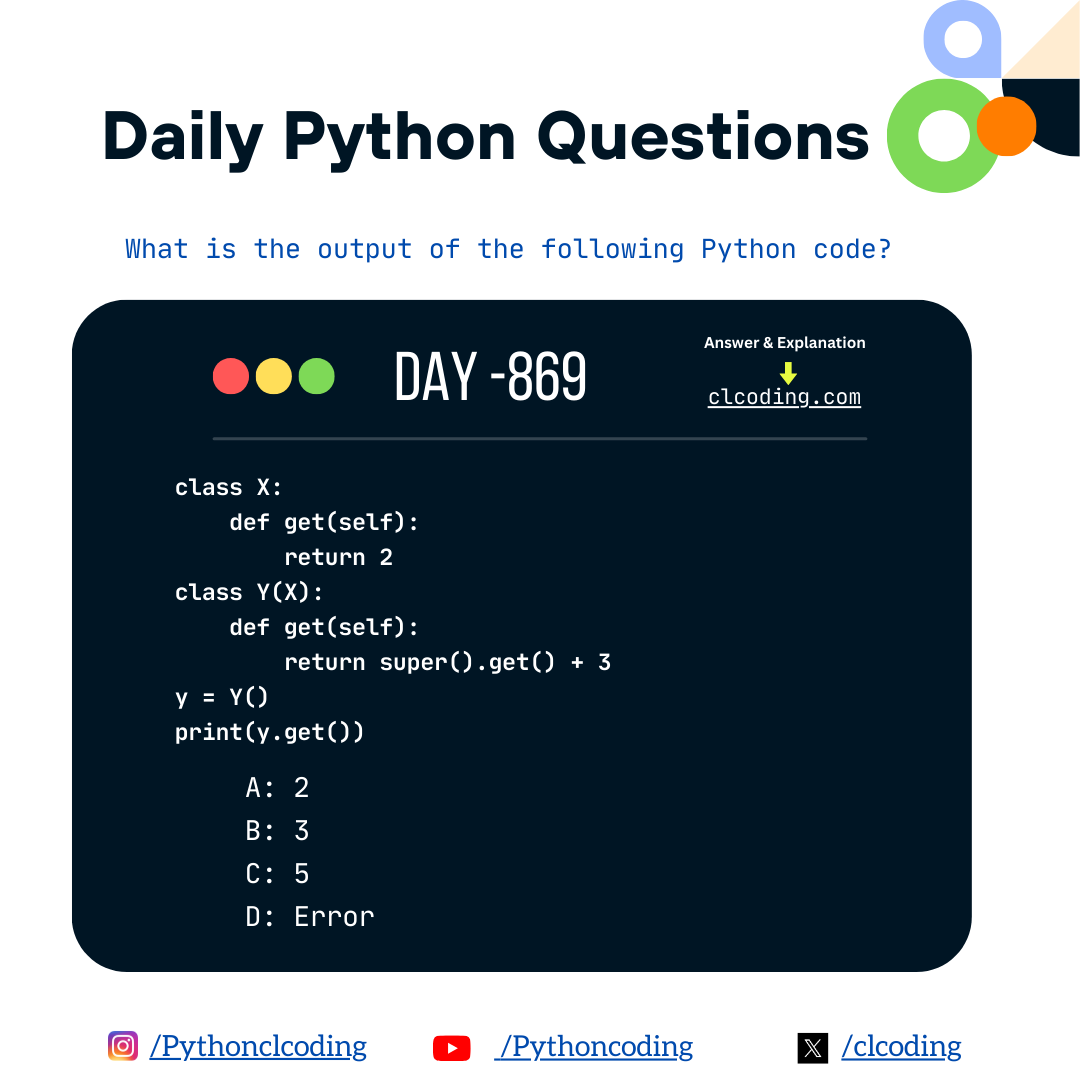
Code Explanation:
1. Class Definition Begins
class X:
A new class X is created.
This class contains one method, get().
2. Method Inside Class X
def get(self):
return 2
The method get() always returns the integer 2.
Any object of class X will return 2 when get() is called.
3. Class Y Inheriting From X
class Y(X):
Class Y is created, and it inherits from class X.
This means Y has access to all methods defined in X unless overridden.
4. Overriding the get() Method in Class Y
def get(self):
return super().get() + 3
Class Y provides its own version of the get() method.
super().get() calls the parent class (X) version of get(), which returns 2.
Then 3 is added to the result.
Final returned value = 2 + 3 = 5.
5. Creating Object of Class Y
y = Y()
An object y is created from class Y.
This object has access to Y’s overridden get() method.
6. Printing the Result
print(y.get())
Calls Y’s get() method.
That method calls X’s get() → returns 2.
Adds 3 → result = 5.
Prints:
5
Final Output
5










.png)


 Posts
Posts


0 Comments:
Post a Comment